Alibaba has fully launched Qwen4-Max, the flagship model of its new Qwen4 family, moving it out of preview and into general availability with published architecture, benchmarks and pricing. The Qwen team announced the release on November 16, pitching the model as a cheaper, steadier worker for long, multi-step jobs rather than a smarter chatbot. The headline claim is economic: on Alibaba’s own Work360 evaluation, the average cost per task fell 62%, from $4.43 for Qwen3.8-Max to $1.67 for Qwen4-Max.
What Was Announced?
Qwen4-Max is a sparse mixture-of-experts model built on the new Qwen4 architecture, with a 2.4-trillion-parameter backbone, only 71 billion parameters activated per token, and an additional 328 billion N-gram Embedding parameters. It has native vision and a 1-million-token context window, and it accepts text, image and video input. Three architectural upgrades do the heavy lifting, according to the Qwen team: GDN and QSA attention designs, which compress long-context history more cheaply, and gated residual connections (GR) aimed at stronger information flow and more stable training.
The model is available now on QwenCloud, as well as in QwenWork, Qoder and QwenStudio. It replaces the preview version, which was sold only through Alibaba’s Token Plan subscription. GPTOnline covered that preview when it opened on November 11.
Cheaper to Run, Not Just Stronger
The cost numbers are the most concrete part of the announcement. On Work360, Alibaba’s own framework for modeling complex professional work, Qwen4-Max scored 52.69, up from 47.74 for Qwen3.8-Max. As the Qwen team put it, “the average cost per task dropped from $4.43 for Qwen3.8-Max to $1.67 for Qwen4-Max, a 62% reduction.” Alibaba says the model uses up to about 50% fewer tokens than its predecessor on the same work, and the token-efficiency charts show the gap widening on agentic coding: on Terminal-Bench 4.0, Qwen4-Max uses nearly half the tokens Qwen3.8-Max needed.
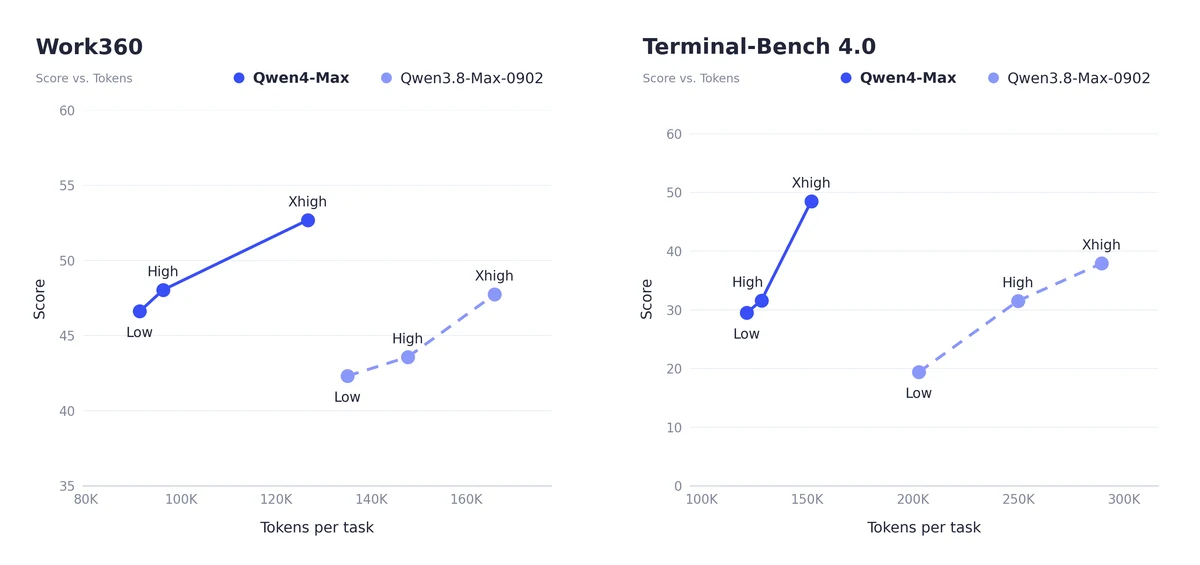
Qwen4-Max scores higher on Work360 and Terminal-Bench 4.0 while using fewer tokens per task than Qwen3.8-Max. Image: Qwen / Alibaba
Two caveats belong with those numbers. Work360 is Alibaba’s own benchmark, so the 62% figure describes Qwen’s own workload mix, not a universal price comparison. The blog also states no per-token dollar prices.
Benchmarks: Ahead on Breadth, Behind on Terminal Coding
Alibaba’s comparison chart puts Qwen4-Max against Qwen3.8-Max-0902, Anthropic’s Opus 5.5, OpenAI’s GPT-6.1-Sol and GPT-6-Astra, and Kimi K3.1 across 16 benchmarks. Qwen4-Max leads its predecessor on most of them, including DeepSWE v1.1 (75.7), JobBench (68.5) and BioMysteryBench (85.0). On legal agent work, it scored 21.3 on HLAB-Vals-1.1, ahead of Opus 5.5 at 9.2 and GPT-6-Astra at 7.1. It also debuted at No. 6 on LMArena’s Code Arena WebDev leaderboard with a preliminary 1,750 Elo.
But the chart is equally clear about where Qwen4-Max trails. On Terminal-Bench 4.0 it scored 48.5, behind Kimi K3.1 at 67.2 and Opus 5.5 at 59.6. On AgentArena, its net improvement of 7.5 trails Opus 5.5 at 18.2. The honest read: a broad, efficient generalist that still loses the hardest terminal-coding contests to its best-funded rivals.
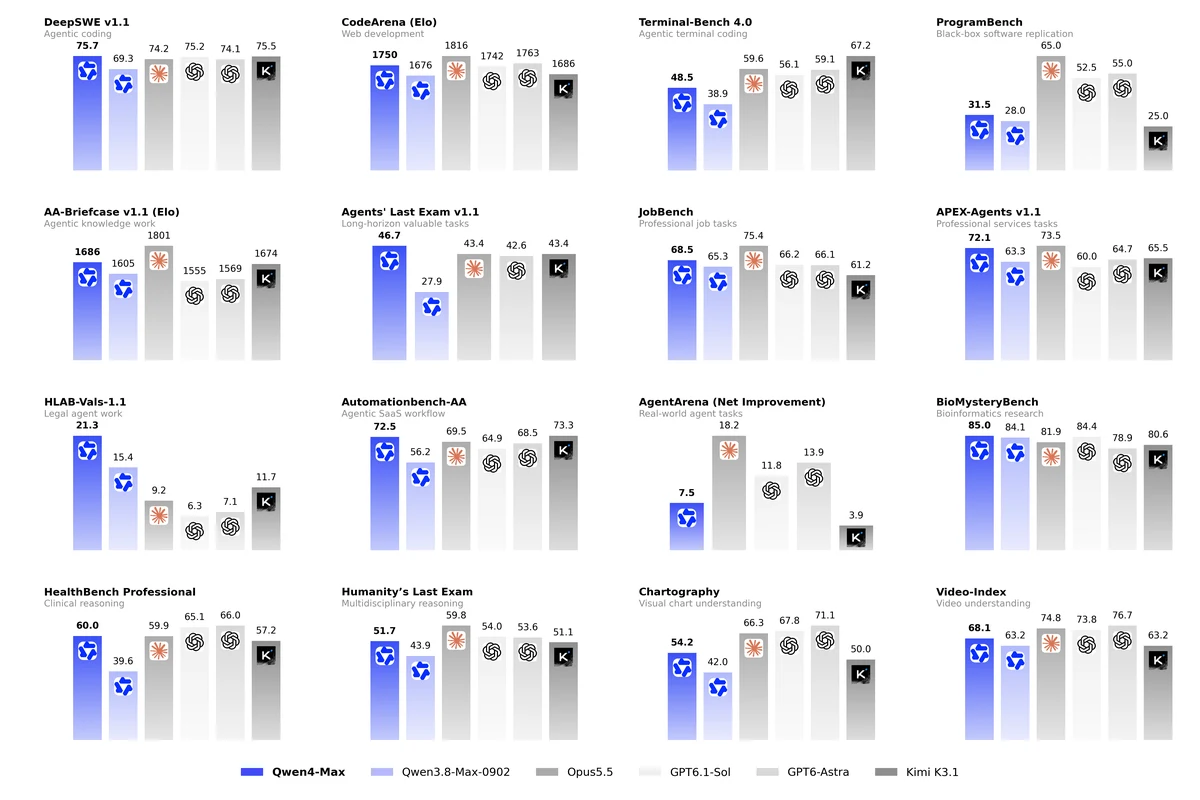
Qwen4-Max leads its predecessor across most of the 16 benchmarks in Alibaba’s comparison chart, but trails rivals on Terminal-Bench 4.0 and AgentArena. Image: Qwen / Alibaba
Built for Long-Horizon Work
The release is framed around a “24/7 AI teammate,” and the demos lean into long-running, multi-step work. Alibaba showed the model driving Blender for 3D scenes and building playable games in Unity, Unreal Engine and Godot. In manufacturing, at partners SANF and Pacific Union, it planned production lines and verified machining, cutting the manual effort to program a single workpiece from about 475 minutes to 24 minutes. For investment research it invoked 90 MCP tools and produced Excel workbooks and PowerPoint decks. For pre-IPO legal due diligence it sorted 198 working papers into 14 folders and produced an 86-page report. For critical care it reviewed a six-day course spanning dozens of lab reports and 1,433 medical images, and its four recommendations matched the attending physician’s actual orders.
Two science demos push the claim furthest. In a continuous 48-hour run, it screened 2.7 million candidate molecules and directed an automated wet lab through four design, synthesis and testing loops to produce a physical sample of a novel coolant material for data-center chips. In drug discovery targeting the NLRP3 inflammasome, it made 454 tool calls and 3,239 evaluations across 24 candidate molecules, ending with a candidate whose estimated binding affinity is about 3.6 times the patent-derived reference molecule. These are single showcases run with partner platforms, and the drug candidate still awaits wet-lab validation.
Under a pattern Alibaba calls Live Delivery, the agent ships a usable first version early and improves it through successive releases, with the user able to step in and redirect at any point. Qwen is open-sourcing the Qwen-Live-Delivery-Plugin so others can build on the pattern.
Pricing and Availability
Qwen4-Max is live on QwenCloud through the Token Plan or the pay-as-you-go API, and inside QwenWork, Qoder and QwenStudio. Alibaba says it lowered API prices compared with Qwen3.8-Max, with particularly large reductions in cached input pricing, but the blog post itself carries no per-token dollar figures. The Max weights are not open: Alibaba says only that smaller Qwen4 models are coming to open source.
Why It Matters
Qwen4-Max is a bet that the next frontier is not a smarter chatbot but a cheaper, steadier long-horizon worker. If the 62% cost cut holds on real workloads, it changes the math for anyone running agents at scale, and it puts direct price pressure on Anthropic and OpenAI. On the Last Secure Code Bench, the function-level pass rate for both functionality and security rose from 22.0% to 31.8%, though most generated code is still not secure by default. The models to watch next are the smaller open-weight Qwen4 releases Alibaba has promised, since those are the ones self-hosters can actually run.