Cognition has launched Devin Apps, private web applications that run directly on Devin’s cloud computer, the company said on November 13. Teams describe the tool they need in plain language, Devin builds it, and teammates open it from a stable link. The apps are designed for internal tools, preview deployments, and extensions to Devin itself, and they are never public: everyone who opens an app must sign in to Devin.
Cognition announced the feature on X alongside a blog post and a short demo video. It is the latest step in Devin’s shift from a coding agent that writes software to a platform where the software it builds can also live and run.
Introducing: Devin Apps
Private, secure, sharable web applications running directly on Devin’s cloud computer.
Devin Apps are designed to power your most ambitious internal tools, preview deployments, and extensions to Devin itself. pic.twitter.com/fm5roQZ8p4
— Cognition (@cognition) November 13, 2026
How to create an app
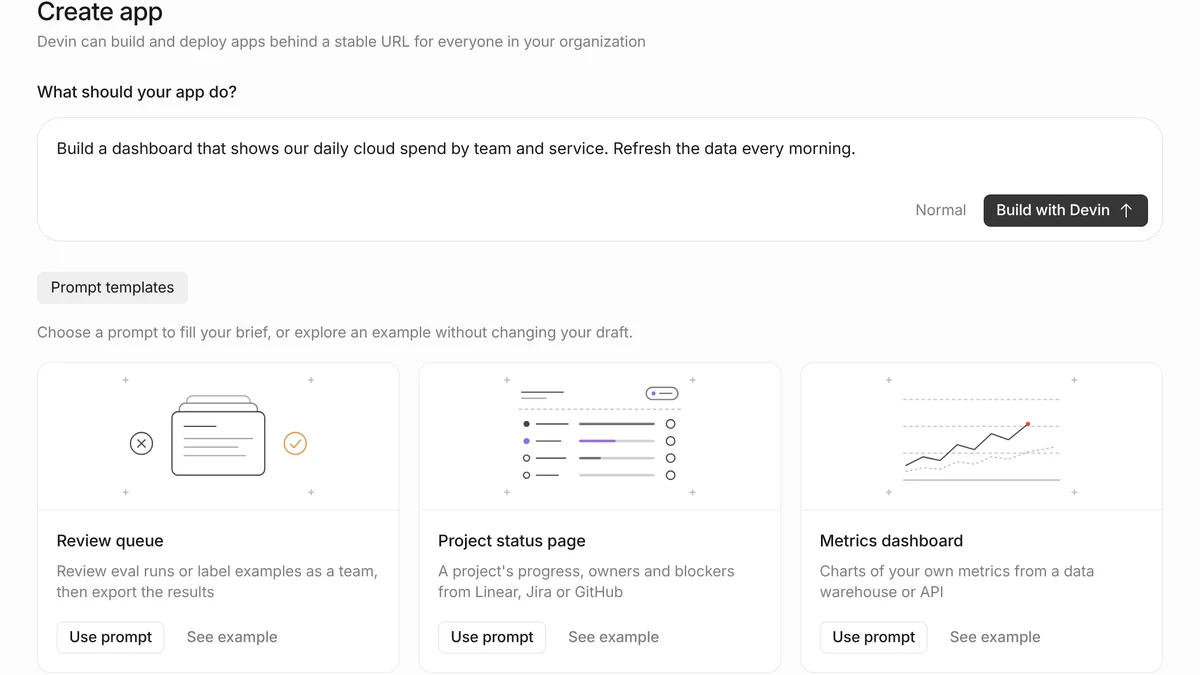
Open Apps in the Devin sidebar and describe what the app should do, or pick a prompt template such as a metrics dashboard, a project status page, or a review queue. Click Build with Devin, and Devin starts a session, asks any questions it has in its first message, then builds the app and puts it online. The app shows up on the Apps page right away with its URL, with the status Building until the first version is live.
Apps can also start from any session. If Devin has already shown a browser preview, it can be published as an app. Because apps run on Devin’s machine, they have access to existing MCPs, integrations, and the codebase, and teams can build with their own internal tech stack and components or start from a built-in template.
Sharing and updating
Each app has a stable URL. Click Share to copy the link or change who can open it: access can be limited to the people added, opened to the whole organization, or opened to the whole enterprise. Apps can be pinned for quick access, and organization administrators can pin an app for everyone.
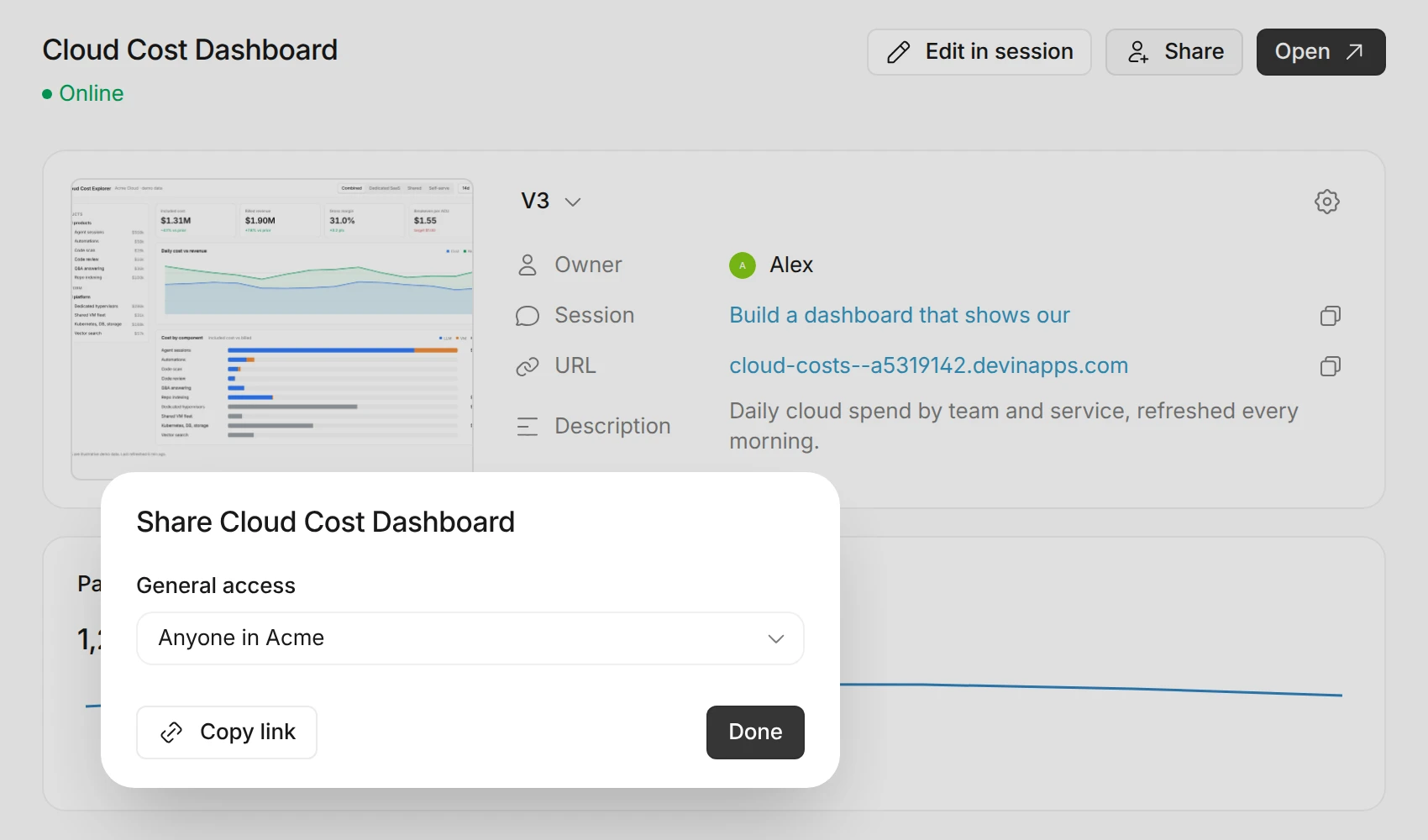
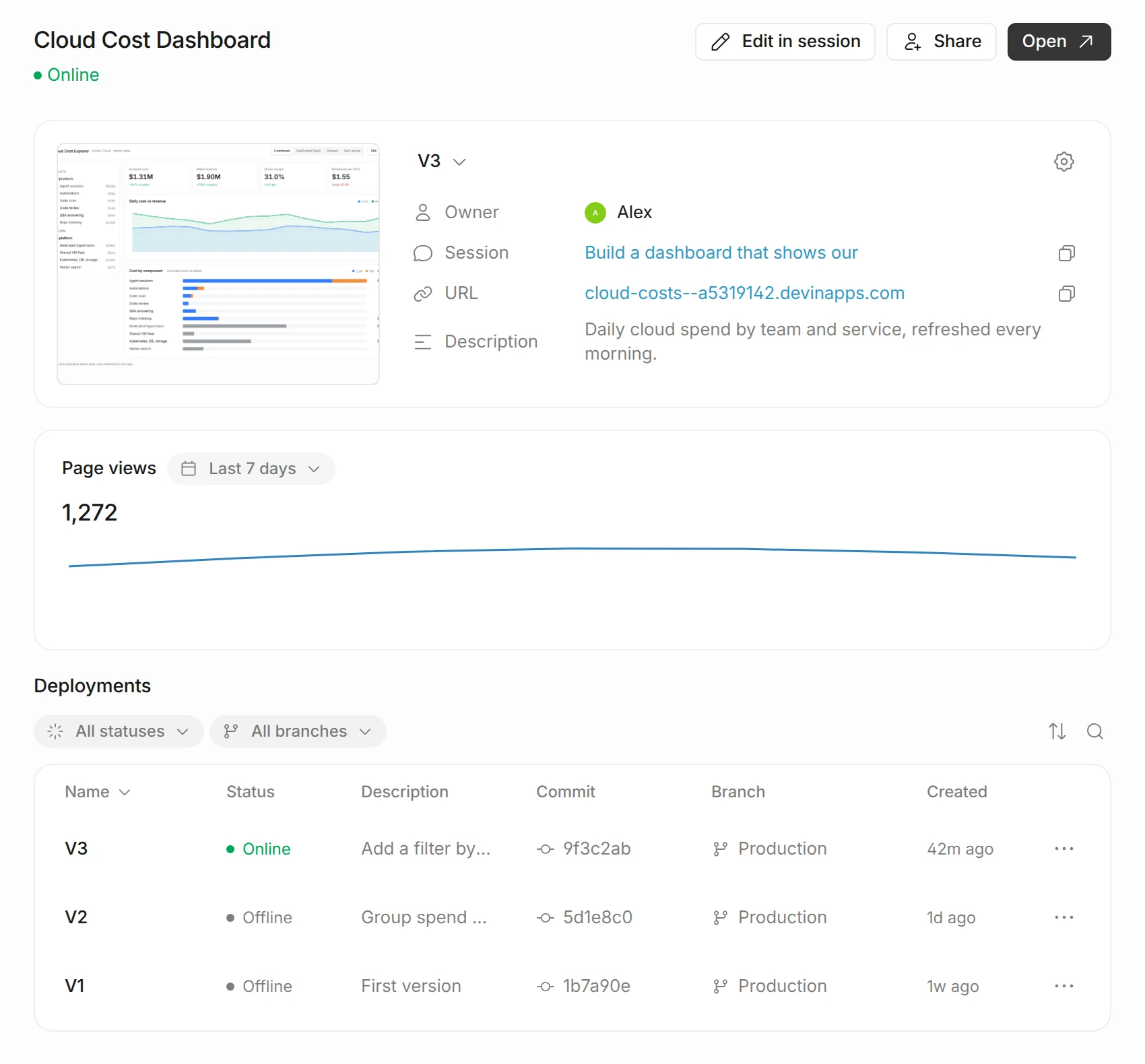
To change an app, open it and click Edit in session, then tell Devin what to change. Devin builds a new version and puts it online without changing the URL. Every update is listed under Deployments on the app’s page, and if a new version fails to start, the previous version keeps serving. An automation can also keep an app current by pulling fresh data on a schedule or redeploying each time a branch changes.
How Devin Apps run
Devin Apps are built on memory snapshots, which let Devin’s machine hibernate between tasks. The machine goes to sleep when nobody is using the app and wakes when someone opens it, so the first load after a sleep can take a few seconds. Billing is based on how long the machine is awake.
An app can use any stack that serves HTTP on a port, with a database such as SQLite or Postgres on the same machine, and it can call the Devin API, so teams can build their own tools on top of Devin. Each app runs on one machine, which makes the feature a good fit for internal tools and dashboards rather than high-traffic production services.
What teams use them for
Cognition points to three uses: internal tools such as admin panels, request forms, and approval queues that replace a shared spreadsheet; dashboards that track metrics, support queues, and sales numbers, refreshed from the team’s own data sources on a schedule; and beta or staging versions of a product, with Devin running the real frontend, backend, database, and workers so teammates can open a copy from a link.
Why it matters
Devin Apps closes a gap in the agentic coding workflow: an agent can now build a tool and host it in the same place, without a separate deployment step. For internal tools, the tradeoffs Cognition describes are the point, not a drawback. Private by default, billed only while awake, and versioned with automatic fallback, the feature is aimed at the dashboards and admin panels teams usually build once and then neglect. The open question is how far the model stretches: one machine per app and sleep on idle rule out public services, so Devin Apps will be judged on internal tooling, where speed of creation matters more than scale.
Cognition, which raised a $2 billion Series E in September at a reported $48 billion valuation, has been adding to Devin at a fast pace, including SWE-2 sessions for Devin Teams on November 12 and the SWE-2 Flash model on November 4.