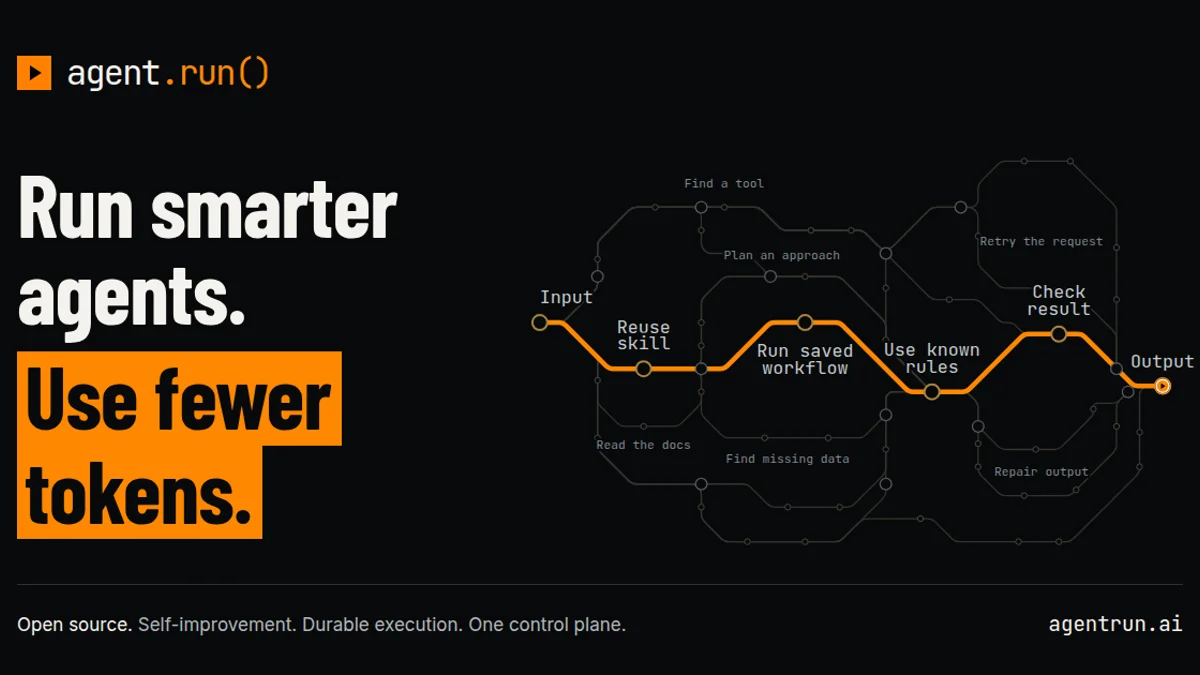
AgentRun Self-Improving AI Agents is an open-source platform that adds self-improvement, durable execution and a control plane to the coding agents developers already use. Built by the team behind Grep and introduced on Hacker News on 12 November 2026, AgentRun sits around a developer’s chosen harness and manages runs, workspaces, recovery and learning through one API. It works with Claude Code, Codex, Pi and OpenCode, so teams keep their existing tools while AgentRun handles the parts around them. Repeated work should get better and cheaper with every run, instead of starting from scratch each time.
What AgentRun Does
Most harnesses are good at reasoning and tool use, but they leave the surrounding work to the developer. AgentRun fills that gap. Developers define agents, start runs through a common API, and manage revisions, run history, recovery and learning from one console. The harness still handles the agent’s thinking and tool calls, while AgentRun takes care of where a run executes, what files it produces, what happens when it stops, and what it learns for next time. That split matters most for work that repeats.
Key Features
Self-learning is the headline feature. When learning is enabled, an agent reflects on its runs and proposes notes, reusable skills and workflow drafts. Each proposal passes structural checks and an AI grader before it can be reused, and changes that widen trust, loosen checks, or direct money or data require owner approval. Durable execution is the second pillar: AgentRun saves the conversation, files and completed tool results, so after an interruption a new process can reopen the saved state and continue the run. The platform also offers a choice of compute, and one console shows agents, runs and learning notes.
How It Works in Practice
Getting started follows a familiar developer flow. Teams install the TypeScript client with npm, set a base URL and an API key, and define an agent with a name, instructions, a harness and the tools it may use. A run starts with an input message and an optional cost cap, and the client can wait for completion or respond when the run asks a question. Because AgentRun is open source under the Apache 2.0 licence, it can run on a team’s own server with its own model keys. The hosted option, AgentRun Cloud, removes the server work for teams that prefer a managed deployment.
Who It Is For
AgentRun fits developers and small teams who already run coding agents in real work and feel the cost of repetition. If an agent handles the same class of task many times a week, the learning loop has material to work with, and the token savings can add up. The official site reports a 90 percent cost reduction for one compliance workload in its launch example, while noting clearly that savings depend on how much work repeats and that reflection and grading also add cost, so teams should measure total spend and answer quality on their own workload. Engineering leads will value the single console, and platform teams will value the self-hosted option. It is less suited to one-off prompting, where there is nothing to learn from.
Pricing
Self-hosting AgentRun is free under the Apache 2.0 licence, with model and infrastructure costs paid to the team’s own providers. AgentRun Cloud does not publish prices, and no pricing page was available when this article was checked on 14 November 2026. Enterprise deployments are arranged through a sales conversation covering deployment planning, security and access review, and team onboarding. Prices and plans may change, so readers should confirm current details on the official AgentRun website before deciding.