Leetsys AI System Design Interviews is a practice tool that runs realistic system design mock interviews with an AI interviewer. Introduced on Hacker News on 13 November 2026, Leetsys gives a candidate a design prompt, an interactive whiteboard for sketching the architecture, and a voice or chat conversation in which to explain trade-offs, followed by focused AI feedback. The format mirrors the real interview loop: work through a prompt, draw the system, defend the choices out loud, and review what could be better while the session is still fresh. For engineers preparing for senior interviews, that rehearsal is hard to practise alone.
What Leetsys Does
System design interviews test a different skill from coding tests: the candidate must turn an open prompt into a coherent architecture under time pressure. Leetsys recreates that setting with prompts drawn from real interview topics: a news feed, a chat service, a video platform, a payments system, a maps service, a URL shortener, file storage, a rate limiter, a notification system, an analytics pipeline or a booking system. The candidate picks a prompt from the library, sketches components and data flows on the whiteboard, and talks through the design with an interviewer that adapts to the candidate’s seniority level.
Key Features
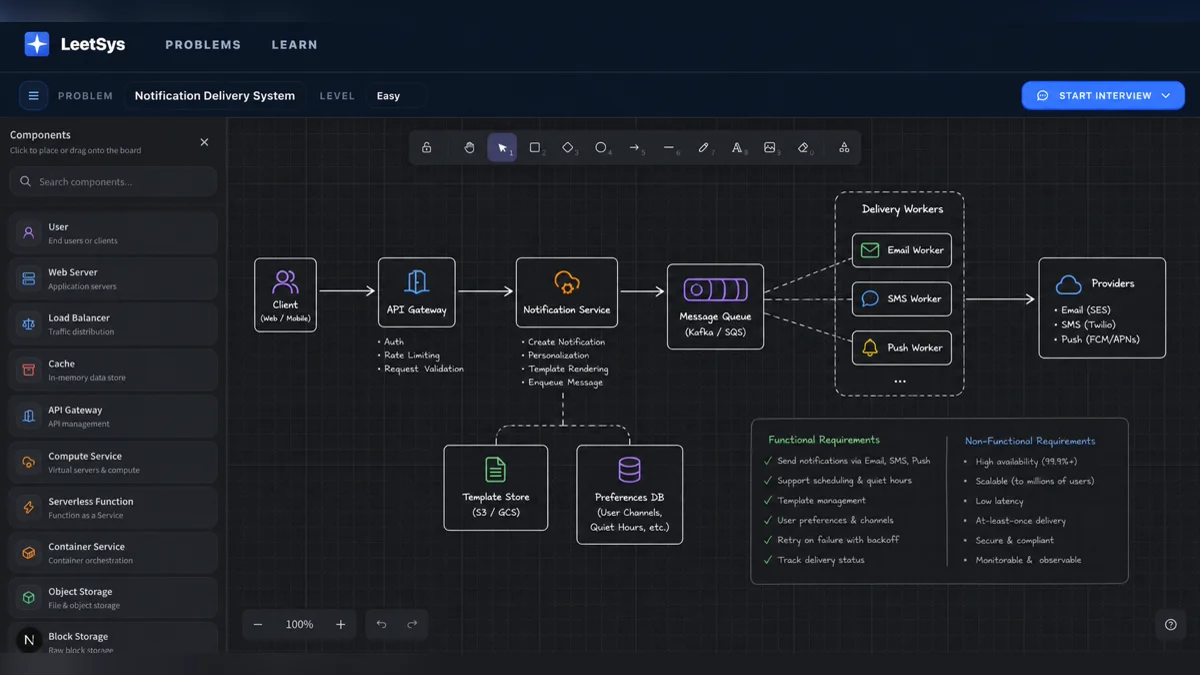
The realistic mock interview is the core of the product. The AI interviewer adapts to seniority, so a junior candidate and a staff level candidate face different expectations and different follow-up questions on the same prompt. The interactive whiteboard is the second pillar: candidates draw system diagrams on a canvas, create components and map data flows, with a palette that includes servers, caches, gateways, compute services, storage and more. The prompt library covers real-world interview problems, from a URL shortener to a globally distributed social network, so practice stays close to the prompts that actually appear in interviews.
How It Works in Practice
A practice session starts with a prompt. The candidate chooses a problem from the library, for example a notification delivery system, and opens the whiteboard with the problem statement, a difficulty level and a start button. Components are placed on the board, then connected to show how requests flow from the client through an API gateway and a notification service into a message queue, and out to delivery workers for email, SMS and push. During the session the candidate explains the design in voice or chat, the interviewer probes the choices, and the session closes with feedback to review while it is still fresh.
Who It Is For
Leetsys fits software engineers preparing for interviews at companies that test system design, from mid-level roles up to senior and staff positions. It is useful for candidates who know the theory but have rarely had to explain a design out loud, because the interviewer forces the spoken reasoning that a book or a video cannot provide. It also fits engineers who are switching domains and need to practise prompts outside their comfort zone, such as a backend engineer working through a maps or payments problem. The tool is less useful for pure coding interview prep, since its focus is architecture rather than algorithms.
Pricing
Leetsys publishes no paid plan on its website, and the official listing shows a price of $0, so the tool is free to use as listed when this article was checked on 14 November 2026. That may change as the product develops, so readers should confirm the current terms on the official Leetsys website before relying on free access. For now, the absence of a paywall makes it easy to run a first mock interview and judge the feedback.