OpenAI has disbanded its standalone robotics team and reassigned its researchers to other parts of the company, betting that its general purpose frontier models can now do work that once needed a dedicated robotics group. The company confirmed the reorganization to Fortune on November 13, 2026, and described the move as an effort to speed up robotics work, not to walk away from it.
Under the change, the robotics research team joins OpenAI’s main research team, reporting to Chief Research Officer Mark Chen, while the applied robotics and hardware teams move to the company’s larger Applied organization, which reports to President Greg Brockman. A company spokesperson said robotics remains a core part of OpenAI’s long-term vision, adding that “OpenAI remains committed to bringing general-purpose robots into the world.”
The timing underlines how recent the decision was. OpenAI had already registered a booth at CoRL, a leading academic robotics conference held in Austin this week, but when Fortune visited booth 208, it sat empty, with no OpenAI logo in sight. OpenAI did not disclose how many researchers are affected.
Why GPT-6 Astra Changed the Calculation
The reorganization reflects a bet that is gaining ground across the AI industry: general purpose models built for language, code and vision can also control machines that act in the physical world. At the start of the year, OpenAI’s researchers assumed the best path into robotics was to build on Sora, its video generation model, which needs an implicit understanding of how the physical world works to create realistic video. Since then, the company’s frontier models, including GPT-6 Astra, have shown they can be applied directly to robotics, and that discovery is what motivated the change, according to the company.
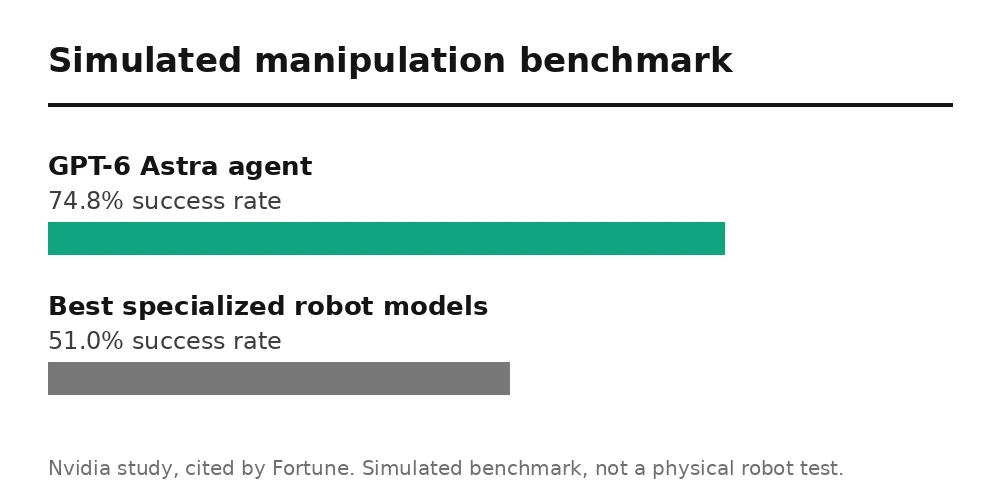
Researchers have reported surprising results when connecting Astra to robots. In the experiments, Astra received camera images, information about the robot and a control interface, then issued commands for the robot to carry out. In one study by Nvidia, an Astra powered agent reached a 74.8 percent success rate on a simulated manipulation benchmark, compared with 51.0 percent for the best specialized robotic models on the same leaderboard. The benchmark is simulated, not a test on a physical robot, which matters when judging how far the result goes.
Guanya Shi, an assistant professor at Carnegie Mellon University’s Robotics Institute, told Fortune the move signals that OpenAI sees robotics as “no longer a special problem.” In his view, the company now treats robotics as a downstream application of general intelligence, similar to the way the same underlying models now power specialized tools for coding, legal work and finance.
There are limits to that view. Large language models are powerful but slow, and they usually need to be hosted in the cloud, which means a robot needs a constant network connection. Shi still sees a need for smaller, specialized models that can run on a robot’s onboard computer without one. “There may be different starting points for how to grow intelligence,” said Pete Florence, cofounder of Generalist, a startup training general purpose AI models for robots.
A Familiar Pattern
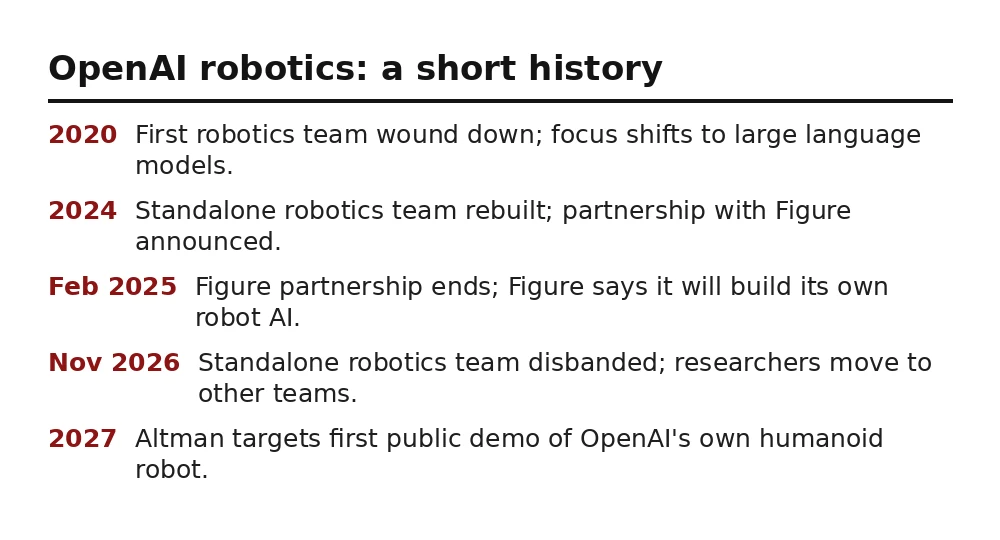
This is the second time the OpenAI robotics team has been wound down. The company had a robotics group in its early days and shut it down in 2020, when cofounder Wojciech Zaremba cited limited robot data and a more efficient path to artificial general intelligence through very large language models. That approach produced ChatGPT in late 2022.
OpenAI rebuilt a standalone robotics team in 2024, announcing a partnership with the startup Figure to develop AI models for humanoid robots. The partnership ended in February 2025, when Figure said it would develop its own robot AI. OpenAI has said it is building its own humanoid robot, and chief executive Sam Altman has targeted a first public demonstration in 2027.
The robotics team is not the only group OpenAI has reshaped as it narrows its focus. Last year, Altman told the company it needed to abandon “side quests,” and Fortune reported that OpenAI has dropped some efforts, including Sora, to shift computing resources toward more core and potentially profitable work.
Why It Matters
The reorganization lands while OpenAI is under pressure to control costs. Its operating losses reportedly totaled $10.9 billion in the most recent quarter, as the company tries to close a new funding round and prepares for a possible initial public offering in early 2027. Folding robotics into the main research and Applied teams removes a standalone cost center while keeping the humanoid goal alive.
The move also tests an assumption behind much of the robotics startup boom. Many young robotics companies have raised billions on the premise that robots need brains of their own, built specifically for the physical world. If general purpose models keep closing the gap, that premise weakens, and the value shifts toward deployment: robots already working in factories and warehouses, gathering the site specific data that helps them adapt. Russ Tedrake, an MIT professor and cofounder and chief executive of Walden Robotics, made that case to Fortune, arguing that real world deployment experience is an advantage the AI labs do not have.
What to watch now is the 2027 humanoid demonstration Altman has promised, and whether Astra style general models keep improving on physical robots, not only in simulation. If they do, OpenAI’s bet will look prescient. If they stall, the company has just dissolved the team best placed to notice.