OpenAI has launched ChatGPT Wallet, a feature that lets users save a credit or debit card inside ChatGPT so its dots agents can complete purchases on their behalf. The rollout, announced on Friday, November 13, starts with ChatGPT Pro subscribers in the United States who are 18 or older. It is OpenAI’s biggest step yet toward agentic commerce, the idea that an AI agent can carry a task all the way from finding a product to paying for it.
What Was Announced?
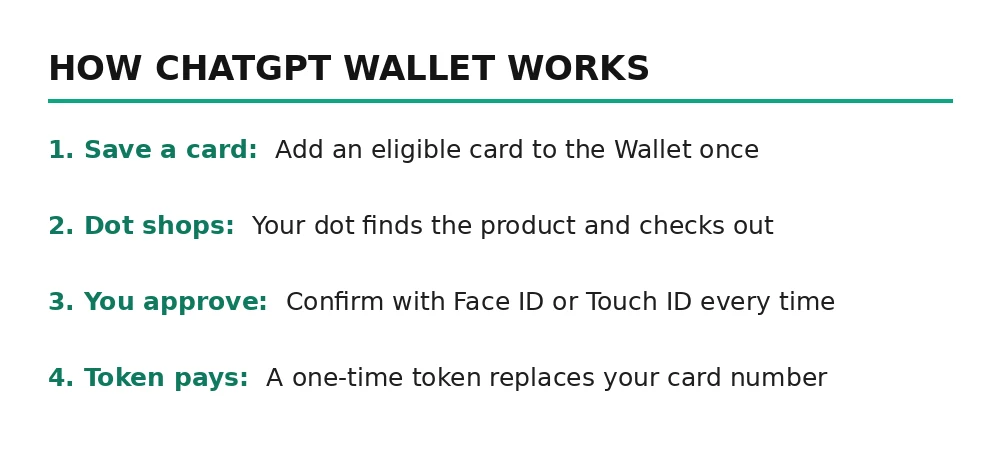
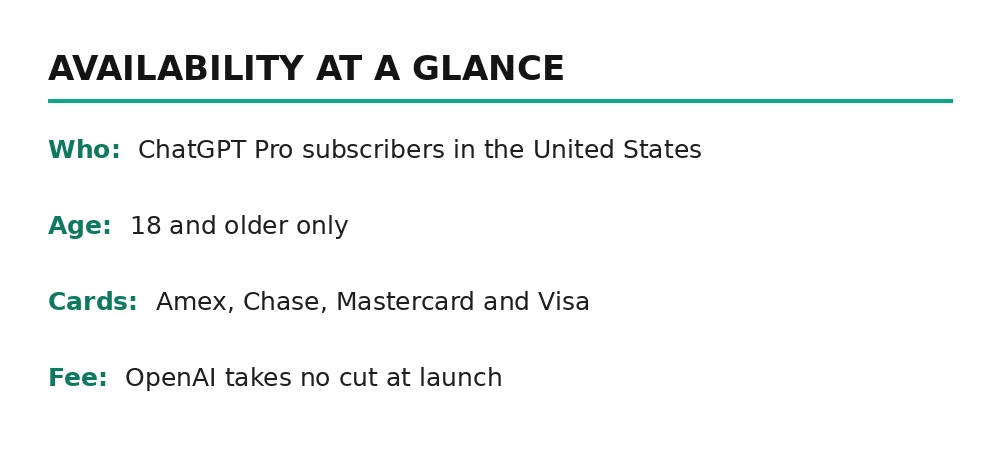
ChatGPT Wallet lives inside ChatGPT. Pro subscribers save an eligible card once, and their dots can then use it to complete purchases. The Wallet is open only to users in the United States who hold eligible cards from American Express, Chase, Mastercard and Visa.
The agent never sees the real card number. For each purchase, the payment network generates a unique payment token, a one-time card number, security code and expiration date valid only for that transaction. OpenAI does not store full card numbers or CVVs. It keeps tokenized card credentials instead.
Every purchase needs a human green light. Users must explicitly approve each transaction with biometric verification, such as Face ID or Touch ID, on compatible devices, after reviewing the item, the total price and the selected card. The agent can do the shopping. It cannot complete the purchase on its own.
OpenAI says it will not take a cut from transactions during the initial launch. The focus, for now, is on building partnerships with merchants and payment networks. The company has also released a merchant partnership guide and is working with anti-fraud providers Forter, Riskified, Sardine and Signifyd, as well as payment processors Adyen, Checkout.com and Stripe, to help merchants identify legitimate transactions started by AI agents.
The legal groundwork is already in place. OpenAI’s terms of service and privacy policies covering ChatGPT Wallet took effect on November 12, 2026. The Wallet is separate from a different balance used for gift-card redemptions, so the two should not be confused.
Why It Matters
Until now, most AI shopping help stopped at recommendations. The user still had to leave the chat, open a checkout page and type in card details. The Wallet tries to close that loop inside ChatGPT itself, with the biometric approval step creating a clear moment of consent for every transaction.
The launch builds on dots, the always-on personal agents OpenAI introduced on September 29, 2026, which run in ChatGPT for Pro and Business Premium subscribers. Dots can already browse, research and work across connected apps. Payments were the missing piece. OpenAI and Visa announced a strategic collaboration on agentic payments in June 2026, and OpenAI overhauled product search and comparison inside ChatGPT in March 2026. An earlier attempt, Instant Checkout, launched in September 2025 with a fee of roughly 4 percent, saw little merchant adoption and was dropped in March 2026.
The launch also lands at scale. ChatGPT had more than 1.2 billion weekly active users and nearly 100 million paying users as of the end of the third quarter, according to figures cited in coverage of the launch. Even a narrow rollout, Pro subscribers in the US only, puts a payment credential in the hands of a large pool of agent users from day one.
OpenAI is not alone in this race. Meta’s Muse agent already has access to a digital wallet powered by Link by Stripe, and Google is building similar payment rails for its Gemini agents. The contest now is not only which agent shops best, but which one merchants and card networks trust enough to let through the checkout.
What Merchants Think
Merchant attitudes toward agents making purchases remain mixed, and that is the Wallet’s biggest open question. United Airlines has said it will block agent access to its booking system, and Amazon does not permit agents to place orders on its platform. OpenAI has released tools and guidelines for merchants to check whether their websites inadvertently block its AI agents.
For now, the Wallet is a narrow launch: US only, Pro only, and 18 and older. OpenAI has not said when it will reach Plus subscribers, free users or other countries, or what fees, if any, it plans to charge once the launch period ends. What is clear is the direction of travel. The agent that used to stop at a recommendation can now, with the user’s approval, finish the purchase too.