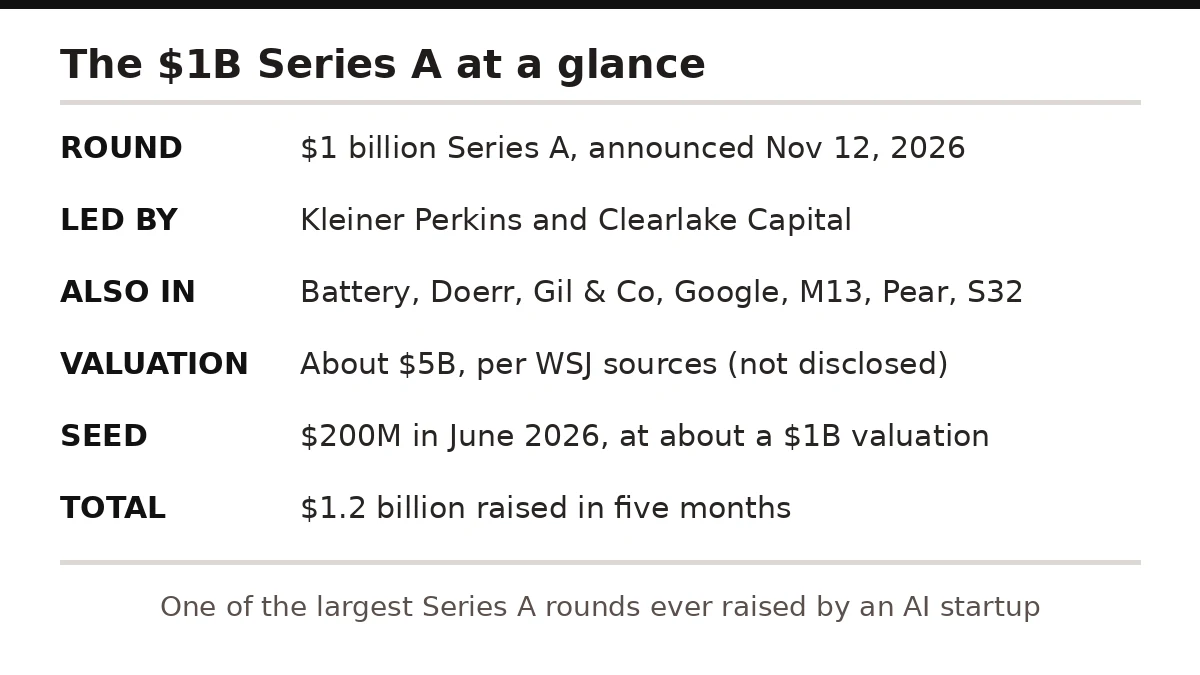
Mirendil, a San Francisco AI lab founded by former Anthropic researchers to build self-improving AI, has raised $1 billion in a Series A round, the company announced on Thursday, November 12. The financing, led by Kleiner Perkins and Clearlake Capital, is one of the largest Series A rounds ever raised by an AI startup, and it arrives a week before Anthropic, where much of Mirendil’s founding team came from, is set to price its initial public offering.
“We believe making AI R&D more accessible is the most direct path to AI that solves humanity’s most pressing problems across science and technology,” Mirendil said in its announcement. “We’re building tools to democratize frontier AI R&D and help put it within reach of every scientist and engineer.”
What Was Announced?
The $1 billion Mirendil Series A was led by Kleiner Perkins and Clearlake Capital, with participation from Battery Ventures, Doerr Capital, Gil & Co, Google, M13, Pear VC and S32, alongside other new and existing investors, according to the company’s announcement on PR Newswire. Mirendil did not disclose a valuation. The Wall Street Journal, citing people familiar with the matter, reported the round valued the company at about $5 billion.
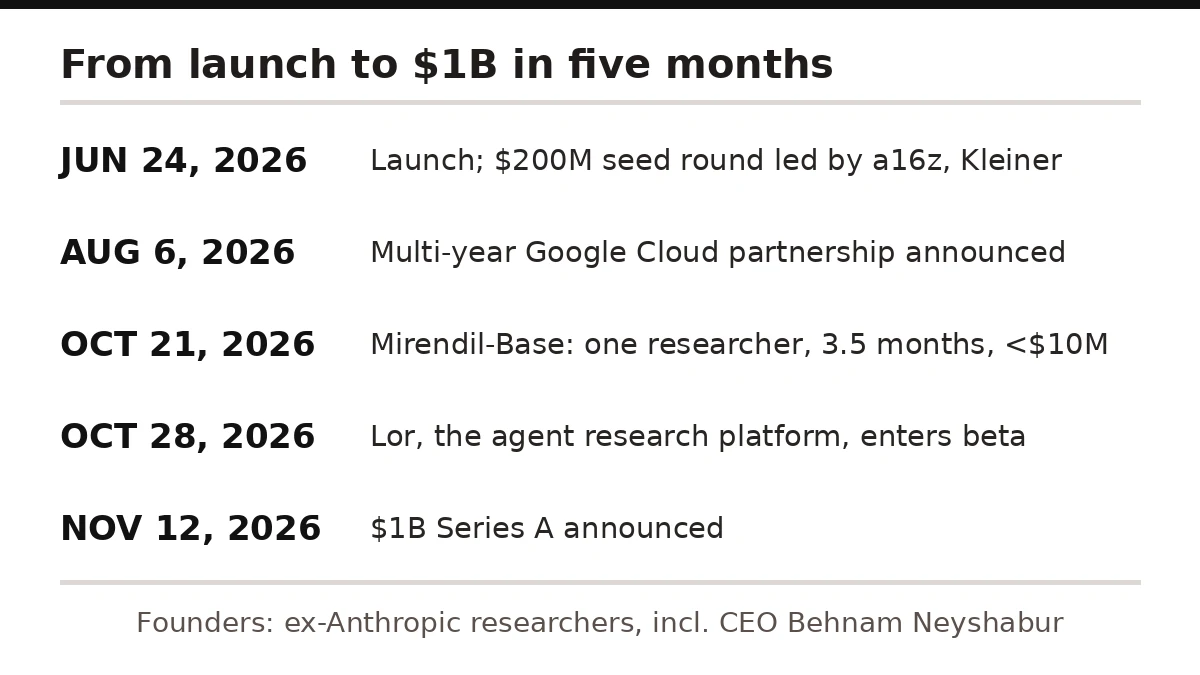
The round comes less than six months after Mirendil’s $200 million seed round in June, which valued the company at around $1 billion and was led by Andreessen Horowitz and Kleiner Perkins, with Nvidia later joining as an investor. In five months, the startup has raised $1.2 billion in total.
A $1 billion Series A is rare even in AI. Dealroom noted the round puts Mirendil among the best-funded of the new AI research labs, alongside Safe Superintelligence, Thinking Machines Lab and Recursive Superintelligence.
The One-Researcher Result
The funding follows the first results Mirendil shared over the past three weeks. In an October 21 report, the company said one researcher, working with AI agents, pretrained Mirendil-Base, a competitive coding model, from scratch in 3.5 months with less than $10 million in compute. Agents wrote more than 99% of the code, ran experiments and diagnosed failures, while the researcher chose what to try and intervened when needed. The experiment used only publicly available code, web pages and public datasets, with no distillation or synthetic data, according to the company.
Mirendil-Base sits in the 100 billion to 500 billion parameter range, according to the company’s report, with larger Mirendil-Base-Large and Mirendil-Base-XL versions still in training. Mirendil then post-trained the model into Fern, its first model, which holds up to 10 million tokens of context, enough for days of an agent’s work, the company said.
The third piece is Lor, introduced on October 28 and now in private beta. Lor is a cloud-based platform whose agents write code, run experiments, provision compute and operate on machines selected by the user. “Hundreds of agents writing code and running experiments for days at a time. Mirendil runs on Lor every day,” the company said.
“When agents do the hands-on work, the size of your team stops limiting what you can build,” Mirendil said.
Mirendil has not published benchmark scores for Mirendil-Base, so “competitive coding model” remains the company’s own description for now. The test of the approach will be whether outside teams can repeat the one-researcher result with Lor.
Who Is Behind Mirendil?
Mirendil is led by chief executive Behnam Neyshabur, who co-led Google DeepMind’s Blueshift team, and chief technology officer Harsh Mehta, who built the first version of Anthropic’s internal AI research platform. The founding team of 20 researchers and engineers came from Anthropic, xAI, Google DeepMind and OpenAI, and includes two Anthropic alumni who left the company at the close of 2025.
In August, Mirendil announced a multi-year partnership with Google Cloud, putting training, inference and AI research workloads on Google Cloud’s AI Hypercomputer, using Google Cloud TPUs and Nvidia AI infrastructure.
“This round lets us go further, toward a world where one person can take on what used to need a team, a team what used to need an institution, and we can help accelerate science and technology in a more direct way than we’ve done before,” the company said.
Why It Matters
A $1 billion Series A is a bet that frontier AI research can be done by small teams with the right agents, rather than only by the largest labs with the largest clusters. If Mirendil’s one-researcher result holds up at larger scale, it would lower the cost of entry to frontier model development and widen the field of labs that can compete.
The bet also carries a sharper edge. Mirendil’s stated goal is AI that can improve and build upon itself, and the Journal noted that some voices in the AI community have voiced alarm that self-improving AI could advance at speeds that would make it effectively impossible for humans to control. Mirendil frames the same capability as the fastest route to AI that solves hard problems in science and technology.
The timing adds another layer. Anthropic, where much of Mirendil’s founding team came from, is in the middle of its IPO roadshow, with pricing set for November 18 and trading expected to begin on November 19. Mirendil’s raise shows that the talent and capital flowing out of the frontier labs are now funding a second generation of labs built around the same people and ideas.
Sources
- Mirendil via PR Newswire, “Mirendil Raises $1B to Democratize Frontier AI R&D”
- The Wall Street Journal, “This Startup Raised $1 Billion to Build AI Faster and With Fewer Humans”
- Dealroom, “Ex-Anthropic researchers’ Mirendil raises $1B Series A led by Kleiner Perkins and Clearlake”
- Unite.AI, “Mirendil Raises $1B Series A to Bring Frontier AI R&D to More Teams”
- Mirendil, company website