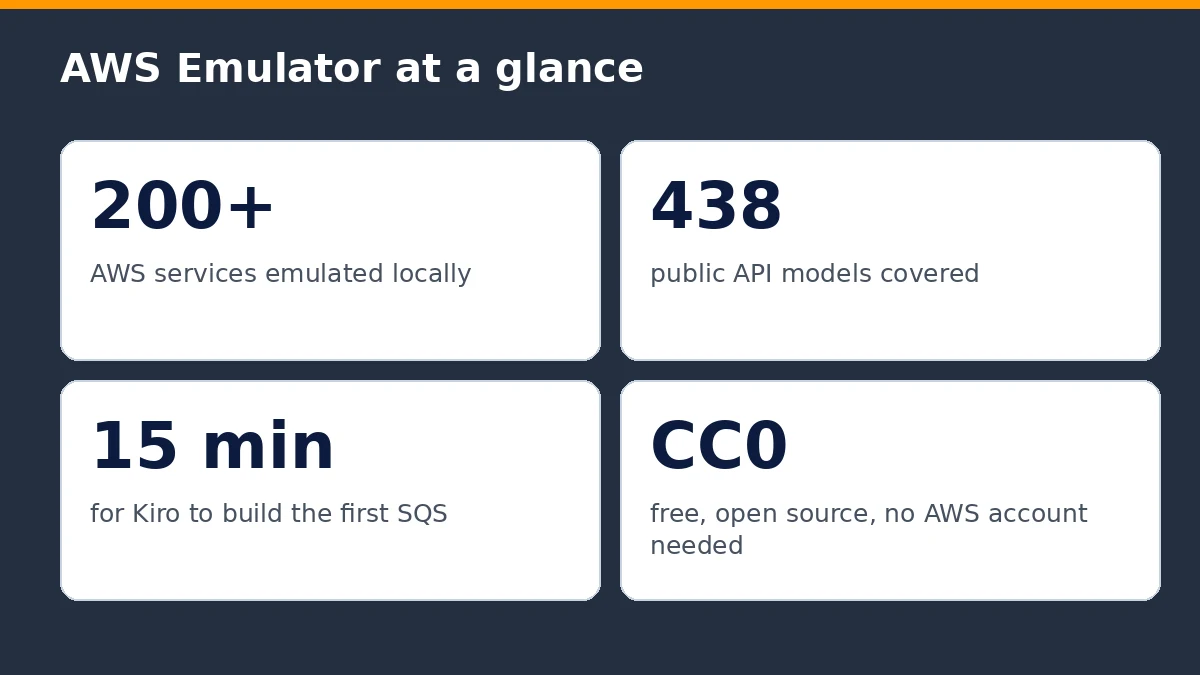
Amazon Web Services has released a free tool that simulates its cloud on a developer’s own machine, and the company says no human engineer wrote or reviewed a single line of its code. On November 11, 2026, AWS released AWS Emulator, a local emulator covering more than 200 AWS services, built entirely by autonomous AI agents.
“The emulator was written entirely by autonomous agents. Our team hasn’t written or reviewed any of the code,” wrote Matt Goldberg, the AWS senior principal engineer behind the project, in the announcement. The claim is the point of the launch as much as the tool itself: AWS is presenting the emulator as proof that agents can build production software at scale, provided they work inside strict guardrails.
From a Weekend Experiment to a Product
The project began as a weekend experiment. Earlier this year, researchers at Anthropic demonstrated that AI agents could autonomously build a C compiler from a specification, and Goldberg saw a parallel: AWS has both a well defined spec, in its public API models, and a reference implementation, in the real AWS cloud. He gave the Kiro coding agent a three step prompt: write tests based on the AWS Command Line Interface, iterate until they pass against real AWS, then build an in memory implementation that the same tests pass against.
Kiro returned a passable first version of Amazon Simple Queue Service in 15 minutes. Goldberg refined the prompt and had Kiro build the rest of AWS over the weekend. The result had gaps, but it was compelling enough that his team started using it to test its own software that Monday.
Three Teams of Agents, No Human Reviewers
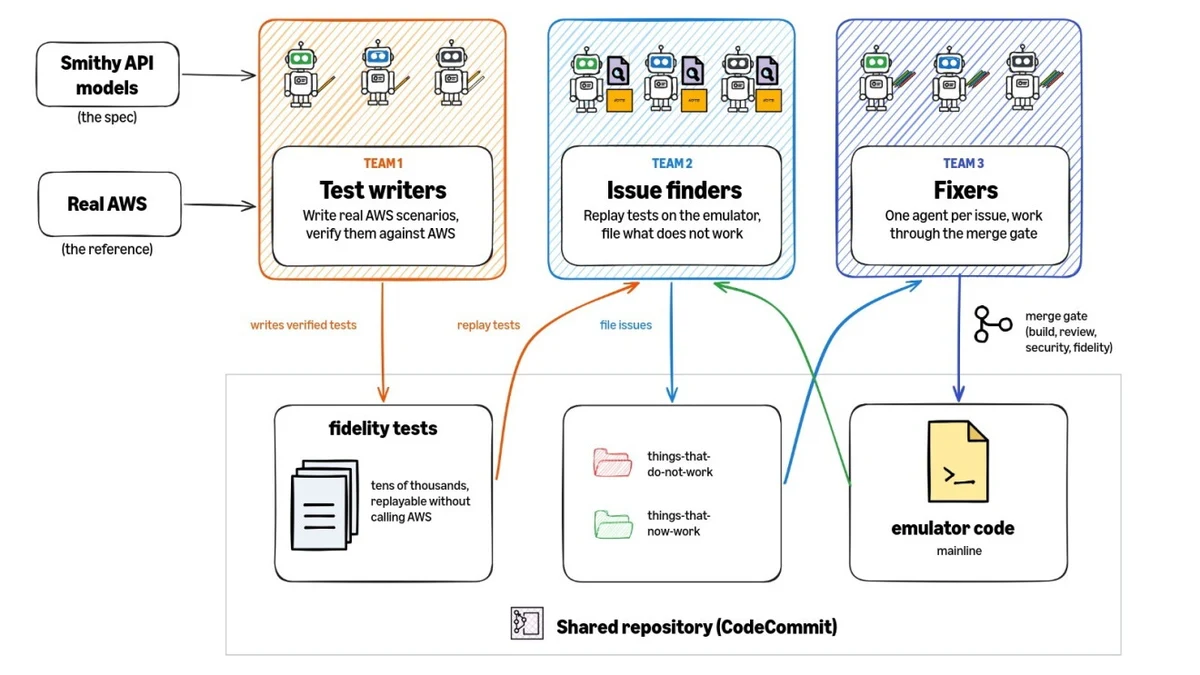
Turning the experiment into a product meant building the guardrails that let agents work independently while keeping the result trustworthy. AWS Emulator is built by three teams of agents running on Amazon Bedrock AgentCore, each with a bounded job.
The first team writes fidelity tests, real world AWS scenarios devised from the public API models and verified against the real cloud before they are accepted. There are tens of thousands of them, and the suite keeps growing as agents discover new things AWS can do. The second team replays those tests against the emulator and files the failures in a public folder called “things-that-do-not-work.” The third team fixes one issue per agent, and every fix must pass a merge gate that checks the build, coding standards, security and fidelity. If any check fails, the change goes back for rework. Goldberg says the teams fix thousands of issues every day, with hundreds of agents working on the codebase at once.
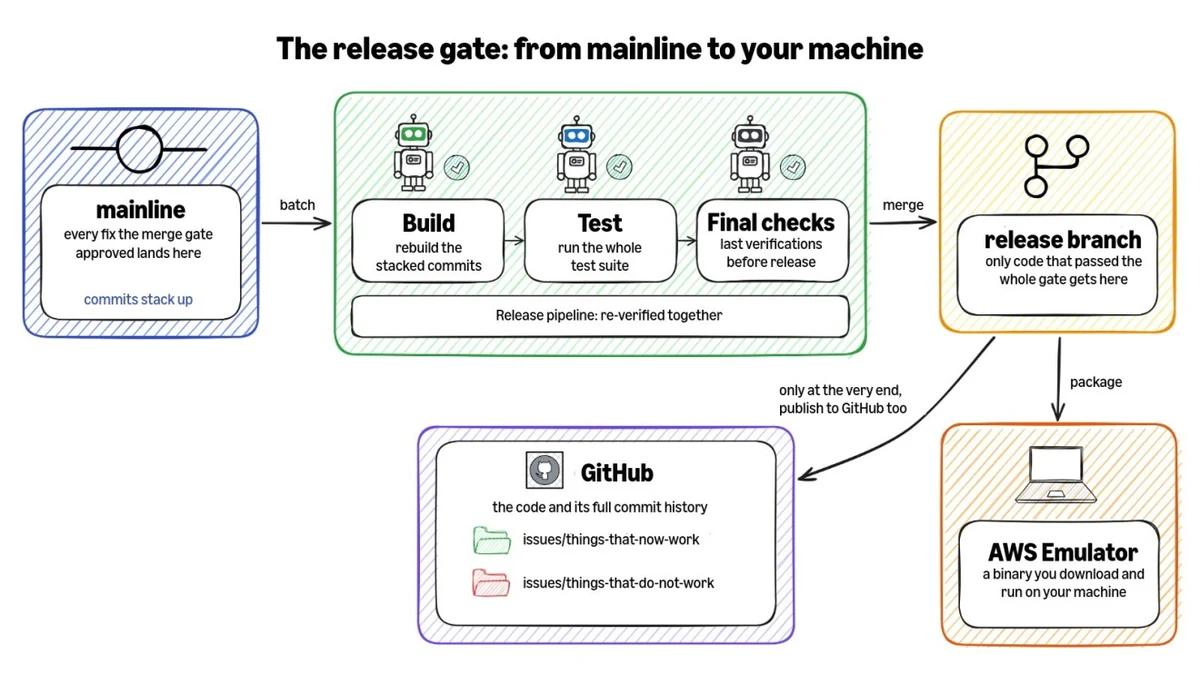
The structure matters because the code itself never passes through human review. The guardrails, the test suite and the merge gate are the quality control. Tom Callaway, a principal open source technical strategist at AWS, clarified the division of labor: AWS wrote the framework that made the system possible, while the emulator code itself was written entirely by agentic AI.
What Developers Get
AWS Emulator is built in Rust and runs as a local HTTP server on Linux, macOS and Windows. It is built from more than 400 API models covering more than 200 AWS services, and it works offline, with no network connection and no AWS account needed. Developers and their AI coding agents can test code against it without calling the real cloud or running up a bill.
The software is free under a Creative Commons CC0 public domain dedication. The source code and the fidelity tests are both on GitHub, along with the full commit history and every issue the agents have filed, fixed ones in “things-that-now-work” and the open backlog in “things-that-do-not-work.”
The tool has limits, and AWS does not hide them. At launch it does not simulate throttling or outages, does not reflect differences in which services and features are available by region, and does not sandbox the code it runs. Unimplemented operations return an HTTP 503 rather than a fake success, so code that passes locally is not guaranteed to pass in production.
Why It Matters
The emulator solves a problem that AI coding agents made worse. Agents test their work by running code in a loop, and each loop used to hit the real cloud, adding latency and cost. A local copy of AWS lets agents run that loop on the developer’s own machine, which is exactly the audience AWS is targeting: the tool is designed as much for coding agents as for the humans supervising them.
The bigger story is the method. If thousands of agents can build and maintain a faithful emulator of one of the world’s largest cloud platforms without a human writing or reviewing the code, the bottleneck in software engineering shifts from writing code to designing the specifications, tests and gates that keep agents on track. AWS plans to share more about that workflow at re:Invent, and the public commit history is now open for anyone to inspect, including the odd detour: in an earlier version, the agents decided to build their own Python interpreter to support AWS Lambda functions before being told to reuse existing libraries.
Sources
- About Amazon, “AWS Emulator: a local emulator built 100% by autonomous AI agents,” November 11, 2026
- GeekWire, “AWS gives developers a free local stand-in for its cloud, built from scratch by AI agents,” November 11, 2026
- SiliconANGLE, “Amazon’s open-source AWS Emulator lets developers validate their code locally, without the cloud,” November 11, 2026
- All Things Distributed, “AWS Emulator and the engineer’s job when agents write the code,” November 11, 2026