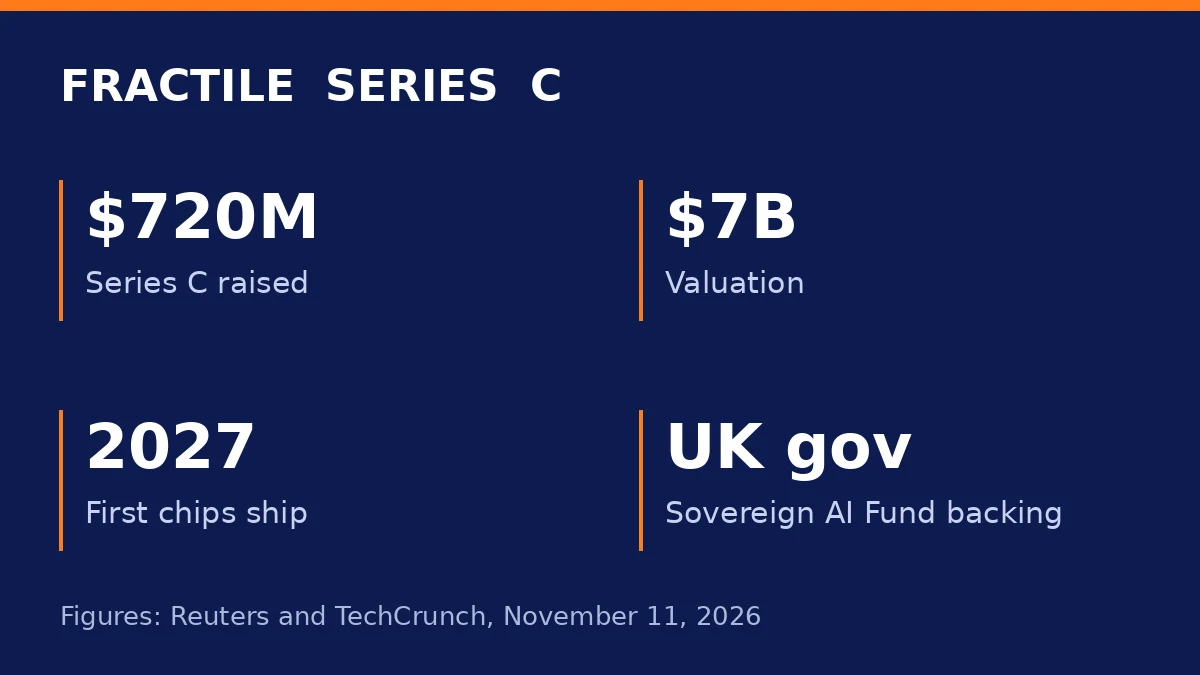
British AI chip startup Fractile has raised a $720 million Series C at a $7 billion valuation, becoming one of the best funded challengers in the race to build cheaper hardware for running AI models. The round, announced on November 11, 2026, was led by Thrive Capital, Founders Fund, Lightspeed Venture Partners, and Redpoint, with backing from the British government through its Sovereign AI Fund.
The deal makes Fractile one of Britain’s most valuable technology startups and one of the top funded startup players in purpose built AI chips, alongside Axelera, Etched, and OLIX, according to TechCrunch. The company plans to ship its first commercial chips next year.
The Round and the Valuation
The $720 million Series C was led by Thrive Capital, Founders Fund, Lightspeed Venture Partners, and Redpoint. Other investors included CapitalG, BlackRock, DST Global, Elad Gil, Balderton, and SV Angel, plus Britain’s Sovereign AI Fund and the British Business Bank, Reuters reported.
The valuation figure comes with the usual caveat for a private round. Reuters, citing a person involved in the deal, put it at $7 billion, a figure the Financial Times also reported. The British government described the valuation only as over 5 billion pounds. Either way, the round prices Fractile as a serious contender in a field where hardware startups rarely reach this scale before shipping a product.
What Fractile Is Building
Fractile, based in London and Bristol, is developing chips designed to make AI inference cheaper and faster. Inference is the process through which AI models generate responses, and its cost has become one of the main bottlenecks as companies run larger models in production.
The company’s differentiator is its hardware design. After a pivot, its approach now revolves around DRAM, the most common type of RAM, stacked on top of each chip in a way the company hopes will bypass the usual tradeoff between memory and capacity. That tradeoff has become more pressing with the rise of agentic AI, as companies seek to run longer chains of tasks with large models without compromising on speed.
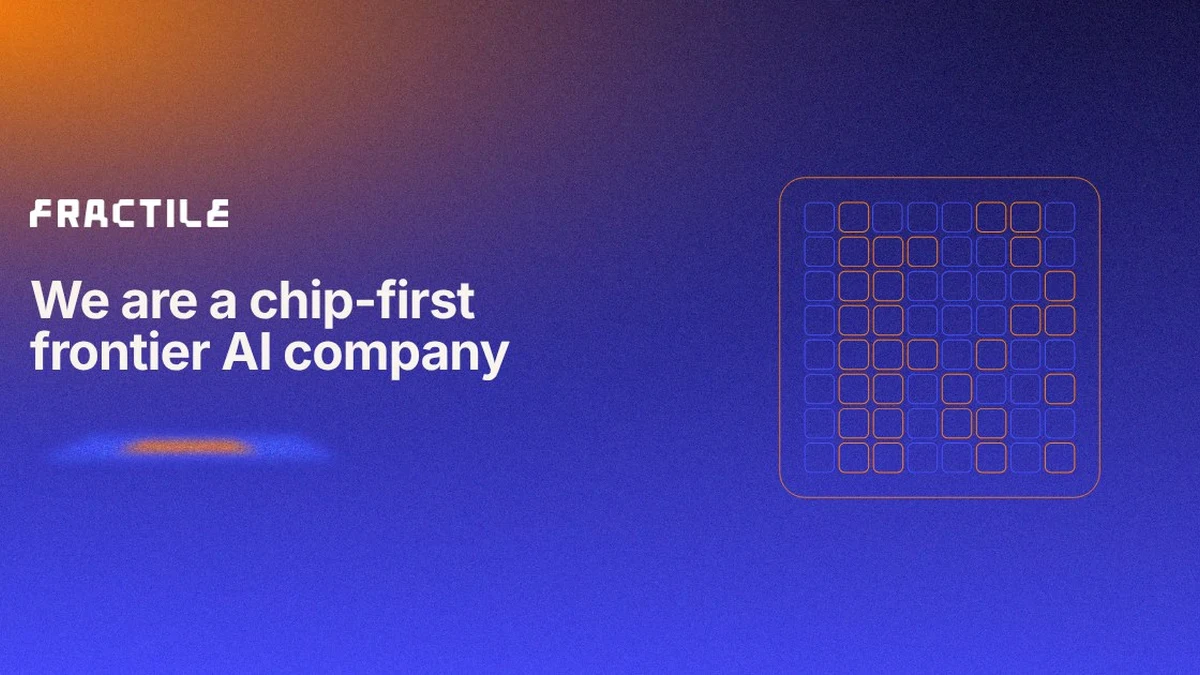
Fractile also takes a full stack approach, pairing the hardware with a machine learning compiler meant to maximize the speed at which large language models execute on its chips. The company frames itself as a frontier AI company rather than a pure chip vendor, and the round was priced accordingly.

First Chips in 2027
Chief executive Walter Goodwin struck a cautious note even while announcing the raise, writing in a LinkedIn post that “there is still a lot of work ahead” for the company. The new funding, he said, will enable the startup to “ship [its] first chips and systems next year.”
That timeline is the number to watch. AI chip startups have a long history of raising large rounds and missing ship dates, and Fractile has no commercial chip on the market yet. The $720 million gives it runway, but the product still has to arrive.
Why It Matters
The round is a bet that inference, not training, is where the next hardware value will be created. Training grabs the headlines, but inference is the recurring cost every AI application pays, and purpose built chips that cut it could reshape the economics of the whole industry.
It is also a strategic bet for the UK. The government’s participation through the Sovereign AI Fund reflects a stated aim of ensuring the country “has a greater stake in the hardware that will underpin its future economy.” If Fractile ships on schedule, Britain would gain a homegrown inference chip supplier at a moment when most AI hardware still comes from a handful of US companies.