Google has launched a new way for developers to get fast, structured answers from AI without generating a single word of text. On November 11, 2026, the company introduced the Gemini Decisions API, a new endpoint powered by its new Gemini Decision 1 model, available through the Gemini API in Google AI Studio.
Instead of producing prose token by token, it scores candidate options in a single forward pass and returns probabilities and confidence scores, acting as a control plane for software: the layer that decides which tool to call, which model should handle a request, or whether content passes a policy check, all in 150 to 250 milliseconds end to end.
What the Decisions API Does
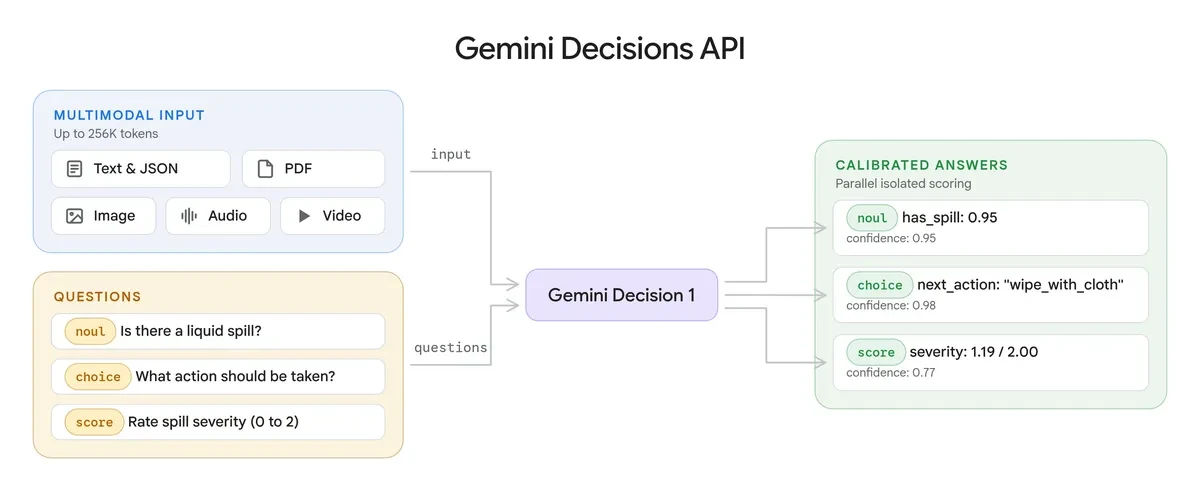
The API is built for bounded choices rather than open ended generation. Developers pass one multimodal input, spanning text, images, audio, video, and PDFs up to 256K tokens, along with up to 1,000 independent questions to evaluate against it. The shared input is billed once per request no matter how many questions are asked, with each question adding only its own instruction and criteria tokens.
That design targets a familiar pain point in agent systems, where a yes or no decision usually requires a full generative call and the answer then has to be parsed back into a structured value before code can act on it. The Decisions API returns the decision and a confidence score directly.
Three Question Types in One Pass
Every request can mix three question types against the same shared input, and every answer carries a confidence score from 0 to 1:
- noul (yes/no): estimates the probability that a yes or no condition holds, with optional true and false description criteria.
- choice (multiple choice): selects from 2 to 255 choices, returning the winner and normalized probabilities for every candidate.
- score (ordered rubric): grades inputs across an ordered rubric starting at 0, returning a continuous weighted score and per level probabilities.
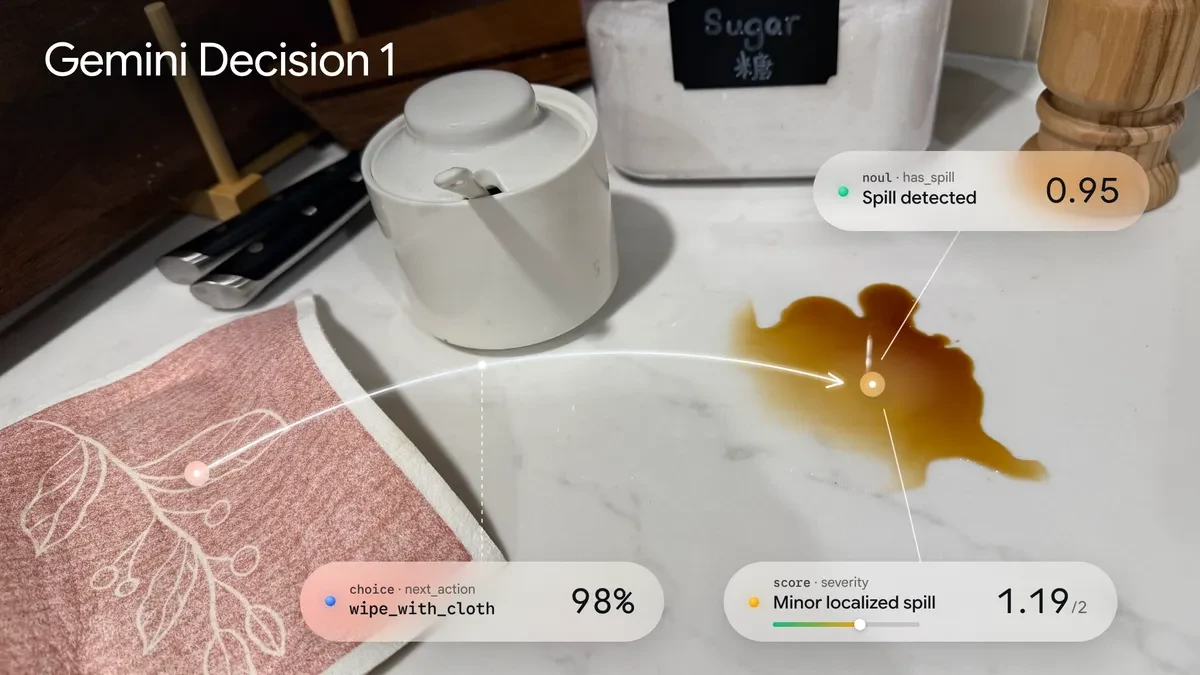
Google illustrates the idea with a photo of a breakroom spill: one request returns a 0.95 probability of a spill, a 98% confidence choice of wiping with a cloth, and a severity score of 1.19 out of 2.
Speed, Price, and Benchmarks
Gemini Decision 1 keeps median model compute time at 50 to 100 milliseconds, with 150 to 250 milliseconds end to end, across multimodal inputs and contexts up to 16K tokens, and Google says latency stays nearly flat from 1 to 100 questions per request. Pricing is $0.10 per 1M input tokens with $0 for output tokens, and a no cost tier is available in Google AI Studio for prototyping. There are no separate audio transcription or OCR charges.
On benchmarks spanning agent routing, reasoning, ranking, and multimodal understanding, Google says Gemini Decision 1 leads the suite overall and posts the lowest calibration error, with a Top-1 ECE of 0.0250. Its reported scores include 92.2% on JevBench, 58.7% Macro-F1 on Amazon ESCI, 79.7% on New Yorker Caption, 86.0% on Global-MMLU-Lite, and 69.1% on Video-MME. The picture is not a clean sweep: rivals edge it on two individual tests in Google’s own table, with TypeSafe Jev 1.14 ahead on Mind2Web Multimodal (86.8% versus 86.2%) and When2Call (82.0% versus 79.9%).
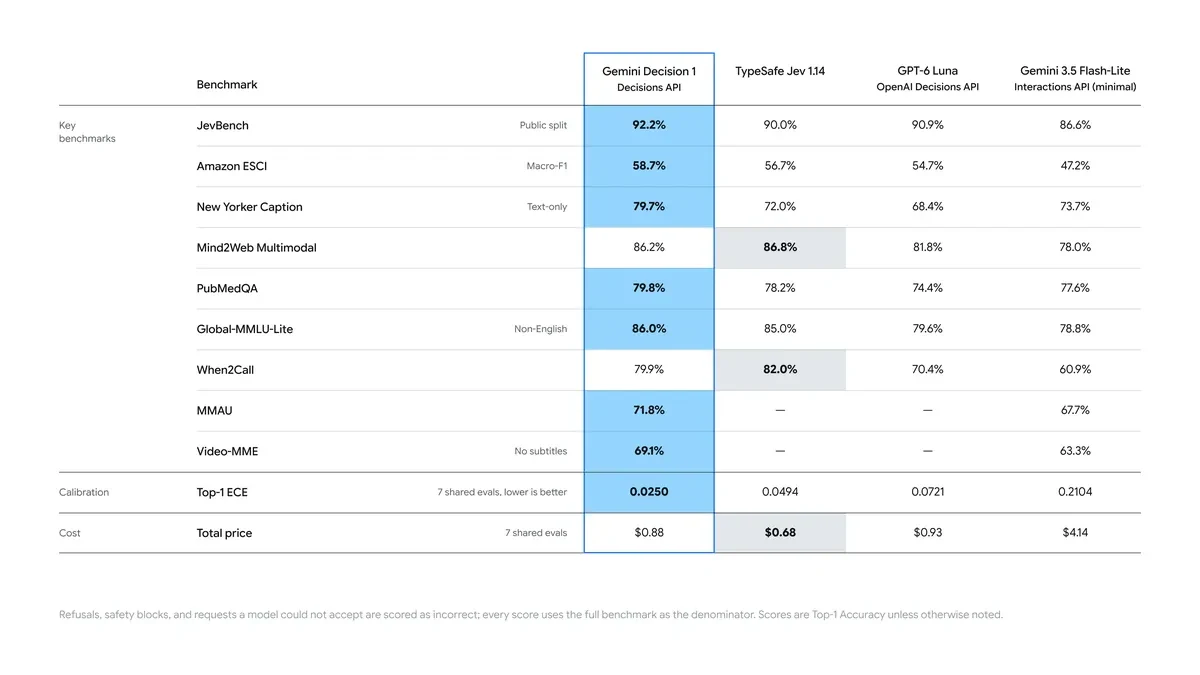
On cost, Google says the Decisions API is nearly 5 times cheaper across the shared benchmark suite than Gemini 3.5 Flash-Lite with the Interactions API. The total price across the seven shared evaluations is $0.88, against $0.93 for GPT-6 Luna, $0.68 for TypeSafe Jev 1.14, and $4.14 for Gemini 3.5 Flash-Lite.
How Google Is Already Using It
Teams inside Google are already using the Decisions API as a low latency control plane. Gemini Notebook uses it as a real time router to direct queries to the best model tier and thinking level, delivering up to 40% lower latency for everyday queries while reserving deeper reasoning models for complex tasks. The new rapid canvas experiment in Stitch uses it to generate playable wireframes in seconds and apply voice or tap edits almost instantly. CC from Google Labs uses it to pick an emoji reaction from a palette of more than 200 options in a fraction of a second, and Google Search uses it as a safety layer to detect adversarial behavior against MCP tools.
Availability and Ecosystem
Gemini Decision 1 is available now through the Gemini Developer API (v1beta) in Google AI Studio, where developers can grab an API key and try demo apps. Integrations are rolling out across OpenRouter, LangChain, Vercel, LiteLLM, Pydantic AI, Pipecat, LiveKit, and OpenCode, alongside the google-genai SDKs, with support for Gemini in Google Cloud coming soon.
Why It Matters
The launch signals a new front in the model race: not bigger generative models, but smaller, cheaper, faster models purpose built for the decisions that sit in front of them. OpenAI’s GPT-6 Luna Decisions API and TypeSafe’s Jev already occupy this space, and Google’s own benchmark table names both as direct rivals. If decision models work as advertised, the expensive reasoning model only runs when a cheap classifier says it is needed, which could cut both latency and cost across agent workloads. The open question is calibration in the wild: Google’s figures are its own, and independent testing will show whether the confidence scores hold up outside its benchmark suite.