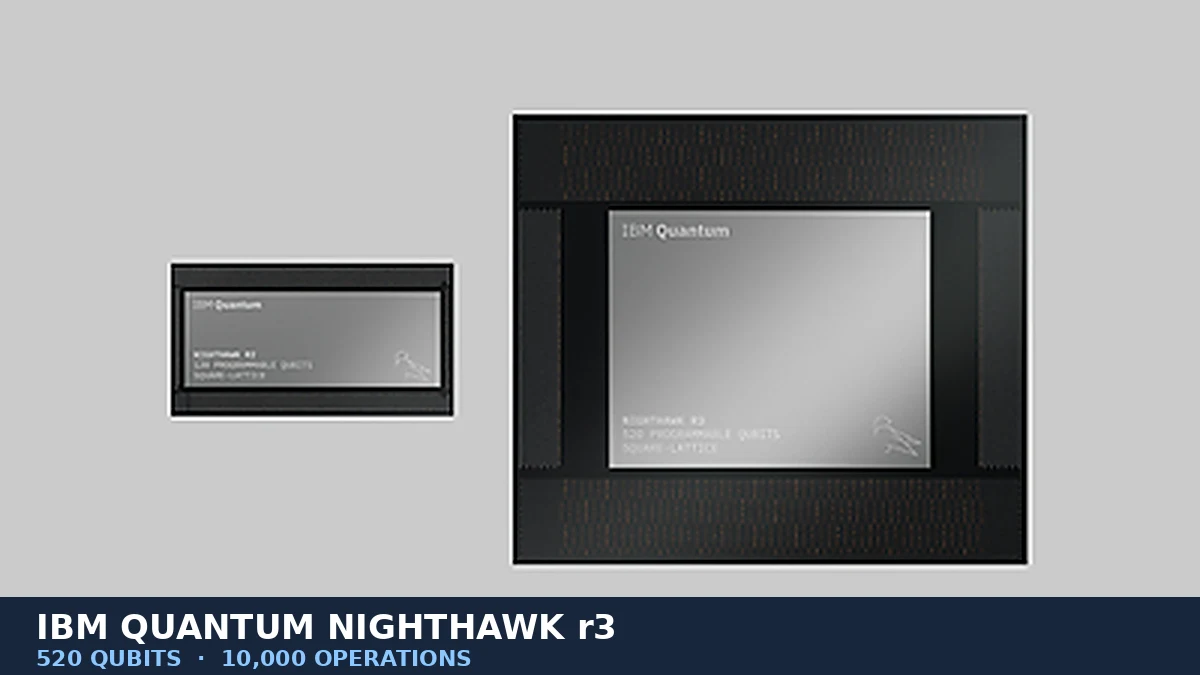
IBM has unveiled IBM Quantum Nighthawk r3, its next-generation quantum processor, designed to execute 10,000 quantum operations across 520 programmable qubits. The company announced the chip on November 11, 2026, and said it plans to link two r3 processors into a single 1,040-qubit system in 2027, a step on its road toward fault-tolerant quantum computing.
The announcement pairs the new design with evidence from the current generation. Nighthawk r2, introduced in September 2026, is already running real workloads for IBM clients and research partners, including quantum machine learning for energy grid optimization and simulations of magnetic materials. For AI readers, that is the point that matters: IBM is pitching quantum hardware not as a distant research project, but as a working complement to classical and AI computing that is already producing measurable speedups.
What Was Announced?
Nighthawk r3 extends the high-speed architecture of r2 to a larger machine. According to IBM, the new processor is designed to support 10,000 quantum operations on 520 programmable qubits, with 2,034 total physical qubits. It keeps r2’s square-lattice connectivity and fast operations while adding 10 chip-to-chip interconnects, called l-couplers, designed to connect processors into larger systems.
One detail deserves emphasis: r3 is a design IBM will build, not a chip shipping today. The processor available now is Nighthawk r2. The 520-qubit and 10,000-operation figures are design targets, and the 1,040-qubit system is planned for 2027.
“Useful quantum computing hinges on whether results can be delivered with accuracy and speed, both are fundamental,” said Jay Gambetta, Director of IBM Research and IBM Fellow. “Nighthawk is already showing us what that looks like today. As we scale this architecture to larger and more powerful quantum computers, the capabilities of quantum computation will reach new levels as we integrate more closely with classical resources and march ahead to fault tolerance.”
Nighthawk r2 Is Already Doing Real Work
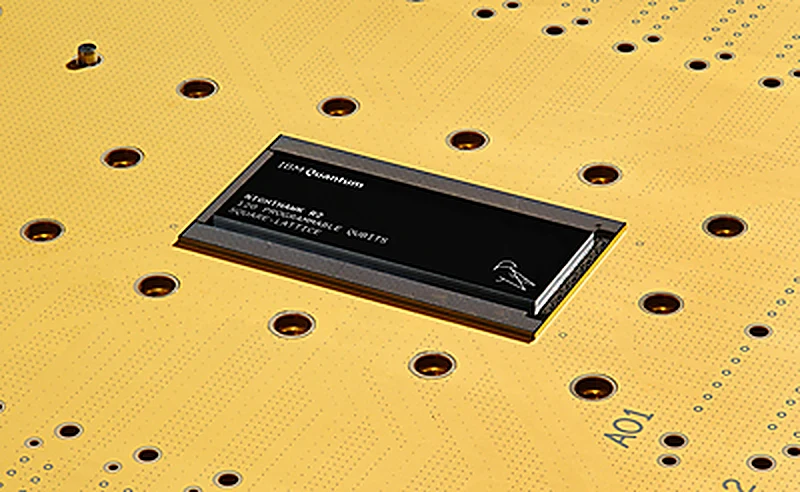
Introduced in September 2026, Nighthawk r2 delivers up to 100,000 samples per second while supporting accurate computations with more than 7,500 quantum operations on 120 qubits. Its high-speed qubit reset technology shortens the wait between circuit executions, so demanding workloads can collect the millions or billions of samples they need far more efficiently.
Clients and partners including E.ON, Algorithmiq, and Q-CTRL have executed 34 billion circuits on Nighthawk r2 to date, reporting performance improvements of up to 19 times over previous IBM quantum processors. The results include a 15x speedup reported by E.ON in quantum machine learning for energy grid optimization, and a 12x speedup for an IBM experiment with Oak Ridge National Laboratory that simulated real magnetic materials and produced results consistent with neutron scattering experiments.
An experiment with Algorithmiq to simulate a heterogeneous quantum material ran circuits 8 times faster on Nighthawk r2 than on IBM Quantum Heron. The new circuits are also significantly harder for classical computers to simulate, requiring an estimated 240 times more memory for comparable accuracy with leading classical tensor-network methods, according to IBM.
Scaling to More Than 1,000 Qubits
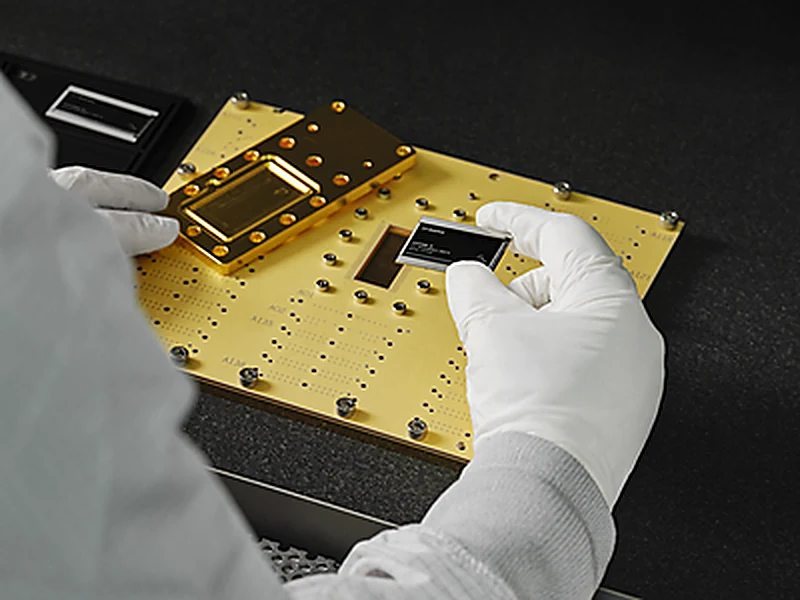
The path from one processor to a 1,040-qubit system runs through the l-couplers. This year IBM connected Nighthawk r1 processors using four l-couplers, achieving 99.3 percent quantum state transfer fidelity and progressing toward its 99.9 percent target. IBM also connected two cryogenic modules into a single system for the first time, reaching operating temperature in under five days and cooling below 15 millikelvin.
In 2027, IBM plans to connect two Nighthawk r3 processors into a single 1,040-qubit system, extending the same high-performance architecture to larger and more complex computations. The modular approach is the core of IBM’s scaling strategy: instead of building one ever-larger chip, it links proven processors together.
Quantum Meets Classical on One Platform
IBM also announced that its IBM Quantum Platform now brings high-performance classical computing and quantum computing together in a single managed environment. Users can integrate quantum workflows directly with classical compute, whether on a laptop or a supercomputer.
The integration is already showing results. IBM and RIKEN scientists executed their original sample-based quantum diagonalization workflow roughly 5 times faster while performing 100 times more computations than in the original study. Cleveland Clinic and RIKEN used the platform to automatically process 608 million samples for modeling biologically relevant structures, 33 times faster than without workflow automation.
IBM also recently launched a co-design platform for quantum error correction with Oak Ridge National Laboratory and AMD that physically co-locates Nighthawk with ORNL’s Umbra high-performance computing system, powered by AMD Instinct MI355X GPUs and 5th Gen AMD EPYC CPUs.
Why It Matters
Quantum computing is often discussed as a future technology, but IBM’s announcement is built around work happening now: energy grid optimization with quantum machine learning, materials simulation, and large-scale biological modeling. Those are the kinds of workloads where quantum processors and classical AI systems are increasingly used together, with classical machines orchestrating the workflow and quantum hardware tackling the parts that are hardest to simulate.
The honest caveat is that r3’s headline numbers are targets, not demonstrated results. What IBM can demonstrate today is r2’s speed and quality at 120 qubits, plus the interconnect and cryogenic technology needed to scale. If the 2027 two-processor system delivers on its design, IBM will have crossed the 1,000-qubit line with a machine built from linked processors rather than a single chip. For AI teams watching the frontier of compute, Nighthawk r3 is a concrete marker of how fast that frontier is moving.