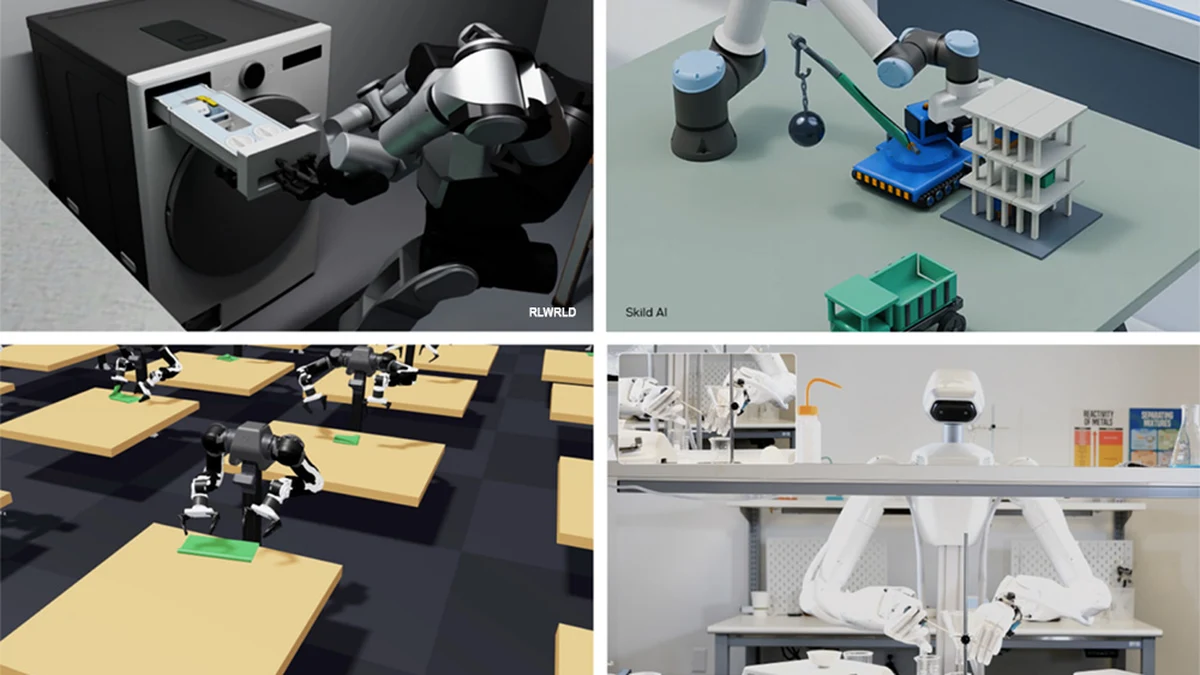
NVIDIA GR00T 2, introduced on November 9 at the Conference on Robot Learning (CoRL) in Austin, Texas, is an open frontier world action model that teaches robots dexterous manipulation skills by learning from human video. NVIDIA unveiled the model alongside Isaac Lab 3.0, its latest robot learning framework, and new industrial benchmarks for robot generalization.
The idea is to learn skills by watching people work, then transfer them to robots that never practiced the task.
What NVIDIA GR00T 2 Does
GR00T 2 is built on NVIDIA Cosmos, the company’s platform of world models. A single diffusion transformer, with 2 billion parameters, reads recent camera views, the robot’s state and a written instruction, then denoises future video and the next action sequence together. One pretrained checkpoint covers parallel gripper arms, dexterous hands and a humanoid robot.
That design yields three capabilities: skills shown only by humans carry over to robots that never practiced them, the model handles new tasks with few or no demonstrations, and a reasoning agent can call it through an API to sequence skills and recover from errors.
Learning From Human Video
The pretraining mixture explains the bet. GR00T 2 trained on 402,730 hours of first-person human video, 10,184 hours of demonstrations with a handheld UMI gripper across 2,897 tasks, and 23,500 hours of robot teleoperation spanning YAM and Franka arms, Sharpa and Wuji dexterous hands, and the Unitree G1 humanoid.
Human video is the largest share, and NVIDIA measured its effect: pretraining on none, 1, 10 and 100 percent of the human video raised real-robot task progress from 50 percent to 70 percent across 72 tasks. NVIDIA also released 100,000 hours of that egocentric data openly as Human-1M-100K on Hugging Face, under a CC BY 4.0 license.
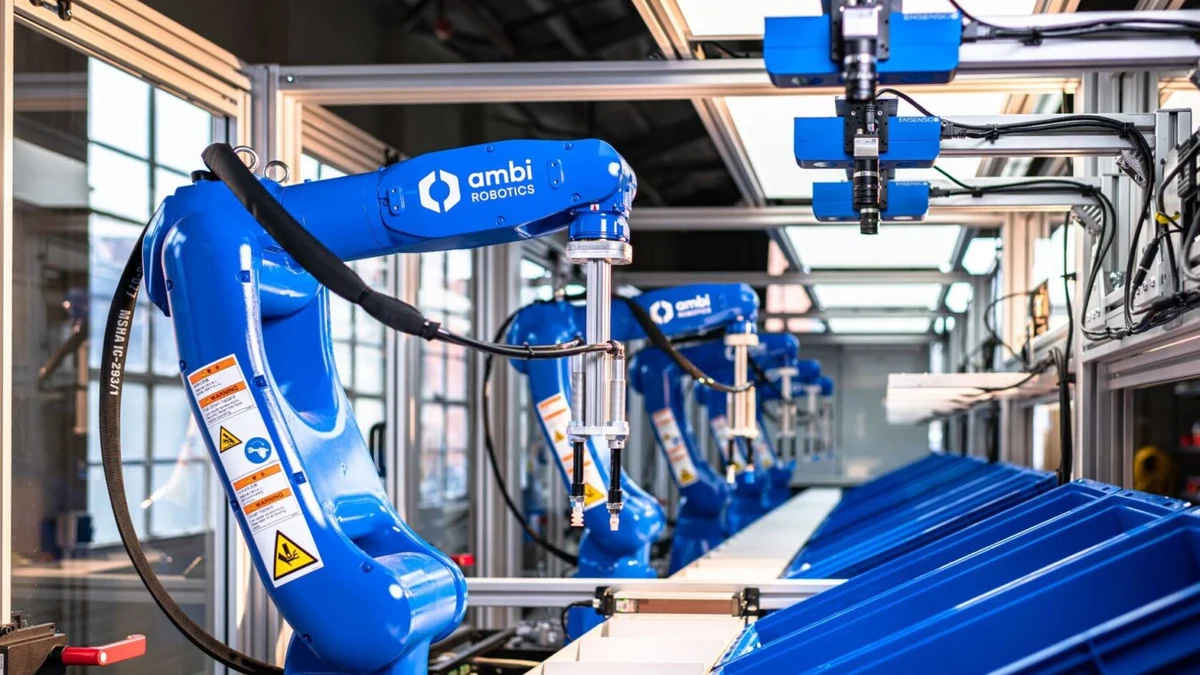
Ambi Robotics is among the partners exploring NVIDIA’s robotics workflows. Image: NVIDIA
Zero-Shot Results and Few-Shot Mastery
On 50 tasks that appeared in human video or other robots’ data but never in the target robot’s own data, GR00T 2 succeeded 40 percent of the time with no demonstrations, completing at least one attempt on 40 of the 50 tasks. One demonstration per task lifted average success to 71 percent, and five demonstrations, under three minutes of robot data, lifted it to 95 percent after a 30-minute fine-tune on a single RTX 5090.
Cross-body skill transfer is the more striking result. Shown a chemistry lab task only by people wearing gloves and head cameras, with no teleoperation at all, a two-handed robot lined a lab funnel with filter paper and wet it with a wash bottle in 65 percent of trials. Shown only with a handheld gripper, a different robot arm assembled a toy dump truck end to end in 60 percent of trials.
With minimal post-training, GR00T 2 performs long-horizon dexterous work with two 22-degree-of-freedom Sharpa hands, seating GB300 memory modules in 85 percent of trials and assembling a toy truck in 65 percent. Reinforcement learning on the real robot lifted three contact-rich insertion tasks from 40 to 76 percent to 88 to 96 percent. NVIDIA says the model ranks among the top three models across vision-language-action and world action model categories on the RoboCasa365, RoboLab, RoboDojo and MolmoSpaces benchmarks.
GR00T 2 Turbo Runs Onboard a Humanoid
A lighter variant, GR00T 2 Turbo, is built for speed. A smaller transformer and a more compact video representation make it light enough to run on the Unitree G1 humanoid itself, with each prediction taking 124 milliseconds on the robot’s own Jetson Thor computer. Through the SONIC whole-body controller, Turbo served popcorn in all 48 trials and cleared a table of diverse objects in 93 percent of trials.
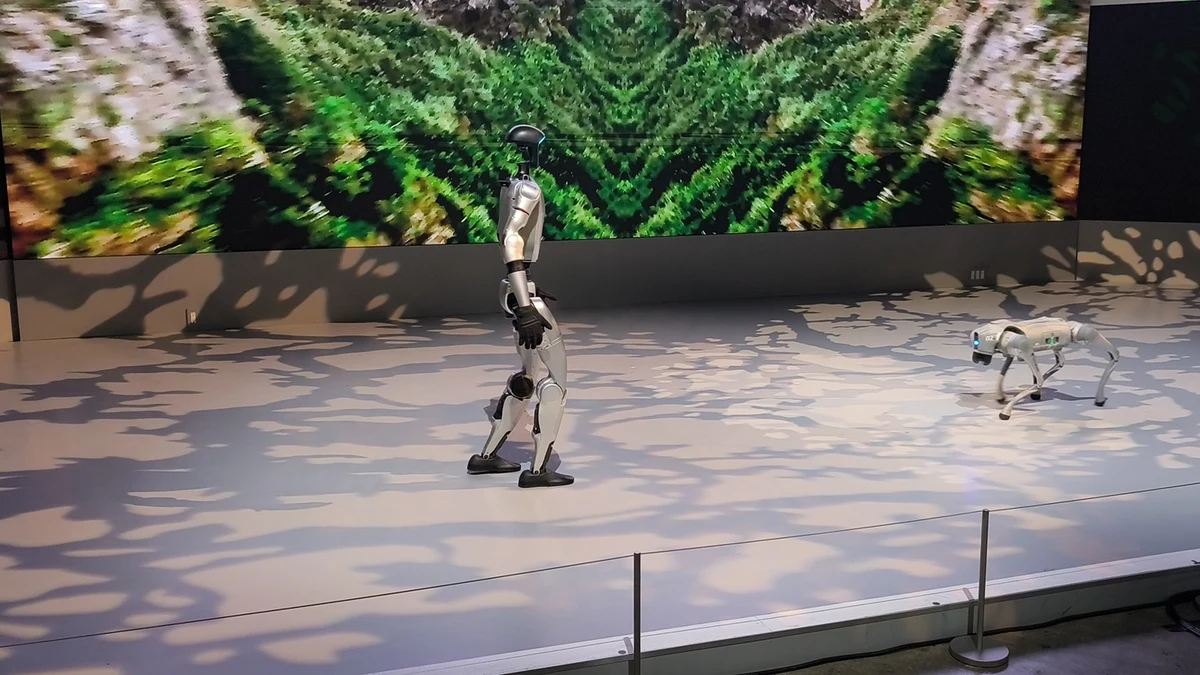
A Unitree G1 humanoid at Japan Mobility Show 2025, not a GR00T 2 demonstration. Photo: RuinDig, CC BY 4.0, via Wikimedia Commons
Agentic Control and Visual Steering
GR00T 2 is designed to work with a reasoning agent that plans while the model handles contact-rich manipulation. With an agent calling GR00T 2 as a tool, a YAM arm assembled a toy plane in 98 of 100 trials, a toy tractor in 97 and a Hot Wheels car in 97, with error recovery along the way. Supervised fine-tuning alone managed only 23 to 69 of 100 on the same toys.
Visual steering adds another layer. Marking grasp and release points on the model’s camera view lifted short-horizon instruction following on YAM from 40 percent to 92 percent. “To me, agentic robotics is the most exciting technological development since the internet in 1995,” said Ken Goldberg, professor of robotics at UC Berkeley.
Isaac Lab 3.0 and New Benchmarks
Simulation is the other half of the announcement. Isaac Lab 3.0, generally available since October 20, is NVIDIA’s open-source robot learning framework. Tighter integration with Newton, an open-source physics engine, lets it model deformable objects such as cables and cloth, and in a vision-based dexterous manipulation benchmark it reached up to 2.5 times the training throughput of Isaac Lab 2.3 with PhysX.
NVIDIA also released Isaac Lab-Arena 0.4 in developer preview for scaled policy evaluation, plus two open benchmarks: DexBench, developed with RLWRLD, with 15 tasks across retail, logistics, manufacturing and hospitality; and VABAR, developed with UC Berkeley, covering six industrial tasks. Early users include Nexuni (robotic laundry), Foxconn (server manufacturing) and Siemens (industrial use cases).
Why It Matters
NVIDIA GR00T 2 matters because it attacks the hardest bottleneck in humanoid robotics: data. Teleoperating a robot for every new task is slow and expensive, while video of people doing the same work is abundant. If human video transfers as NVIDIA’s numbers suggest, teaching a robot a new skill could take minutes, or none at all.
Two caveats apply. All figures come from NVIDIA’s own evaluations, with no independent benchmarks yet. And while NVIDIA calls the model open, the code arrives only in December. The real test will be whether outside labs reproduce these results on their own robots once that code ships.
Sources
- NVIDIA Blog, “Practice Makes Precise: At CoRL, NVIDIA and Partners Reveal How Robots Rehearse Delicate Work in Simulation,” November 9, 2026
- NVIDIA Research, “GR00T 2: Scaling Robot Foundation Models for Generalization, Dexterity, and Adaptation”
- The Robot Report, “NVIDIA launches GR00T 2 and Isaac Lab 3.0 at CoRL,” November 9, 2026
- Unite.AI, “NVIDIA Introduces GR00T 2 for Robots Learning From Human Video,” November 9, 2026