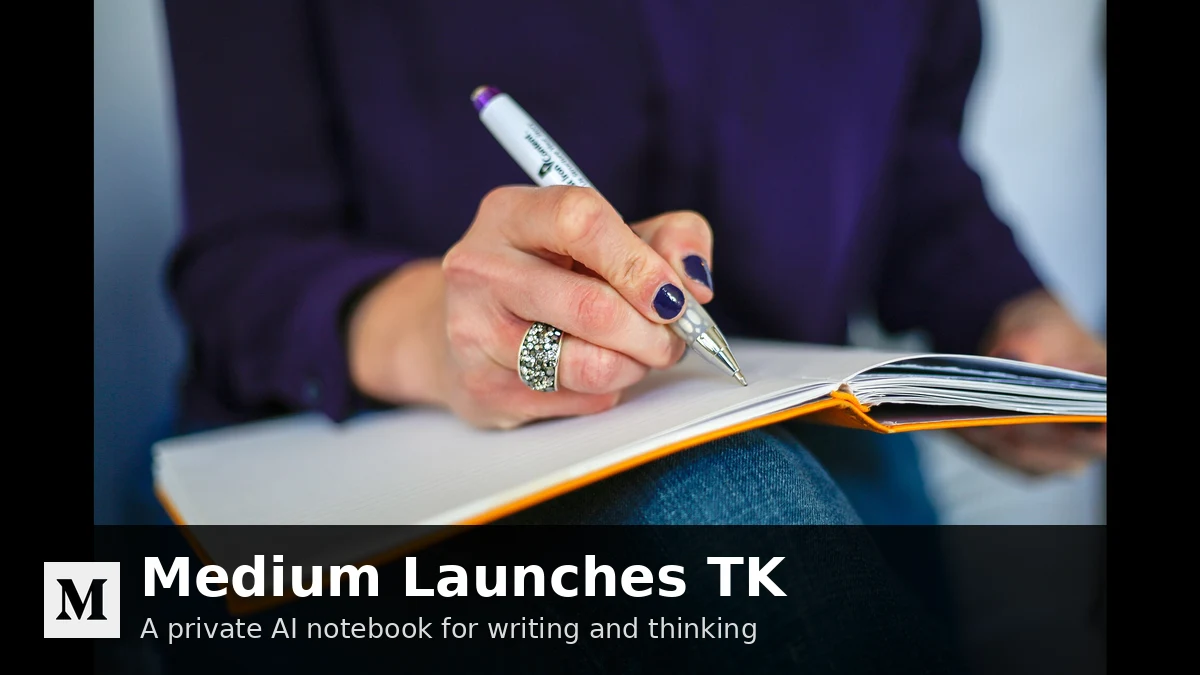
Medium has launched Medium TK, a private notebook app with an AI assistant built directly into the editor, in what chief executive Tony Stubblebine calls the company’s first major product launch since 2017. The app, announced on the Medium blog on November 9, is free for anyone with a Medium account and is available on the web, iOS and Android.
TK is a deliberate bet in the opposite direction from much of the AI industry. “Much of the AI industry is betting that machines will do our thinking for us, and some of its leaders talk as if writing no longer matters,” Stubblebine wrote. “We’re betting the other way. We’re not anti-AI, we’re pro-human, and that’s why we built TK.”

What Medium TK Does
TK is a private, agentic notebook for writing and thinking, designed around three goals: make writing easier, make thinking easier, and make writers feel their writing matters. The first version ships with a mobile app and widgets for quick voice and text notes, instant import of everything a user has ever written on Medium, and imports of vaults from Bear and Obsidian. It reads and writes Markdown, and exports a full archive in Markdown.
The headline feature is the @TK shortcut. Typing @TK in the middle of a sentence summons an AI assistant without leaving the editor, for example to answer a factual question or pull in a paragraph written the day before. The name comes from the publishing convention where writers mark unfinished passages with “TK”, short for “to come”.
TK also ships with AI feedback tools for editorial and headline suggestions. It can match a draft against the style guides of Medium publications and flag writing that could be organized into a book. A morning writing prompt, which can refer back to earlier notes, is designed to keep the habit going.
Private Blogging Through Libraries
The social side of TK is built around Libraries, which Stubblebine calls private blogging. Groups can share drafts through links or email, comment and leave emoji reactions, without pageview counts or visibility in open web search. Medium ships with three open Libraries: Public Journal, for low pressure daily journaling with an audience; Get Feedback on Your Writing, for sharing early drafts; and Write a Book, for turning notes into a self published book.
TK also connects to the wider AI agent ecosystem. It ships with an MCP server and a Claude skill, so a user’s agent can draw on their stored positions, projects and unfinished ideas. “In the AI era, it’s a sidecar you can attach to any AI project,” Stubblebine wrote.

Privacy and Transparency Rules
Medium sets out explicit values for the app. On privacy: “No AI company ever trains on your writing or uses it without your permission.” On transparency, TK lets published notes show what was human written and what was AI written, with provenance inspectable down to the prompts and source material. TechCrunch notes the writing is not end-to-end encrypted, because the app is designed for collaboration, so “private” here means private by permissions, not unreadable by the company.
There is no native desktop app yet, which Stubblebine says Medium wants to fix. The company says it has been profitable since August 2024, which it presents as a reason the tool will stick around.
Why It Matters
Medium TK is also a strategic response to a changing web. As Silicon Report noted, Medium is moving toward private blogging as Google referral traffic declines, taking writing “underground” rather than chasing search distribution. Stubblebine’s shorthand for the split is that “TK is the gym and Medium is the stage”: TK is where writers practice and sharpen their thinking, and Medium is where they publish, perform and get paid.
Whether writers want another notes app is an open question, but TK arrives with a clear position: AI as an assistant inside the writing flow, not a replacement for the writer. For a company whose last important launch was in 2017, it is a significant new bet on human writing.
Sources
- Tony Stubblebine, “We are betting on human intelligence: Meet TK, an agentic notebook for writing and thinking,” The Medium Blog, November 9, 2026
- Silicon Report, “Medium launches TK notes app with private social features,” November 9, 2026
- Unite.AI, “Medium Opens TK Notebook to Writers with Inline AI Assistance,” November 9, 2026
- Medium, “Medium Just Launched an AI Writing App. Here is What That Actually Means,” November 9, 2026