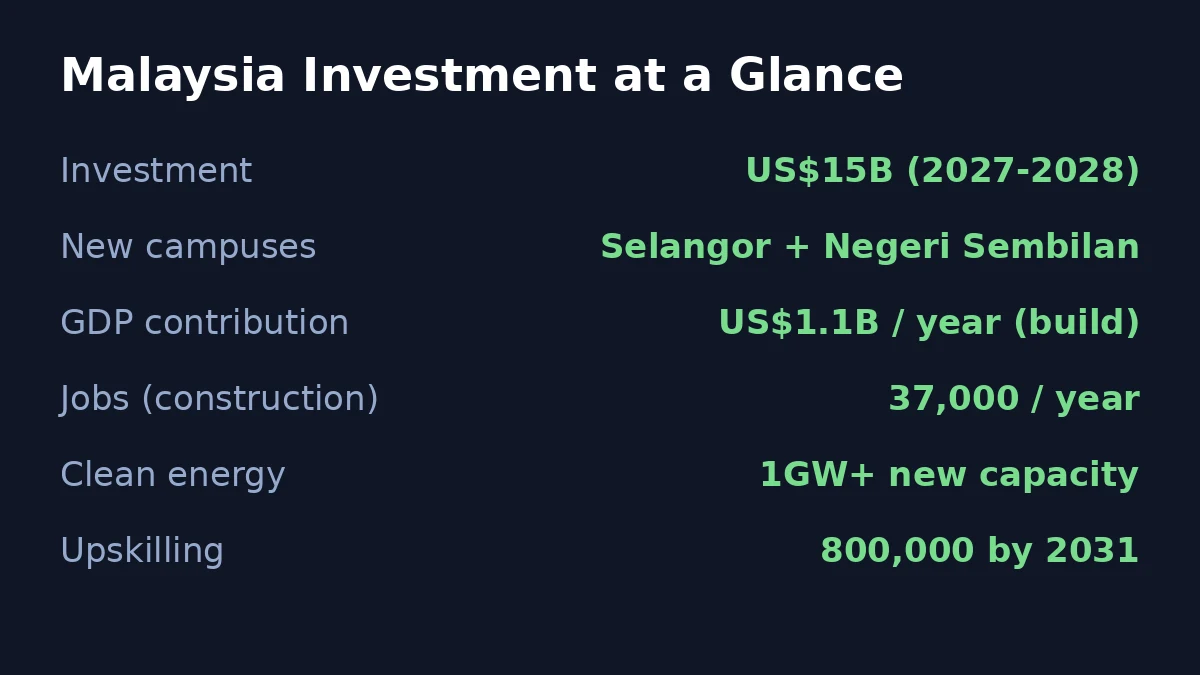
Google announced on Wednesday a $15 billion investment in Malaysia over 2027 and 2028 to build new AI-focused data center campuses, add more than 1 gigawatt of clean energy capacity to the national grid, and upskill 800,000 Malaysians by 2031. The plan was unveiled at the “Mantap Malaysia Bersama AI” event in Kuala Lumpur in the presence of Malaysian Prime Minister Anwar Ibrahim, according to Google’s official blog post.
The announcement builds on Google’s more than 15-year presence in the country and expands on the $2 billion digital infrastructure investment the company announced in 2024, the post said. Google’s first Malaysian data center campus at Elmina Business Park in Selangor is now operational, and new campuses are planned in Selangor and Negeri Sembilan.
What Was Announced?
Alphabet and Google president and chief investment officer Ruth Porat presented an integrated plan covering energy-efficient data center campuses in industrial zones, water replenishment projects, clean energy additions, and workforce development. Google’s in-country infrastructure will provide “the world-class computing capacity needed to run homegrown, next-generation digital and AI applications,” while also powering services such as Search, Maps, and Chrome used daily by millions across Malaysia and the Asia-Pacific region.
The company is working with a domestic supply chain of more than 80 Malaysian entities to develop and operate its infrastructure, spanning construction, network infrastructure, power and cooling components, and services such as logistics, legal, catering, and waste management.
Key Figures
The construction phase of the new campuses (2027 to 2028) is expected to contribute an annual average of $1.1 billion to Malaysia’s GDP and support more than 37,000 local jobs per year, generating $378 million in average annual labor income, Google said. Approximately 6,000 of those jobs are estimated to be in construction. Once operational, the facilities are projected to sustain more than 9,000 local jobs per year, with wages averaging 45% above the national median.
On energy, Google said it will add more than 1GW of new clean energy capacity to Malaysia’s national grid through a collaboration with Tenaga Nasional Berhad under the country’s Corporate Renewable Energy Supply Scheme, and will pay for 100% of the electricity its data center campuses consume plus the direct infrastructure costs required to connect them to the grid. Reuters reported that Google said its Malaysian campuses will run at a Power Usage Effectiveness (PUE) of 1.12 to 1.14.
“Google is committed to growing our presence responsibly, delivering lasting value for Malaysia’s economy and people,” said Porat in the announcement. “This investment aligns with Malaysia’s development priorities, providing the foundational computing capacity to deliver the upside of innovation across the country while adding local power and water resources as our operations scale.”
Malaysia’s Digital Minister Gobind Singh Deo said Google’s plan “sets a high standard for sustainable, high-impact digital infrastructure development in Malaysia,” adding that through its clean energy and water commitments, Google is “helping to anchor a high-value digital economy where local businesses, workers, and communities directly benefit from the transformative potential of AI and digital innovation.”
Workforce and Water Programs
Google also announced four new upskilling programs targeting 800,000 Malaysians over five years (2027 to 2031), focused on educators and youth, microentrepreneurs, civil servants, and vocational jobseekers: Experience AI Malaysia (AI literacy in classrooms), Jelajah AI MSME (digital skills for microentrepreneurs), AKAD Rakyat (AI literacy for local council officers), and Data Center Institutes at polytechnics in Selangor and Negeri Sembilan to train jobseekers for data center operations roles starting in 2027.
On water, Google said it will expand watershed stewardship in the Sungai Buloh and Sungai Selangor river basins and install 20,000-liter storage tanks, rainwater harvesting systems, and self-closing faucets at four schools in Selangor, giving each school at least two weeks of emergency water capacity for up to 2,000 community members during municipal supply disruptions.
Why It Matters
Malaysia has become Southeast Asia’s fastest-growing hub for new data centers, and the $15 billion commitment is one of the largest single AI infrastructure bets announced in the region. It lands as hyperscalers race to secure power, land, and government goodwill for the AI buildout, with Google pairing the campus spending with an explicit promise to fund the clean energy and water resources its operations will consume.
Sources
- Google: Google Announces Digital Infrastructure Expansion, Local Jobs, Water Replenishment, and Clean Energy Initiatives with US$15 Billion Malaysia Investment (official announcement, Nov 4, 2026)
- Reuters: Google to invest $15 billion in Malaysia in 2027 and 2028
- The Straits Times: Google to invest US$15 billion in Malaysia in 2027 and 2028
- AFP via Tribune: Google unveils $15 billion data centre investment in Malaysia