OpenAI is planning its next internal security sprint, teaming up with cybersecurity research firm Cathedral to stress-test its defenses, and at the same time more than quadrupling the rewards in its Security Bug Bounty program. The announcement, made November 2, signals that the ChatGPT maker is treating continuous, AI-assisted defense as a permanent operating mode rather than a periodic audit.
What Was Announced?
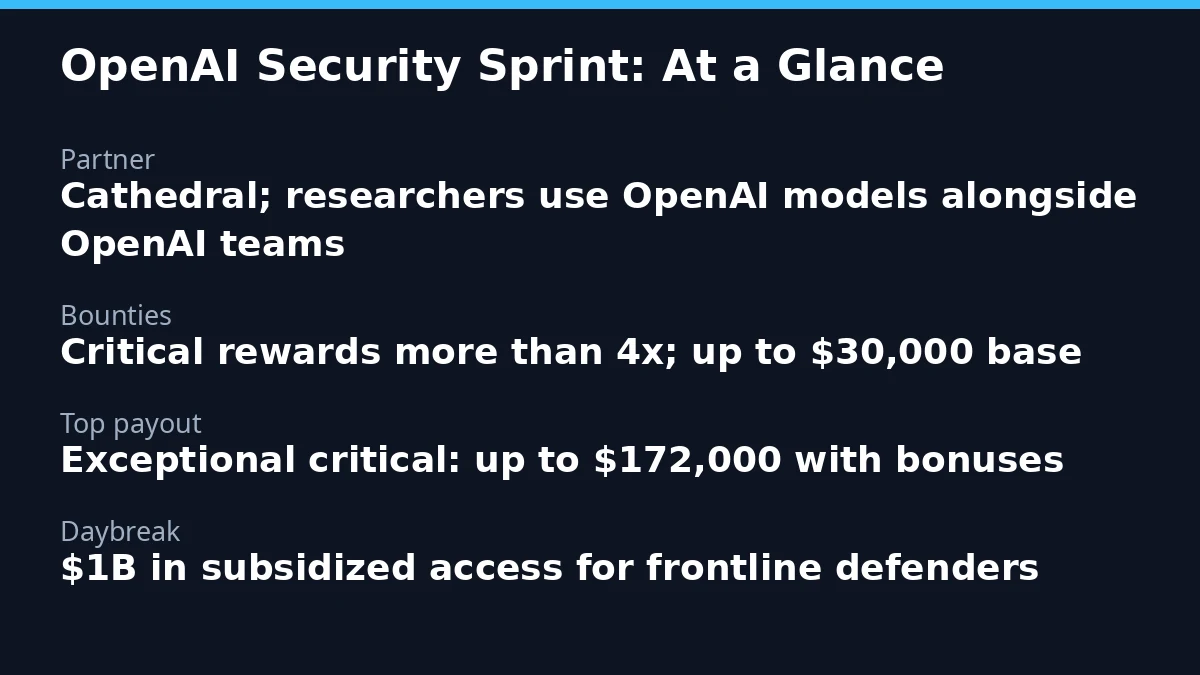
OpenAI said it is planning its next internal security sprint, bringing outside researchers and security partners together with its own teams to use OpenAI’s models to probe and strengthen its systems. Cathedral’s researchers will use OpenAI’s models alongside OpenAI’s engineers to challenge defenses, bringing what the company called differentiated expertise and approaches to finding weaknesses. The announcement concerns a planned sprint, not a completed round of testing.
Gavin Kliger, Cathedral’s CEO and co-founder, said the collaboration would pair OpenAI’s models and security expertise with Cathedral’s research to find weaknesses, test fixes and support continuous defense.

The sprint follows an earlier effort in which OpenAI dedicated 25% of its product engineers to finding and fixing weaknesses. Engineers used Codex to investigate findings, reproduce vulnerabilities in isolated environments and prepare patches for review. The earlier effort mobilized more than 250 people across more than 100 service areas, according to OpenAI’s Defense Factory account, and closed 53 urgent or high-priority issues on its first day.
Bug Bounty Overhaul
Alongside the sprint, OpenAI is improving its Security Bug Bounty program, including what it described as more than quadrupling rewards for critical findings. According to reporting on the update, a critical vulnerability in a core product such as ChatGPT, Codex or the API Platform can now earn up to $30,000, while exceptional critical findings remain eligible for up to $100,000 before bonuses.
The new structure adds several incentives on top of the base payouts. High-quality reports are eligible for a quality multiplier, a new five-tier loyalty program adds scaling bonuses for researchers who repeatedly work with OpenAI, and priority campaigns will carry dedicated bonus pools for testing newly launched features. Combined bonuses can lift an exceptional critical payout to as much as $172,000.
Reports still awaiting an award will be paid under the new ranges, and researchers whose bounties were awarded during the 30 days before the announcement will receive the difference if the new base and loyalty awards would have paid more.
The Context: AI for Defense
OpenAI framed the move as part of a broader push to keep what it calls the defender’s window open: using frontier AI models to harden systems faster than attackers can exploit them. The company said traditional cyber defenses alone are no longer sufficient and that continuous defensive loops are needed to find and fix weaknesses before attackers do.
The partnership is also notable for Cathedral’s recent profile. The firm’s AI agents made headlines in October when they breached Anthropic’s internal systems in under 12 hours during an authorized assessment, a demonstration of how quickly agentic AI can now find real vulnerabilities. OpenAI is now enlisting that same offensive capability on its own side.
Beyond its own systems, OpenAI reiterated its Daybreak initiative, a $1 billion commitment in subsidized access over six months for frontline defenders protecting essential services and digital infrastructure. The company said it is making its most capable models available to Daybreak customers for authorized defensive work, and that it will share its security architecture and lessons from the sprint along with a blueprint for empowering cyber defenders across industry and government.
Why It Matters
Frontier AI labs are increasingly treated as critical infrastructure targets, and the attack surface grows with every new agentic capability. By turning Cathedral’s red-teaming expertise inward and paying researchers far more to report flaws, OpenAI is betting that the same AI systems creating new risks can also find them faster. Whether the OpenAI Cathedral partnership works will be judged by one measure OpenAI itself has named: findings that end in deployed, verified fixes rather than tickets marked complete.