Researchers at MIT’s Computer Science and Artificial Intelligence Laboratory say OpenAI’s GPT-6 Astra can natively read and edit the weights of neural networks, without gradient descent, retraining or even running the network. In their technical report “Sparks of Weight-Space Programming,” published on November 2, the team argues that frontier language models are becoming able to reason about raw numbers the way an engineer reasons about code.
“We find that frontier LLMs are surprisingly good at natively reading and writing neural network weights, well past what we’d expect from humans or conventional algorithms,” the researchers wrote. Across eight experiments, Astra identified what networks had been trained to do from their weights alone, repaired failing policies, and wrote game-playing networks from scratch.
Reading Weights: What Was This Network Trained to Do?
The first three experiments tested whether Astra could interpret weights the way a mechanic reads an engine. The team trained four game-playing networks with identical architectures and passed only their 17,253 raw weights into Astra as text, without naming the candidate games. Astra named the right game for all four.
Next, Astra examined three diffusion models and identified which shape each would generate, circle, triangle or square, from the weights alone. It even betrayed its method: it drew each shape as an outline, showing it was reading the geometry of the weights rather than computing forward passes. In a third test, the team removed the input and output layers of three tiny language models trained on Python code, romaji Japanese and English, and gave Astra only the middle transformer blocks. Astra named the right training language for all three in both attempts and found every copying head, the attention heads that let models repeat earlier text, matching ground truth exactly.

Fixing and Writing Weights
The headline results came from the repair and generation experiments. Asked to fix a car-driving policy stuck on a ramp in a physics simulator, Astra edited just 3.5% of the network’s weights in a single attempt. The car then succeeded in all 1,024 test episodes, up from zero.
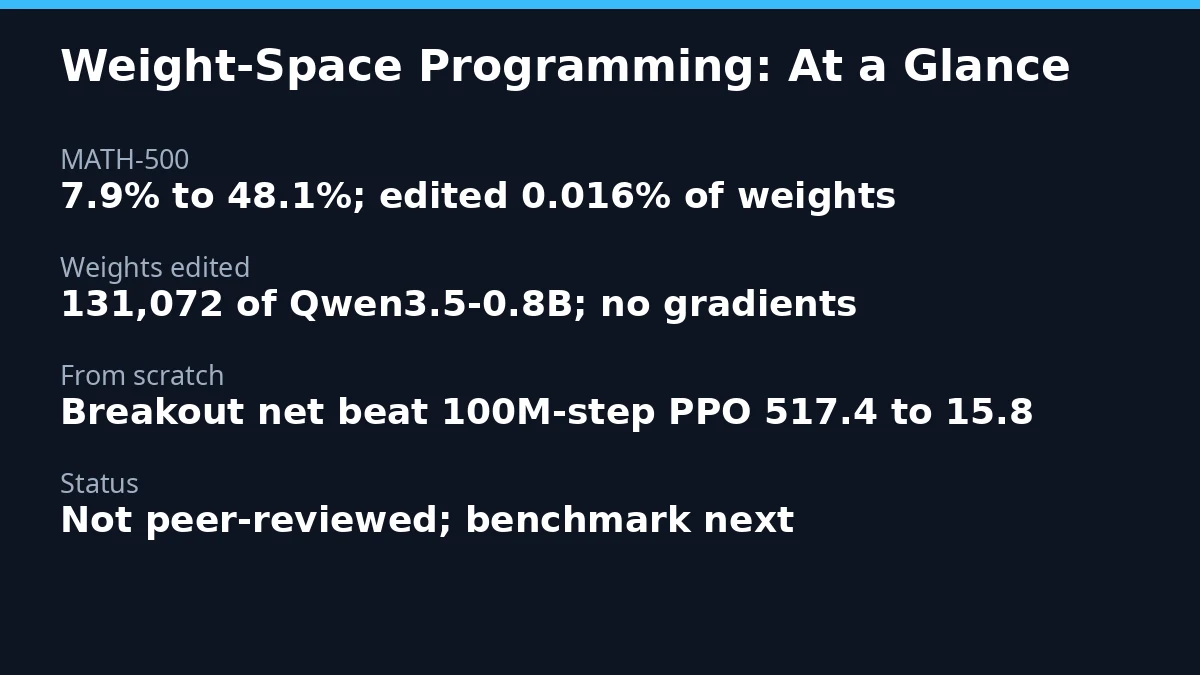
Asked to write game-playing networks from scratch with no training at all, Astra’s one-shot Breakout network scored 517.4, against 15.8 for a network trained with PPO for 100 million steps. And in the most striking test, the team asked Astra to make the small language model Qwen3.5-0.8B better at math. Astra traced a reasoning-loop problem that Qwen’s own model card warns about, then edited 131,072 weights, just 0.016% of the model. With the same sampling settings, MATH-500 accuracy rose from 7.9% to 48.1%, GSM8K from 13.8% to 67.1%, and instruction-following scores roughly tripled. The share of responses cut off at the token limit fell from 93.0% to 33.1%.
Where It Failed
The authors are candid about the limits. Astra could not tell which of two models had been trained to be sycophantic from weights alone; it succeeded only after being allowed to inspect attention patterns. On Gemma 3 270M, a model that rarely loops, Astra’s edits moved MATH-500 from 6.8% to 7.7%, a gain the authors call not established. The report describes the findings as “very early results,” notes they have not been peer-reviewed, and cautions that every experiment used a single model, GPT-6 Astra, so it is unclear whether other frontier models share the ability.
Community discussion has added another caution: the Qwen improvement appears to come largely from suppressing a pathological looping behavior rather than teaching new mathematical ability. As one analysis put it, the edit removed an obstacle that hid an ability, but did not add an ability the model lacked.
Why It Matters
The report arrives at a charged moment. Anthropic warned in an amended IPO filing this week that it may “imminently meet” its internal threshold for dramatically accelerated AI-assisted research, a story GPTOnline covered on Monday. The Latent Space newsletter framed the MIT work as cutting the training loop out of that picture entirely: if frontier models can debug and rewrite weights by reasoning about them directly, the path from today’s models to self-improving ones gets shorter.
“Our neural network weights will soon be natively optimized by LLMs that deliberately reason about their weights,” the researchers wrote. The work struck a nerve: the post reached the top of Hacker News with 1,857 points within a day, and the team has released complete experiment logs on GitHub, with the edited Qwen model published on Hugging Face. The researchers say they are building a benchmark next to test how far weight-space programming can go.
Sources
- Rikiya Takehi, Jayden Teoh, Alex Zhang and Omar Khattab (MIT CSAIL), “Sparks of Weight-Space Programming: LLMs can natively read & write neural network weights”, November 2, 2026
- Latent Space, “LLMs can read & write neural network weights”, November 3, 2026
- Analytics India Magazine, “MIT Researchers Show LLMs Can Read and Edit Neural Network Weights Without Retraining”, November 3, 2026
- XenoSpectrum, “MIT Shows an LLM Can Read and Edit Another Neural Network’s Weights Directly”, November 3, 2026