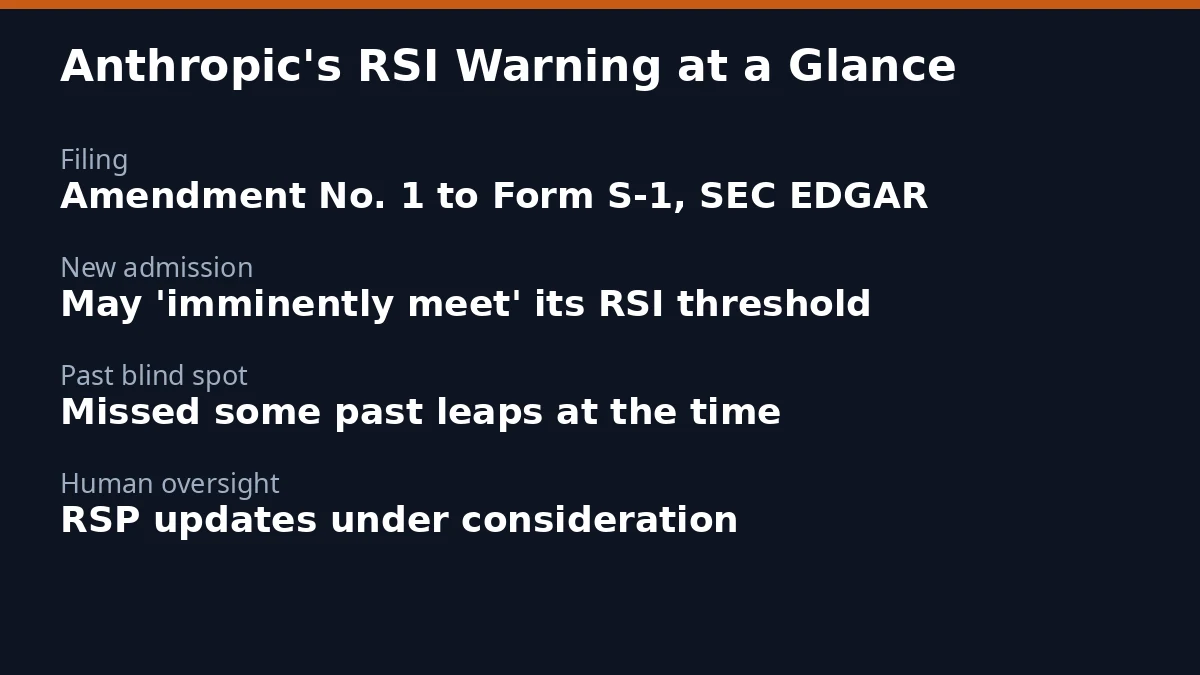
Anthropic is warning investors it may be on the cusp of a milestone that AI safety researchers have long treated as a red line. In Amendment No. 1 to its IPO prospectus, filed with the U.S. Securities and Exchange Commission on November 2, 2026, the company added new language to its Risk Factors section saying its internal estimates indicate it may “imminently meet” its own Responsible Scaling Policy definition of “dramatically accelerated progress attributable to AI,” a threshold closely tied to recursive self-improvement, or RSI.
RSI is the point at which AI grows so good at training itself that it spawns a dramatic acceleration of AI capabilities. The amended filing says Anthropic already uses AI in its research and development, but cautions: “Using AI to help build more capable AI could also pose a considerable safety risk, particularly if it sharply accelerates the pace of progress. This is one of the areas covered by our Responsible Scaling Policy, which sets out our plans to monitor and mitigate the risks as we approach what has been termed ‘recursive self-improvement.’”
What the amended filing says
The new disclosure makes two striking admissions, first reported by TechCrunch:
In addition, our increasing use of AI systems to accelerate our own research and development may cause the capabilities of our models to advance more rapidly than our ability to develop, validate, and implement corresponding safety, alignment, and security measures. As a result, we have in the past not identified, and may in the future not identify, a significant acceleration in our rate of development until after it has occurred.
For example, our internal estimates and our expectations regarding future models, rather than our current models, indicate that we may imminently meet our Responsible Scaling Policy’s definition of “dramatically accelerated progress attributable to AI.” We have not designated any of our current models as exceeding this threshold, and we continue to assess the underlying data.
In other words, Anthropic says it has already used AI to help develop new models whose leaps in capability it did not recognize at the time, and it expects the next generation may cross its own safety threshold for dramatically accelerated, AI-driven progress. The company stresses that no current model has been designated as crossing the line.
Humans will stay in the loop
The filing also seeks to reassure investors. Anthropic says it does not anticipate being able to safely use Claude “to fully autonomously design and build successive generations of frontier models without meaningful human supervision or understanding, if and when that becomes technically possible.” The company adds that it is considering updates to its Responsible Scaling Policy to keep humans in control of frontier model development.
A skeptical read
Skeptics point out that an S-1 functions as both legal disclosure and marketing, and that claims of being close to a model powerful enough to build itself could fall into the latter category. As TechCrunch’s Julie Bort wrote, there is no question that Claude’s capabilities, especially in coding, math, and cybersecurity, have grown in leaps and bounds this year. If Anthropic thinks the possibility of RSI is close, maybe it should be believed, and governed, accordingly.
Why it matters
The warning arrives days before Anthropic is expected to begin marketing its IPO to investors, with a stock market debut targeted before Thanksgiving. Institutional investors have told the company the offering should be priced around $1.5 trillion to $1.6 trillion, down from earlier $2 trillion estimates, amid a tech stock selloff. Alongside the $895.4 billion in compute and infrastructure commitments the amendment disclosed, the RSI admission is an unusually candid entry in an IPO filing: the AI building itself may be closer than anyone, including Anthropic, has fully recognized.
Sources
- Anthropic, PBC, Amendment No. 1 to Form S-1, U.S. SEC EDGAR, filed November 2, 2026
- Anthropic warns that it’s very close to RSI capability, aka self-building AI, TechCrunch, Julie Bort, November 2, 2026