DeepSeek Harness, the open-source agent framework from Chinese AI lab DeepSeek, has formally launched Creator Mode, a feature that lets users describe ideas in conversation and have the agent turn them into ready-to-use plugins. The DeepSeek Harness team announced the launch in an official post on X on November 2, and Bloomberg reported the move as the Chinese lab’s latest push to strengthen its AI agent products.
Official examples of what Creator Mode can build include a design workspace, a sandbox game and a 3D LLM visualization tool, PANews reported. The concept fits Harness’s architecture: everything in the framework, from models and tools to skills, sessions and the UI itself, is a plugin built on DeepSeek’s Cordis framework, so Creator Mode effectively lets the agent reconfigure and extend itself at runtime, described in plain language by the user.

Code on a developer’s screen. Photo: CC0.
Not entirely new, now formal
Creator Mode did not appear out of nowhere. DeepSeek shipped an experimental creation mode in the Harness v0.2 preview on September 29, alongside the first official desktop installers for macOS and Windows, a plugin manager and scheduled automation tasks, MarkTechPost reported at the time. The November 2 announcement promotes it from experiment to a showcased, front-line feature with example plugins and media coverage.
The framing matters because plugins are where Harness lives or dies. DeepSeek says about 60 percent of Harness users run third-party plugins, and the company has previously optimized its V4.1-Flash model specifically for Harness workloads. By making plugin creation a chat-first experience, DeepSeek is betting that the barrier to extending the agent should be an idea, not an npm package and a terminal session. The framework remains an MIT-licensed developer preview, with DeepSeek warning of compatibility-breaking changes as it iterates.
Why it matters
Open-source agent frameworks are racing to build plugin ecosystems the way app stores once raced for developers. Harness’s hook is radical flexibility: Anthropic’s Claude Code and OpenAI’s Codex can even run inside it as subagents, Stackness reported, and the repository picked up more than 200,000 GitHub stars within weeks of its August release. Creator Mode is DeepSeek’s play to keep that momentum compounding: if users can generate useful plugins by describing them, the ecosystem grows with every user, not just every developer. The caveat, as always with model-written code, is trust: third-party plugins run with real permissions, and DeepSeek itself notes the framework has not had a security audit.
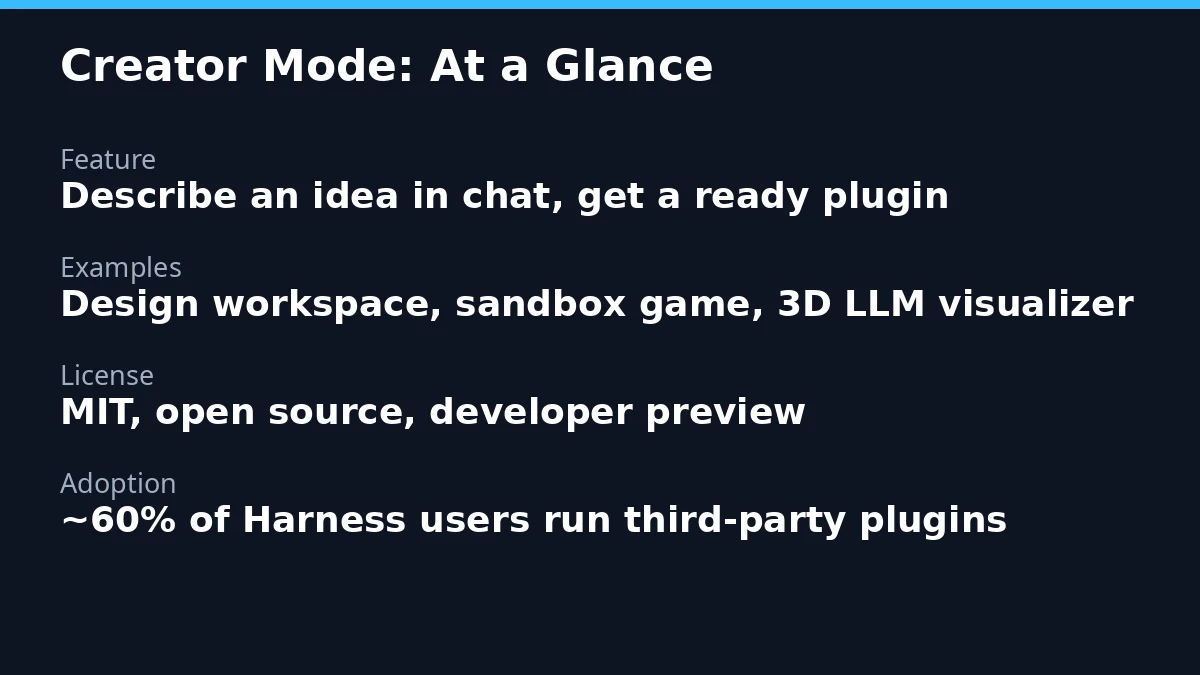
DeepSeek Harness Creator Mode at a glance. Graphic: GPTOnline.