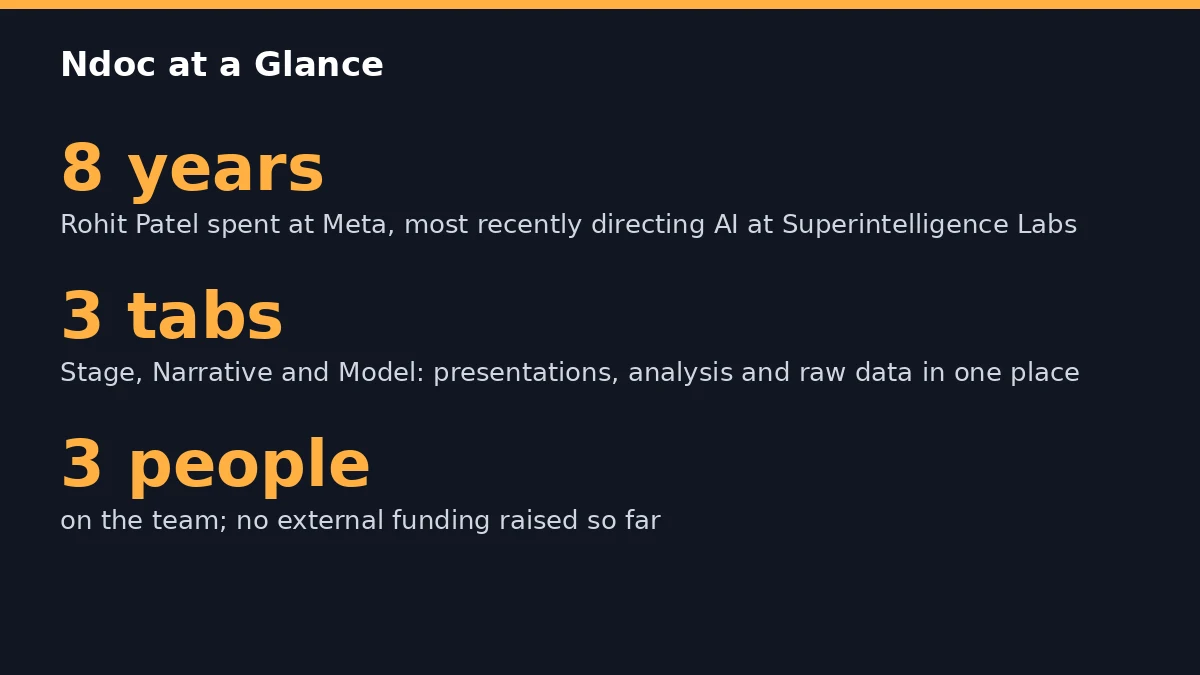
After eight years developing AI at Meta, Rohit Patel is leaving the company to take on two of the biggest names in software. The former director at Meta Superintelligence Labs has launched Ndoc, a startup he is pitching as an AI-native replacement for Microsoft Office and Google Workspace, TechCrunch exclusively reported on October 27. The Rohit Patel Ndoc launch puts a three-person startup on a collision course with two entrenched software giants.
What Is Ndoc
Ndoc is designed to replace the fragmented way people work across spreadsheets, documents, slide decks, dashboards and chatbot copy-paste with one unified workspace. Patel told TechCrunch he finds the current approach of bolting AI onto old software deeply unsatisfying: “Companies are basically attaching AI to spreadsheets and it fills your cells for you,” he said, adding elsewhere that adding AI to spreadsheets “kills my soul.”
The product organizes work into three connected tabs:
- Stage: where presentations of key findings live, including slide decks, dashboards, simulations and mini apps.
- Narrative: written analyses with numbered citations and generated figures, covering the “why” behind the numbers.
- Model: the underlying datasets and Python scripts that generated the results, so anyone can inspect how the numbers were produced.
Crucially, the workspace can be shared with colleagues even if they are not signed up for Ndoc, removing one of the frictions that keeps teams locked into incumbent suites.
Reinventing the File
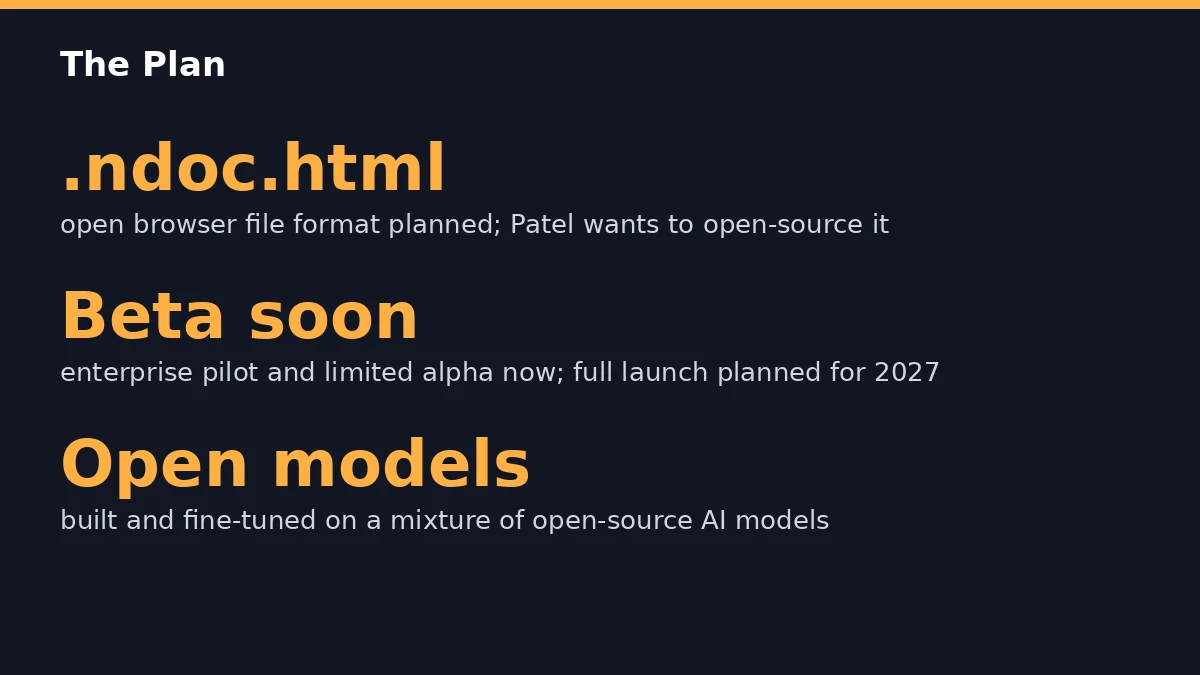
Patel’s larger ambition is to reinvent the document format itself. Ndoc can export documents as a single “.ndoc.html” file that opens in any browser, and he plans to open-source the format so other developers can build compatible apps without being locked into Ndoc the way users have been locked into Microsoft or Google for years.
The platform is built and fine-tuned using a mixture of open-source models, Patel said. At Meta, his work focused on reinforcement learning and on evaluating whether AI output could be trusted, experience that maps directly onto a product whose pitch is trustworthy, verifiable analysis.
Early Days
Ndoc is a deliberately small bet for now: a three-person team that has not raised external funding. The startup is conducting an enterprise pilot and opening a limited alpha to customers on its waitlist. Signup is free, though customers will pay for usage and AI tokens. Patel hopes to release a broader beta in the coming weeks, with a full launch planned for 2027, Dealroom reported.
Why It Matters
Patel is the latest in a string of high-profile departures from Meta, following chief global affairs officer Joel Kaplan, AI researcher Andrew Tulloch and AI-for-work product head Emily Dalton Smith. His exit is notable because it comes from inside Meta’s AI leadership and targets an unusually ambitious prize: not another AI assistant layered on top of existing workflows, but the productivity suite itself.
The bet is that workers want their analysis, explanations and presentations together in one place, not another copilot beside the tools they already use. Whether a three-person, unfunded startup can dent two entrenched monopolies remains to be seen, but the ambition, and the timing, make Ndoc one to watch.