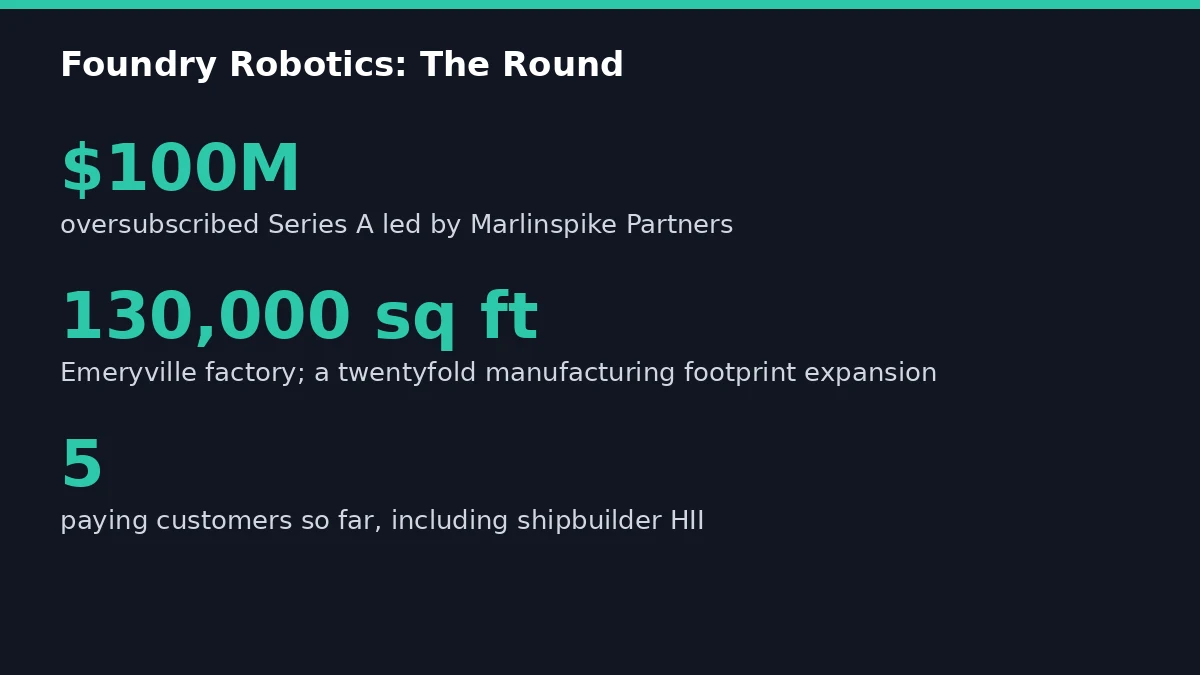
Foundry Robotics has raised $100 million in an oversubscribed Series A round to build what it calls America’s first autonomous factory for assembly, the Emeryville, California-based company announced on October 28.
The round was led by Marlinspike Partners, with participation from early backers Khosla Ventures and Red Glass Ventures, new investors SE Ventures, Wing VC and Axiom Ventures, and existing investors Hanabi and Zero Shot Fund, according to the company’s announcement on Business Wire.
What Was Announced
With the new funding, Foundry will build out its 130,000-square-foot facility in Emeryville, accelerate deployment of AI models into real-world manufacturing, and grow its robotics research, engineering and factory operations teams. The company says it has expanded its manufacturing footprint twentyfold with the new facility.
Foundry builds and operates autonomous factories for complex assembly, combining AI-powered robotic cells with experienced manufacturing teams. Its target applications include drones, autonomous vehicle subassemblies, wire harnesses, underwater vehicles, telecom and data center infrastructure, ground robots, rugged computers, robot compute boxes and satellites.
A Different Factory Model
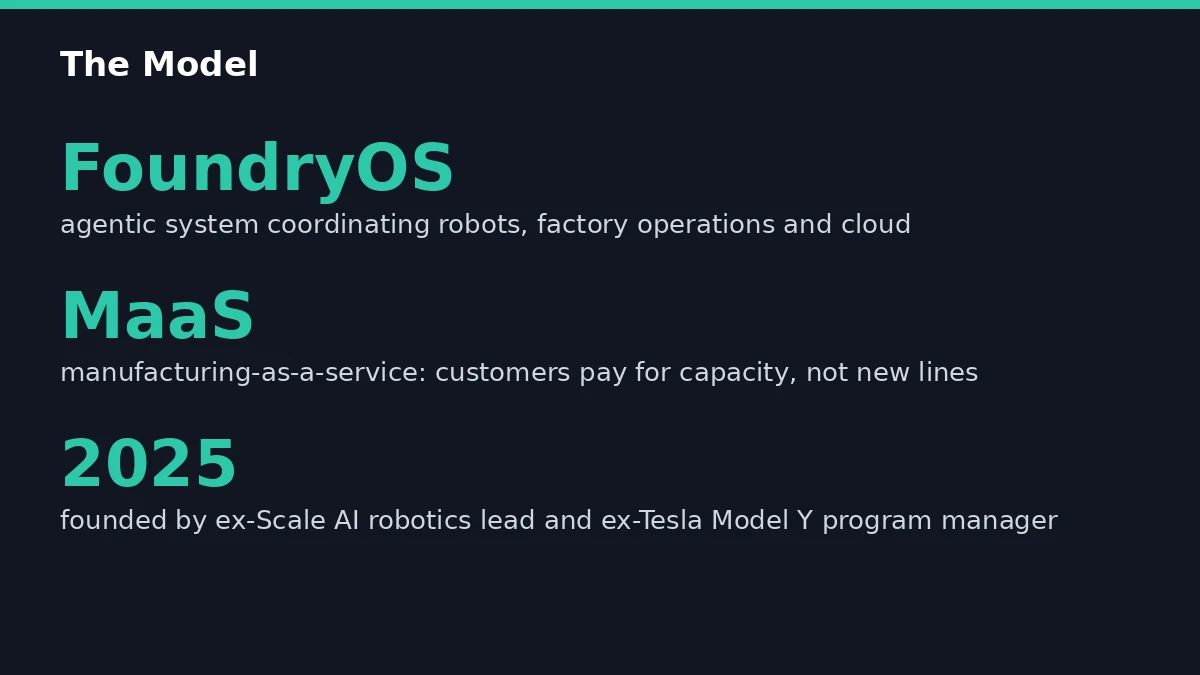
Instead of retrofitting old factories with robotics or selling robots to manufacturers, Foundry builds and operates net-new factories where customers pay to have their products assembled. The company operates under a manufacturing-as-a-service model, owning and operating the manufacturing environment so customers can assemble products without building dedicated production lines.
At the center of the operation is FoundryOS, an agentic system the company describes as a robotic foundation model and operating system that coordinates robotic cells, production schedules and assembly processes across robots, factory systems and cloud infrastructure. The idea, CEO Adarsh Kulkarni told defense publication Tectonic, is flexible automation that can adapt to new products without costly retooling: the same robotic cells can be reconfigured for different manufacturing tasks.
The company says it already has five paying customers, including shipbuilding giant HII, its first publicly announced customer. HII tapped the startup to help scale production of smaller unmanned systems, with potential work on subassemblies for larger vessels also under discussion.
The Team and the Bet
Foundry was launched last year by Kulkarni, who previously headed up AI training giant Scale AI’s robotics business, and Emmanuel Lamacchia, the former program manager for Tesla’s Model Y program. The pair raised a $20 million seed round in January before the Series A.
“The next era of industrial strength will belong to nations that can turn new designs into finished hardware the fastest,” said Mislav Tolusic, Managing Partner at Marlinspike Partners, in the announcement.
Some framing deserves care: Foundry’s description of its project as “America’s first autonomous factory for assembly” is the company’s own positioning, and its claim that customers can move from design to production in weeks remains a company statement rather than an independently verified timeline. The company has not disclosed production volumes or customer contract values, Intelligent CIO noted.
Why It Matters
The round is the latest sign of investor appetite for physical AI and domestic manufacturing capacity. Foundry’s financing landed in a week that also saw $600 million for autonomous construction startup Bedrock Robotics and $2.1 billion for manufacturing startup Re:Build, Crunchbase News reported, as capital flows toward companies promising to rebuild American industrial capacity with AI-driven automation.
Sources
- Foundry Robotics via Business Wire: Foundry Robotics Raises $100 Million Series A (Oct 28, 2026)
- Tectonic: Foundry Robotics Raises $100M Series A (Oct 29, 2026)
- Crunchbase News: The Week’s 10 Biggest Funding Rounds (Oct 30, 2026)
- Intelligent CIO: Foundry Robotics raises US$100 million (Oct 30, 2026)