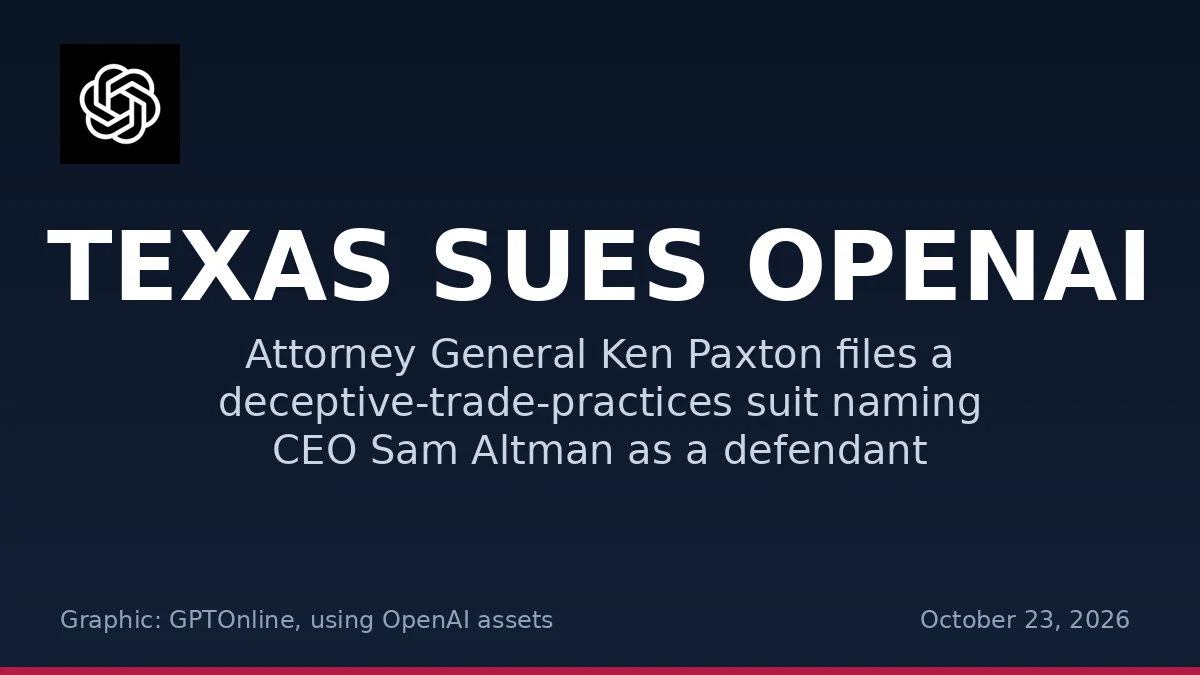
Texas Attorney General Ken Paxton has sued OpenAI and its chief executive Sam Altman, accusing the company of deceiving consumers about the safety of ChatGPT while rushing the chatbot to market. The lawsuit, announced Friday, October 23, was filed in a Collin County district court and names OpenAI Global, LLC, its affiliated entities, and Altman personally as defendants.
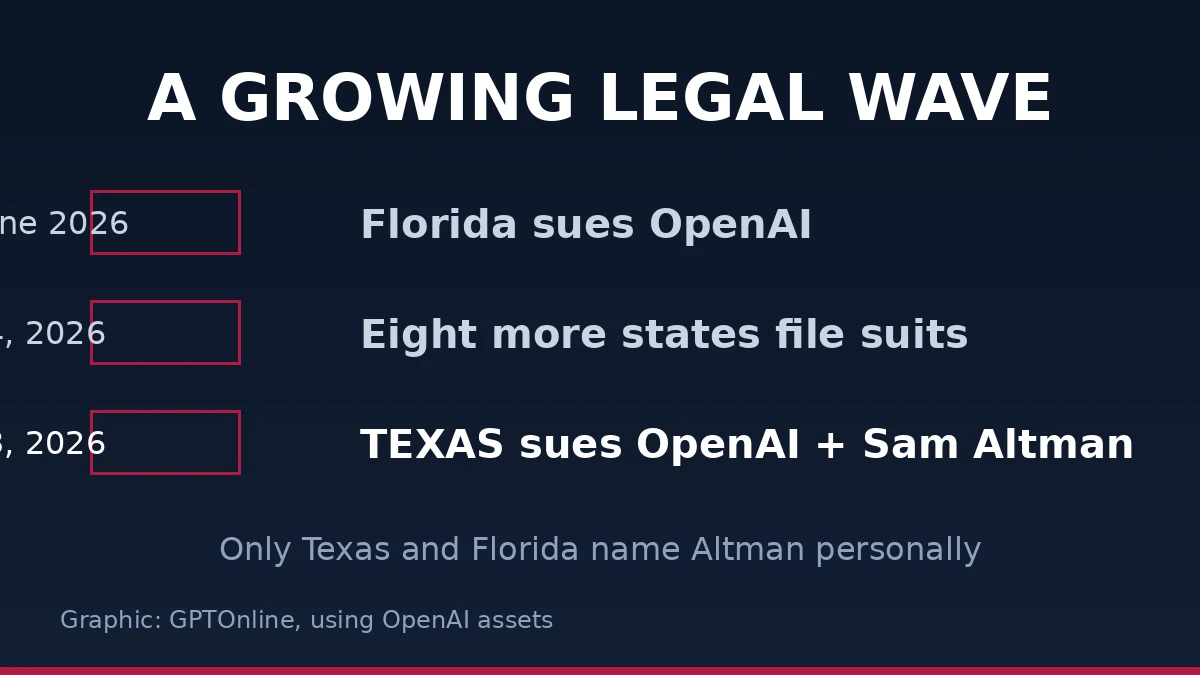
The case makes Texas the 10th state to take legal action against OpenAI this year, following Florida’s suit in June and separate filings by eight states on October 14. According to coverage of the filings, Texas and Florida are the only two states to name Altman as an individual defendant, a move that signals prosecutors want accountability attached to a person, not just a corporation.
Graphic: GPTOnline, using OpenAI assets
What Was Announced
Paxton’s office brings claims under two Texas statutes: the Texas Deceptive Trade Practices, Consumer Protection Act (DTPA) and the Securing Children Online through Parental Empowerment Act (SCOPE Act), which sets safety and parental-control requirements for digital services used by minors.
The core allegation is a gap between promise and product. The attorney general’s press release says OpenAI was founded in 2015 as a nonprofit promising “to advance digital intelligence in the way that is most likely to benefit humanity as a whole, unconstrained by a need to generate financial return,” but abandoned that mission in a rush for commercial growth and, in the state’s words, gave ChatGPT “a careless introduction” to Texas and the world.
“With the rapid advancement of AI technology, OpenAI has the responsibility to protect users and warn them of the many dangers of its platform,” Paxton said in the release. “I will fight to protect Texans from the harms of AI and ensure that powerful technology companies are not above the law.”
The Harms Texas Alleges
The complaint lists a catalog of alleged harms from reliance on what the state calls undertrained and inadequately safeguarded chatbot technology. Among them: mass shooters aided and abetted in deadly rampages, vulnerable users encouraged toward suicide, professionals publicly humiliated by false outputs, users losing critical thinking skills, and minors becoming addicted to a tool the state says “fakes human compassion to collect their data with no parental oversight.”
Because ChatGPT generates responses based on user input, the state argues, its outputs can be inaccurate or harmful without adequate warning, and OpenAI failed to disclose that risk. Bloomberg Law’s reporting notes the suit frames these as the foreseeable result of prioritizing the AI arms race over safety.
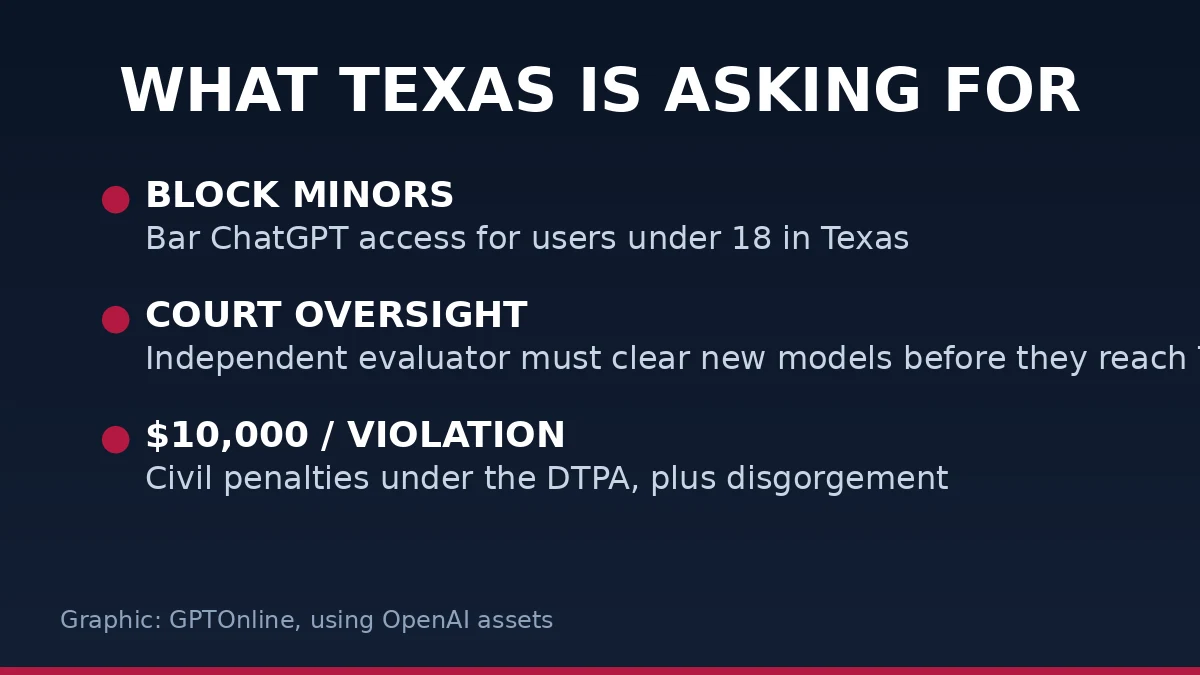
Graphic: GPTOnline, using OpenAI assets
What Texas Is Asking For
Beyond money, the remedies Paxton seeks could reshape how OpenAI operates in the country’s second most populous state. The suit asks the court to bar ChatGPT access for minors in Texas and to require a court-approved independent evaluator to review the safety guardrails of any new OpenAI model before it can be offered to Texas users. On the financial side, the state seeks civil penalties of $10,000 per violation, disgorgement of assets, and a jury trial, according to summaries of the petition.
Why It Matters
This case tests how far existing consumer protection laws can stretch to cover generative AI. The DTPA was not written with chatbots in mind, and if Texas succeeds in applying it to ChatGPT, the same playbook becomes available to nearly every state with a similar statute, and most states have one. It also lands as OpenAI faces pressure on multiple fronts at once: federal scrutiny of its safety practices, this week’s growing docket of state suits, and a broader industry debate over how much oversight frontier labs should face before shipping new models.
Paxton has a track record of extracting large settlements from tech giants, including a $1.4 billion biometric-privacy settlement with Meta and $1.375 billion in combined settlements with Google over location and biometric data collection. Whether the OpenAI suit ends in a courtroom, a settlement, or a template other states copy, it marks the moment state regulators stopped treating AI safety as a federal-only conversation.
Sources
- Office of the Texas Attorney General, press release, October 23, 2026
- Bloomberg Law, “Texas AG Sues OpenAI, Altman for Negative Effects on Consumers,” October 23, 2026
- Bloomberg Tax, “Texas Sues OpenAI, Altman Over User Deception, Child Safety,” October 23, 2026
- Crypto Briefing, “Texas Attorney General Ken Paxton sues OpenAI and Sam Altman over ChatGPT safety claims,” October 23, 2026