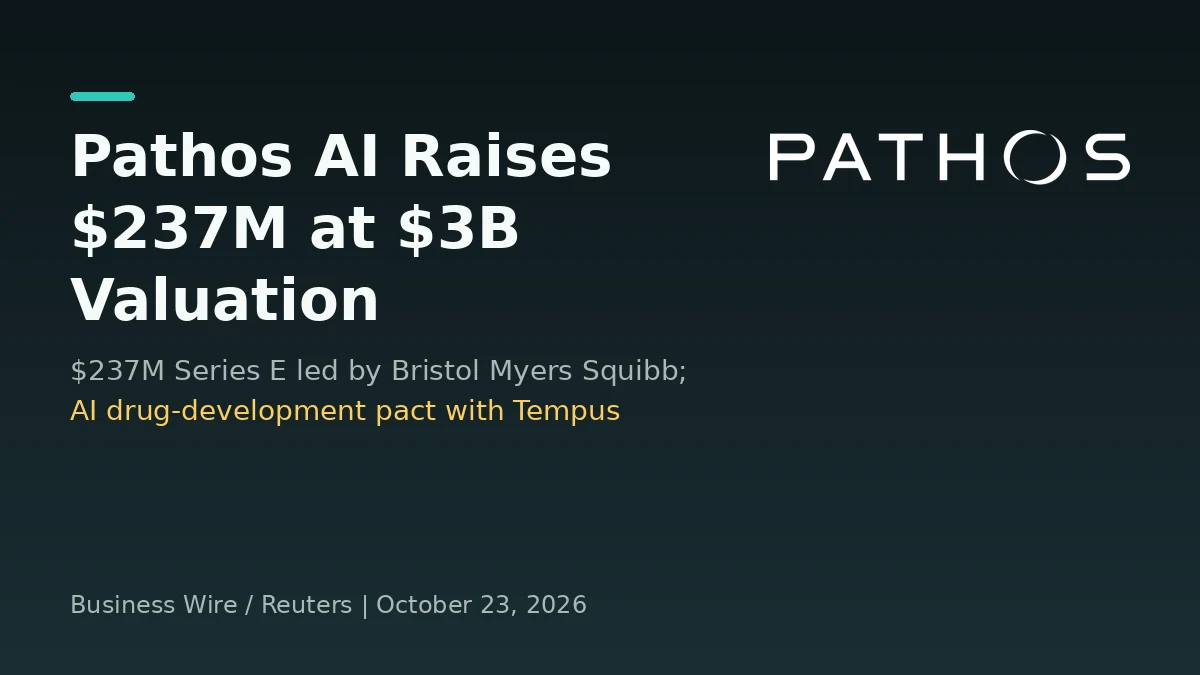
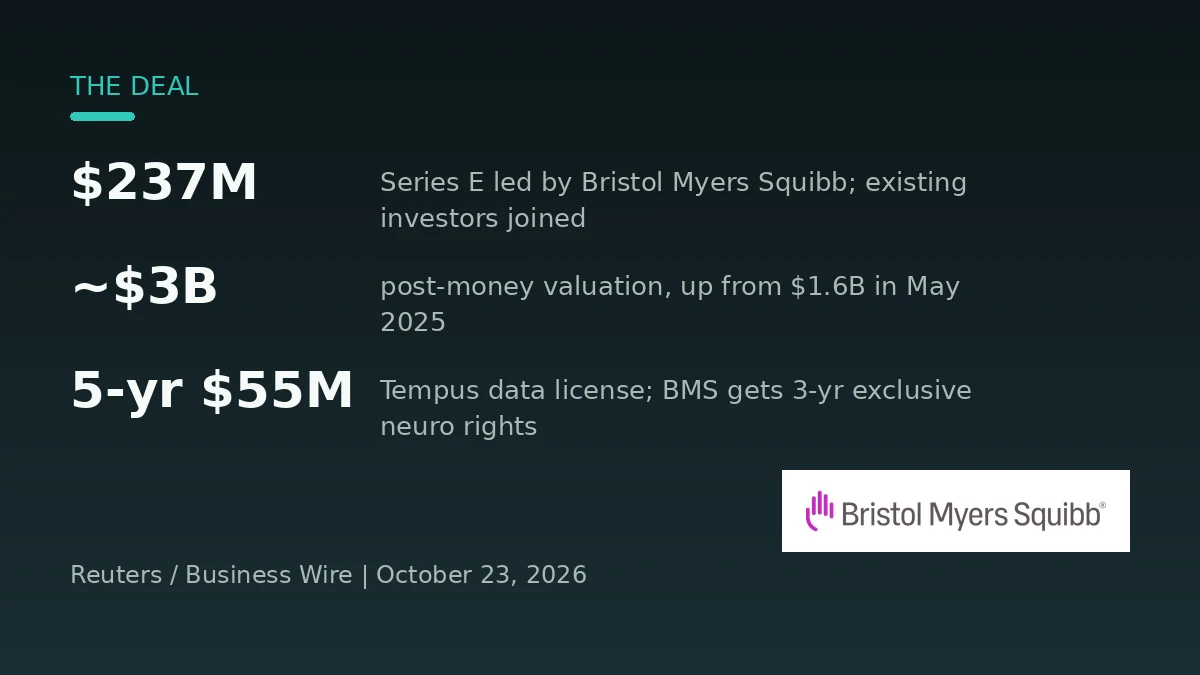
Pathos AI, a New York clinical-stage company that designs drugs with artificial intelligence, said on Friday it has closed a $237 million Series E financing round at a post-money valuation of approximately $3 billion. The round was led by Bristol Myers Squibb, with participation from existing investors, the company announced in a Business Wire press release. The valuation is nearly double the $1.6 billion mark Pathos carried in May 2025, Axios reported.
The financing landed alongside a second, arguably more strategic announcement: Pathos has teamed up with Bristol Myers Squibb and Tempus AI to build AI tools for drug development in Alzheimer’s disease and other neurological disorders, Reuters reported. The triple pact turns a marquee pharma investor into a platform customer on the same day it writes the biggest check.
What Was Announced
Under the collaboration, Tempus AI will assemble a dataset from hundreds of thousands of patients with neurological disorders to track outcomes and speed research into disease biology. Pathos will license that data under a five-year, $55 million agreement and apply its AI platform, Pathos Foundry, to study the dataset at scale, generate and test hypotheses about disease biology, and inform the design of more targeted, adaptive clinical trials.
Bristol Myers Squibb, in turn, gains non-exclusive strategic access to Foundry across its broader portfolio, plus three-year exclusive rights to use the platform for its neuroscience development programs. The structure gives BMS a front-row seat to an AI engine it just helped fund at a $3 billion valuation.
Graphic: GPTOnline, using Pathos AI and Bristol Myers Squibb assets
Foundry: Thousands of AI Agents Scoring Drug Bets
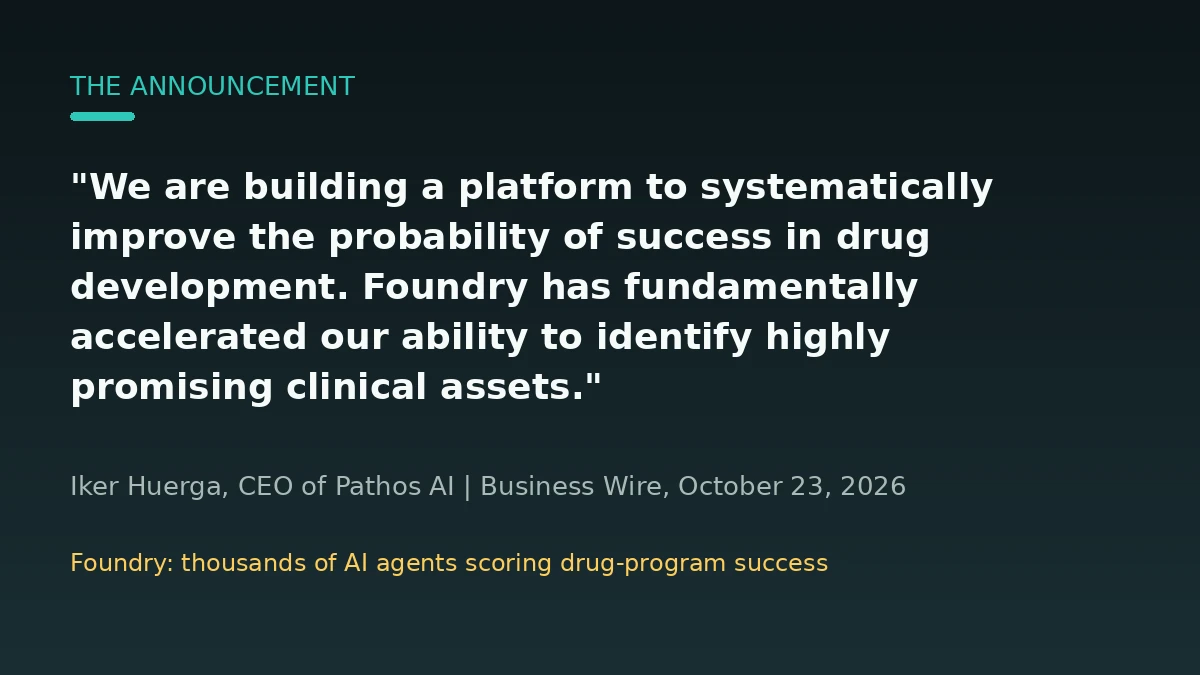
Pathos describes Foundry as a proprietary platform operated by thousands of specialized AI agents that aggregate the totality of information for a drug program in real time. By continuously synthesizing clinical data, genomics, biological specimen data and the competitive landscape, Foundry identifies what the company calls the optimal next decision for a program, pinpoints precise biological subpopulations, steers clinical trial pivots and kills high-risk development paths early.
“We are building a platform to systematically improve the probability of success in drug development,” said Iker Huerga, CEO of Pathos, in the announcement. “Foundry has fundamentally accelerated our ability to identify highly promising clinical assets and integrate them into our pipeline. This capital allows us to rapidly scale our AI engine while actively steering our current programs toward key clinical milestones, ensuring we deliver the right therapies to the right patient populations.”
The company says it has used Foundry to expand its clinical-stage oncology portfolio to four active assets through a series of rapid transactions over the past several months.
Where the Money Goes
Proceeds will scale Foundry’s capabilities and accelerate the AI-steered pipeline. The lead program is JSKN016, a first-in-class TROP2/HER3 bispecific antibody-drug conjugate, which Pathos wants to move toward registrational studies. The money will also advance pocenbrodib in metastatic castration-resistant prostate cancer and relapsed or refractory multiple myeloma; AZD4241, a novel ER PROTAC developed with AstraZeneca; and DO-2, a next-generation MET kinase inhibitor.
The raise came in below the $300 million Pathos had reportedly targeted for the round, but at the post-money valuation the company wanted, Endpoints News reported. Existing investors joined BMS in the Series E.
Graphic: GPTOnline, using Pathos AI and Bristol Myers Squibb assets
Why It Matters
The deal is a bet that AI can fix drug development’s brutal economics, where most drugs that enter clinical trials never reach patients. Pathos’s pitch is that continuously updated probability-of-success calculations let it pick better assets, better patients and better trial designs. Having one of the world’s largest drugmakers both fund the platform and license it for neuroscience is the strongest validation of that pitch to date.
It also continues a busy month for AI-driven biotech capital. Former OpenAI science chief Kevin Weil’s Warp Sciences raised $215 million earlier this week to build AI-robotics wet labs for drug discovery, as GPTOnline reported. The Pathos round, at a higher valuation and with a pharma strategic lead, suggests the largest incumbents are now buying into the AI-native lab model rather than just watching it.
Sources
- Pathos AI press release via Business Wire: “Pathos AI Secures $237 Million in Series E Financing” (October 23, 2026)
- Reuters: “Pathos AI teams up with Bristol Myers and Tempus AI to advance drug development” (October 23, 2026)
- Axios, via Techmeme: “Pathos AI raised a $237M Series E at a $3B post-money valuation” (October 23, 2026)
- STAT News: “AI drugmaker Pathos, in deal with Bristol, hits $3 billion valuation” (October 23, 2026)
- Fierce Biotech: “BMS leads Pathos’ $237M series E alongside Alzheimer’s link-up” (October 23, 2026)
- Endpoints News: “Pathos raises $237M at $3B valuation, signs Bristol Myers neuro partnership” (October 23, 2026)