Graphic: GPTOnline, using OpenAI assets
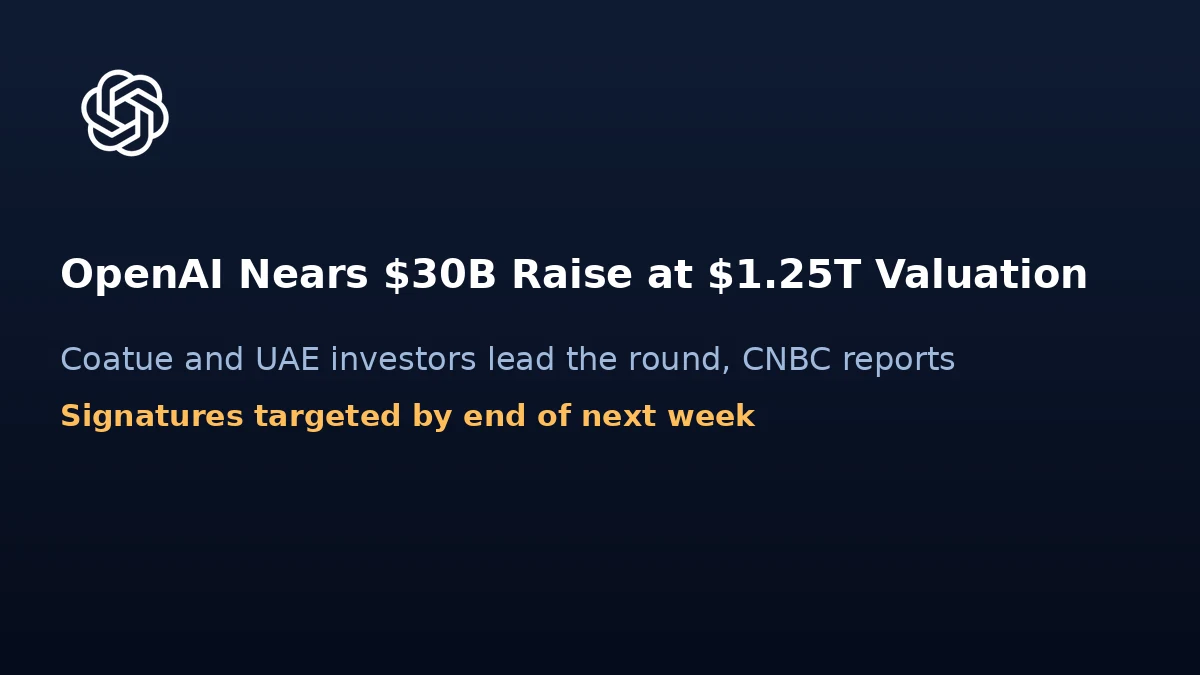
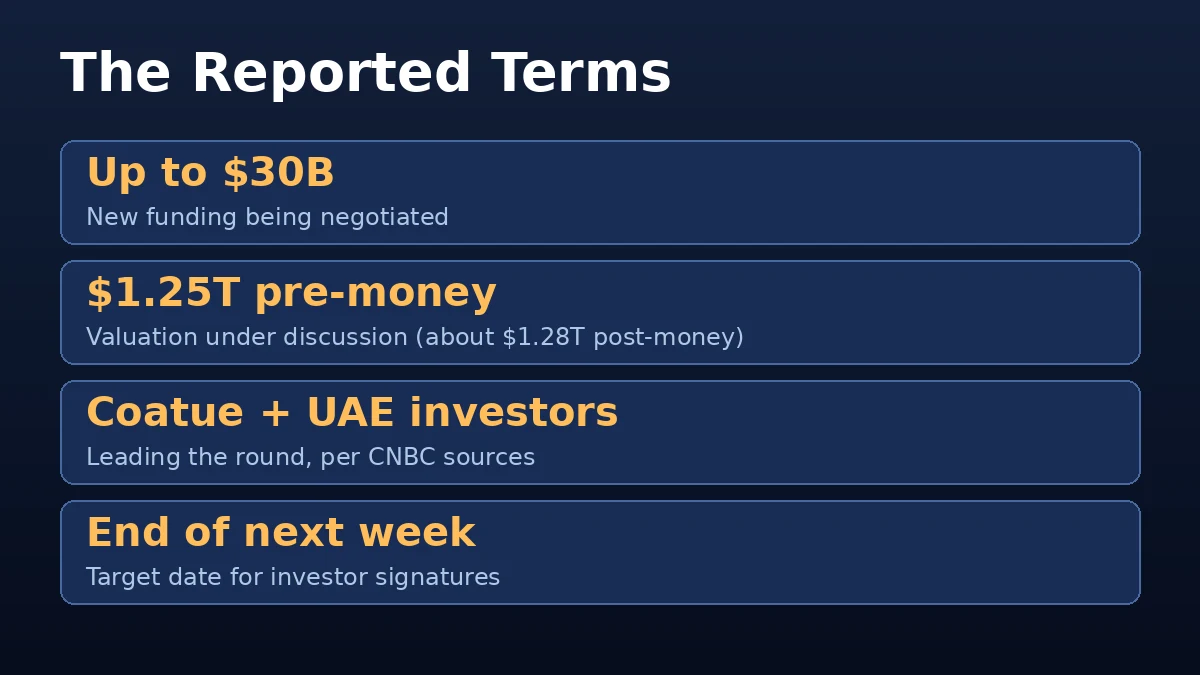
OpenAI is close to locking in one of the largest private fundraisings in technology history. CNBC reported on Thursday that the ChatGPT maker is working on a round of up to $30 billion at a $1.25 trillion pre-money valuation, led by investment firm Coatue and investors from the United Arab Emirates. The company told prospective backers it wants signatures by the end of next week, though the final size of the round is still being worked out.
As TechCrunch summarized the report: “OpenAI is reportedly close to securing another mega round of private funding, rather than plowing ahead with an IPO.” OpenAI declined to comment on the report, and none of the headline figures has been confirmed by the company.
What the Latest Reporting Says
The CNBC report, first picked up by TechCrunch and corroborated by outlets including Seeking Alpha, adds several new details to a fundraise that has been taking shape for weeks:
- Named leaders: Coatue and UAE-based investors are leading the round, according to people familiar with the talks.
- A revised price tag: the $1.25 trillion pre-money figure is below the $1.4 trillion valuation Bloomberg floated a month ago for what appears to be the same raise, a sign that terms are still moving.
- A deadline: OpenAI told investors on Thursday it aims to secure signatures by the end of next week.
- More than money: the UAE investment could be coupled with a separate commercial deal giving OpenAI access to additional computing capacity from the Gulf state.
Graphic: GPTOnline, using OpenAI assets
This is not the first version of this story to surface. GPTOnline reported on October 20 that Reuters had described OpenAI accelerating a roughly $30 billion raise at a valuation above $1.4 trillion. The CNBC account is best read as an update on those talks, with sharper terms and a concrete timeline, rather than a separate round.
The Numbers in Context
The $1.25 trillion figure is a pre-money valuation, meaning it excludes the new cash. If the full $30 billion comes in, OpenAI would be worth about $1.28 trillion once the round closes. As TechCrunch put it: “Should OpenAI command a valuation of more than $1 trillion with this round, it would break records as the most valued private company ever.”
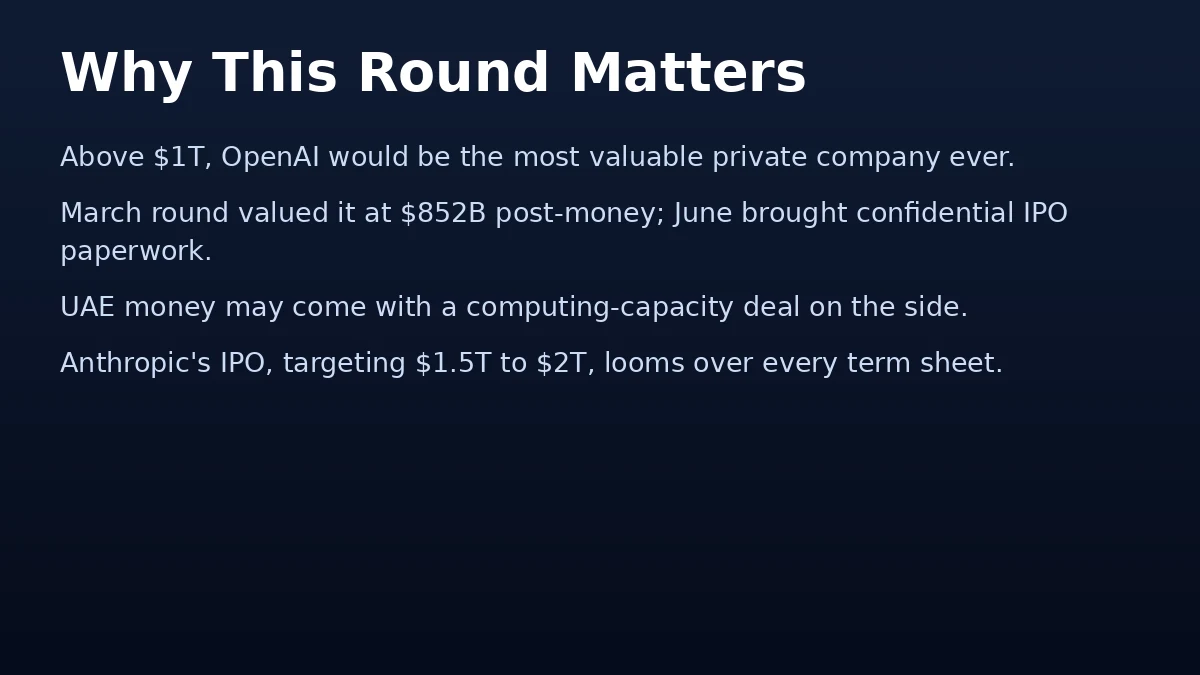
The round would follow OpenAI’s March financing, which valued the company at $852 billion post-money, and its confidential IPO filing in June. It is being pitched as an opportunistic bridge ahead of a potential public listing: CFO Sarah Friar has told staff a listing would likely arrive in 2027, according to CNBC’s reporting.
Graphic: GPTOnline, using OpenAI assets
The deeper logic is compute. OpenAI has previously told investors it expects to spend roughly $600 billion on computing infrastructure by 2030, and the possible UAE compute deal alongside the equity round underlines where the money goes: chips and data centers, not headcount.
Why It Matters
Every term in this negotiation now lands in the shadow of Anthropic’s expected public debut. Anthropic, which raised $65 billion at a $965 billion valuation in May, is reportedly targeting a $1.5 trillion to $2 trillion valuation for an IPO expected as soon as mid-November, with Reuters reporting the company plans to begin marketing shares during the week of November 9.
An OpenAI round at $1.25 trillion pre-money would set a formidable benchmark for its rival, and vice versa. The two companies filed confidential IPO paperwork in the same month, and whichever moves first will define how public markets price frontier AI labs.
The caveat, as always with anonymous-source deal reporting: both CNBC and Bloomberg stress that terms are still being negotiated and could change. Until signatures land, treat every number as a negotiating position, not a fact.
Sources
- TechCrunch: OpenAI working on new $30B raise at $1.25T valuation ahead of IPO (October 22, 2026)
- Seeking Alpha: OpenAI closes in on $30B funding round to reach $1.25T valuation (October 22, 2026)
- Reuters: Anthropic IPO stands alone as AI market jitters sideline others (October 22, 2026)
- GPTOnline: OpenAI Races to Raise $30 Billion Ahead of Anthropic’s IPO, Reuters Reports (October 20, 2026)