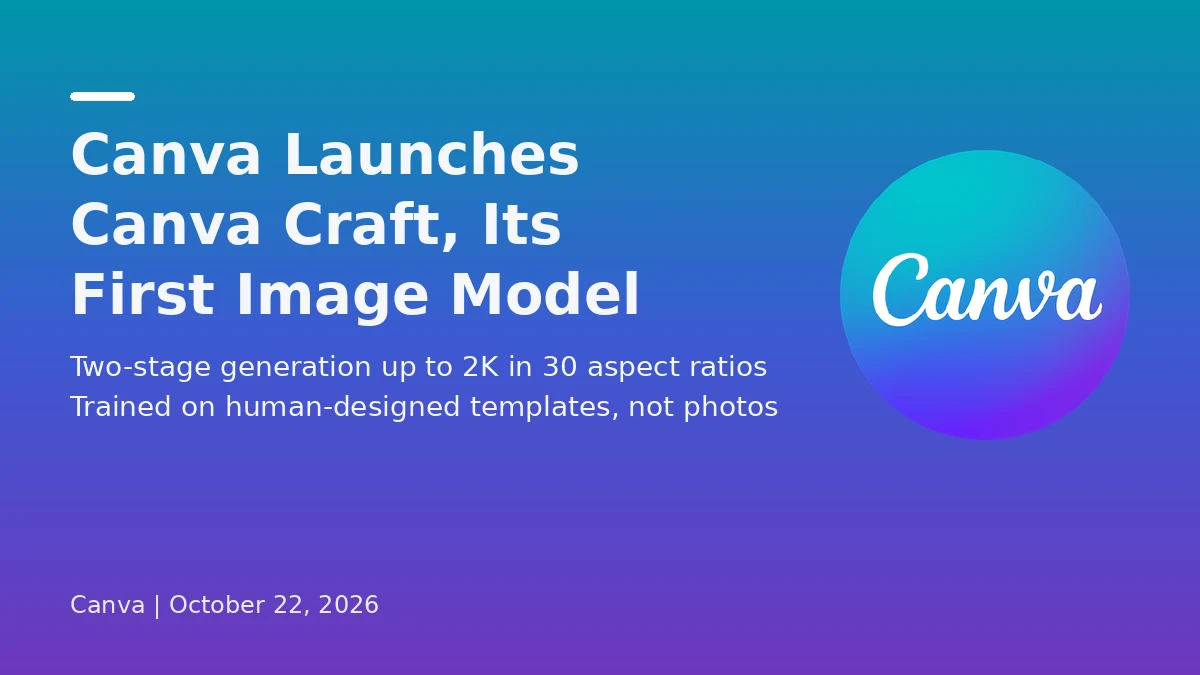
Canva has released Canva Craft, its first image generation model built in house by the company’s research team, putting the design platform in direct competition with image models from Google, OpenAI, ByteDance, and Meta. The model, which launched on October 22, 2026, takes an unusual approach: it plans each image as a structured design before rendering it, and it was trained on human-made design templates rather than photographs, according to TechCrunch.
What Was Announced?
Canva Craft works in two stages. First, the model reads the user’s prompt and draws up a detailed plan covering spatial relationships between elements, relative scale, visual hierarchy, and the text the image needs to show. Then, a rendering model turns that plan into a finished image at up to 2K resolution in as many as 30 different aspect ratios for different platforms.
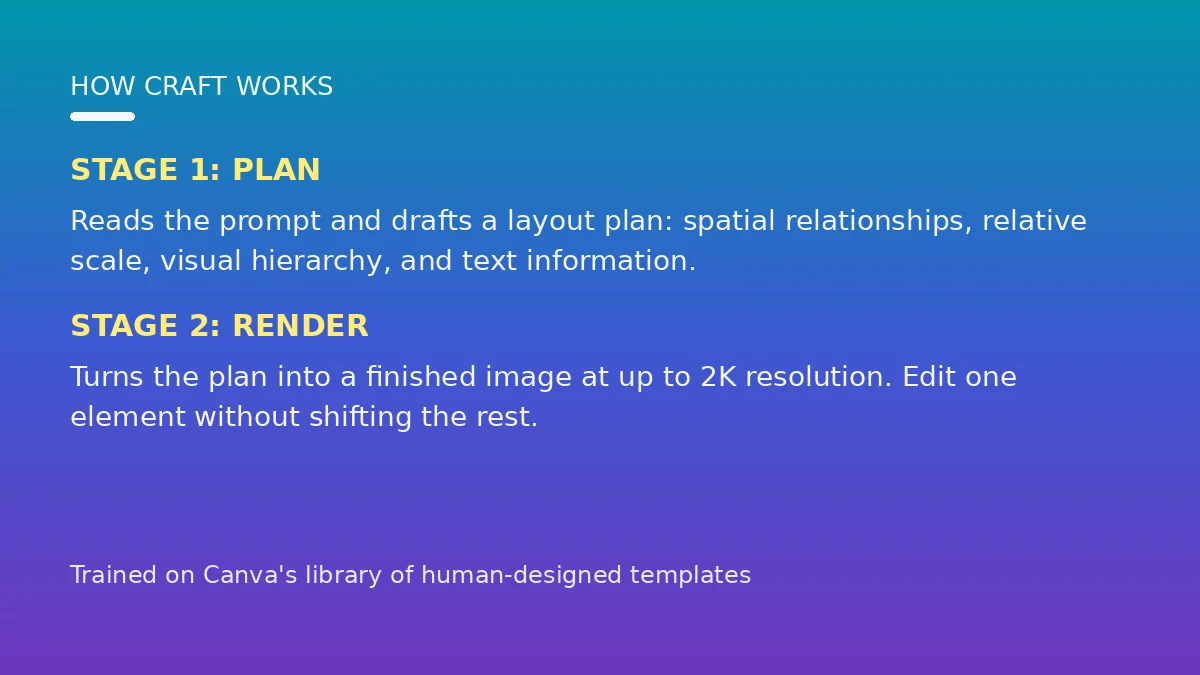
Graphic: GPTOnline, using Canva assets. Craft plans the layout first, then renders the image.
The company said this two-step process produces images with accurate object details and legible text, and lets users make precise edits to one element without changing the rest of the image. That last point matters: AI image generators are notorious for mangling text, and text-heavy formats like posters and social graphics are exactly where Canva’s users live.
Training data is another departure. Instead of photographs, Canva trained Craft on human-designed templates from its own library, including posters, social posts, presentations, infographics, menus, and typography-rich layouts. Because the training data already contains design structure, images made with Craft can be converted into layered designs using Canva Magic, the company’s image-to-design transformer. Canva said it released its own model that understands designs and layers last year, in 2025.
Researchers from Leonardo.ai, the media generation platform Canva acquired in 2024, contributed to the new model.
Availability
Canva Craft is available to all users through the platform’s Dream Lab tab, and it will also be offered through the Canva API. The company plans to support image generation in third-party chatbots such as ChatGPT and Gemini through Canva’s MCP, a move that would put Craft inside the tools where millions of people already ask AI to make images.
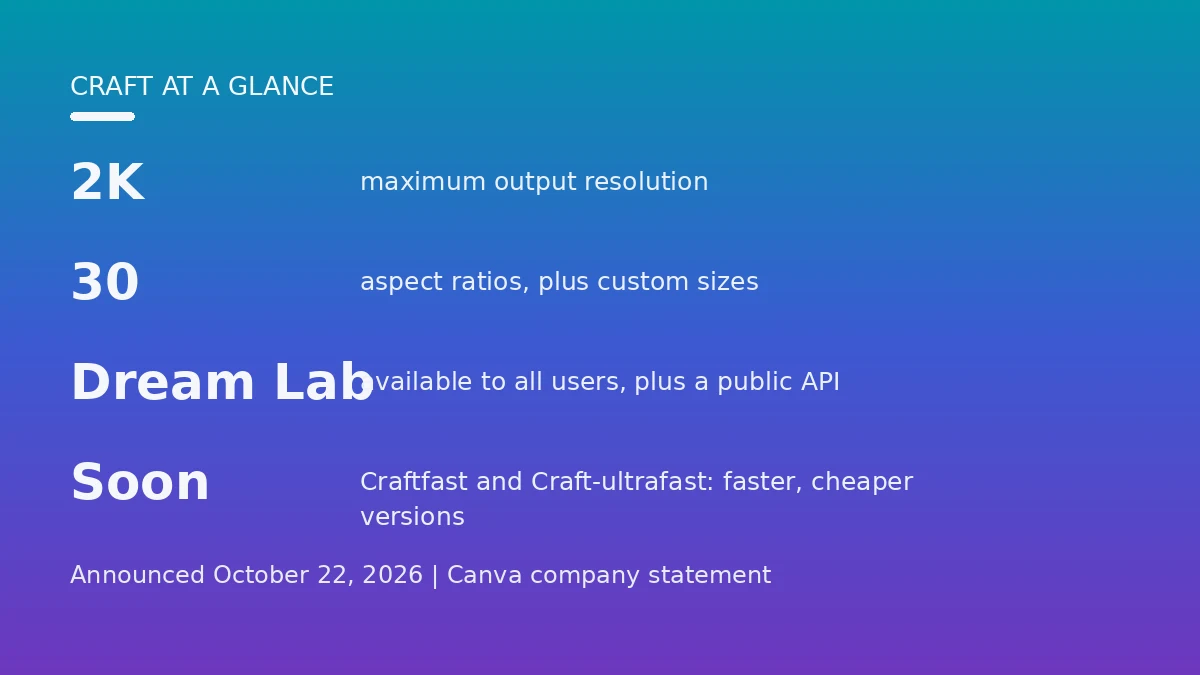
Graphic: GPTOnline, using Canva assets. Craft at a glance.
Canva also said it is developing two more cost-efficient versions, Craftfast and Craft-ultrafast, which it plans to release in the near future.
Why It Matters
Canva has offered AI image generation on its platform for a while, but until now it relied on third-party models. Owning the model changes the economics and the control: Canva said the new model will help it better control the quality and speed of the service, as well as reduce spending on other companies’ APIs, AI Parabellum reported.
The launch comes at a moment of scrutiny for the company. Canva was on track to generate $4 billion in revenue in 2025, according to earlier reporting, but it subsequently reduced its 2026 growth forecast, and external analysts reported its valuation had fallen from $42 billion to $35 billion, Innovation Village noted. An in-house image model could help Canva manage the costs of running AI features at scale, though the company has not disclosed how much it expects to save with Canva Craft.
The design-first framing also differentiates Craft from general-purpose image models. Rather than competing on pure photorealism, Canva is positioning image generation as part of a broader design workflow: generated images flow straight into layered, editable designs instead of arriving as flat files. If the two-stage planning approach delivers on the promise of reliable text and stable layouts, it could become a template for how other creative platforms build their own models.
Sources
- Canva releases its first image generation model, TechCrunch, October 22, 2026
- Canva Craft: Canva Launches Its First AI Image Model, AI Parabellum, October 22, 2026
- Canva Launches Its First AI Image Model, Canva Craft, Innovation Village, October 22, 2026
- Canva launches its own image generation model, Canva Craft, Oossa, October 22, 2026