
Kevin Weil, the former OpenAI executive who led the ChatGPT maker’s AI-for-science efforts, is back with a new company. Warp Sciences emerged from stealth on October 22, 2026, announcing $215 million in funding at an $865 million post-money valuation, Bloomberg reported.
The startup wants to automate one of the most labor-intensive stages of drug discovery: the wet-lab work of making and testing thousands of variations of promising molecules. Instead of outsourcing that chemistry to contractors overseas, Warp is building robotic labs in the United States, where AI models learn from every experiment.
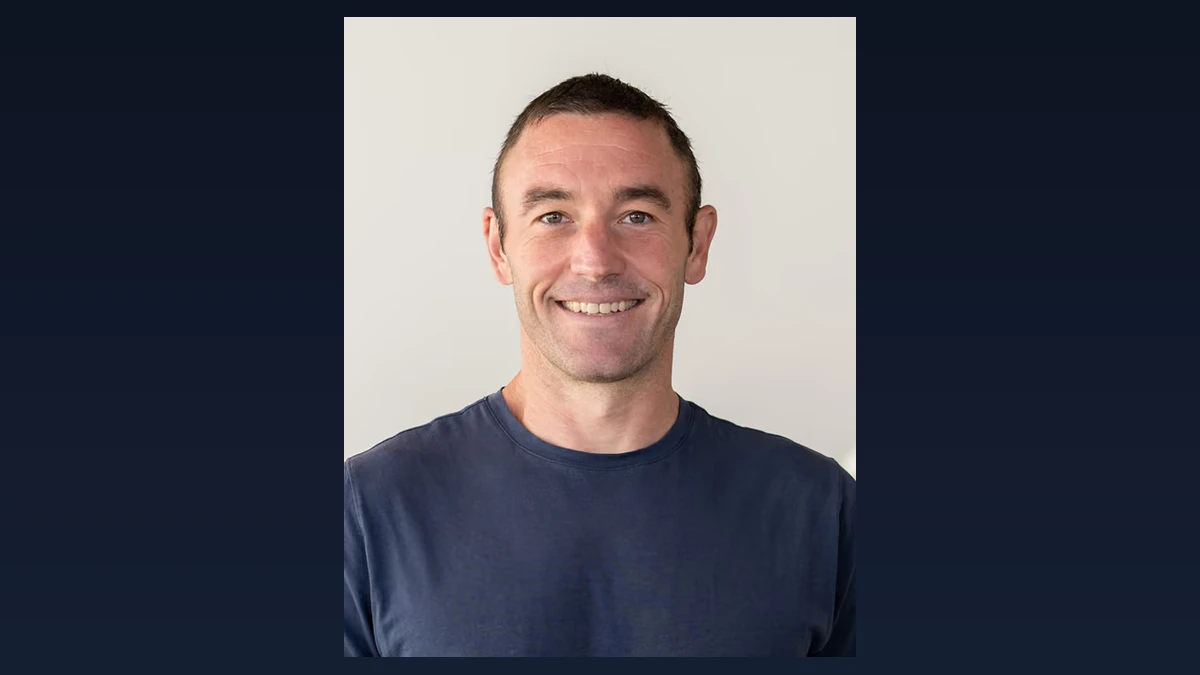
Kevin Weil, co-founder and CEO of Warp Sciences. Image: Warp Sciences
What Was Announced
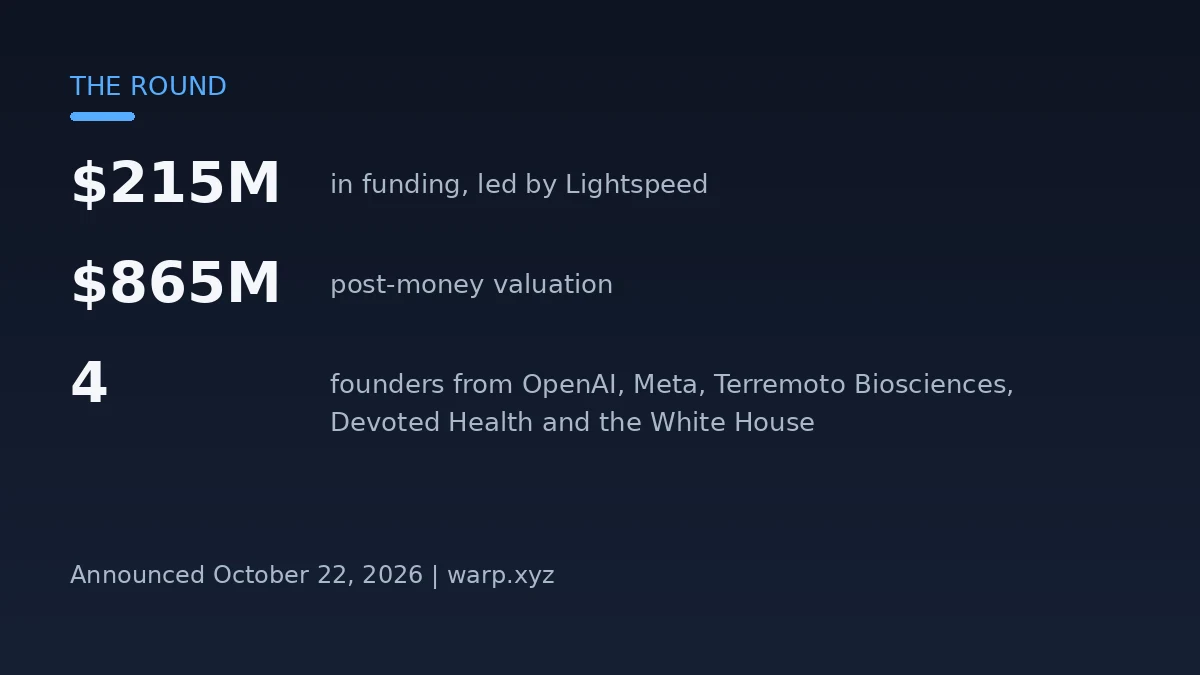
The round was led by Lightspeed Venture Partners, with IVP, Premji Invest and Lux Capital also participating, according to Bloomberg. Warp’s own About page additionally lists Mayfield and Menlo Ventures among its backers. The company confirmed the $215 million figure and the $865 million valuation, TechCrunch reported.
Weil is joined by three co-founders: DJ Patil as chief operating officer, Sol Reisberg as chief scientific officer and Manohar Paluri as chief technology officer, according to the company’s website. The team brings experience from OpenAI, Terremoto Biosciences, Meta, Devoted Health and the White House.
The angel roster reads like a who’s who of tech: OpenAI CFO Sarah Friar, Coinbase CEO Brian Armstrong, Palantir CTO Shyam Sankar and LinkedIn co-founder Reid Hoffman all participated, per Warp’s own site.
Graphic: GPTOnline
Robots Trained by Chemists
Warp’s first service focuses on lead optimization analog synthesis, the process of producing and testing hundreds or thousands of variants of a promising molecule to improve its effectiveness and limit harmful side effects.
Experienced chemists will guide experiments while wearing cameras and sensor gloves, capturing training data as they work, according to TechCrunch. The goal is a fully automated laboratory: AI models trained on data from physical experiments, running robots that can operate around the clock.
“AI has dramatically accelerated software engineering and mathematics, but it has yet to make the same impact in the physical sciences,” Weil said in the company’s announcement. “Chemistry and biology move forward when you make something, test it and learn from the result. If we want to build more capable AI for science, we need to generate real-world data at scale.”
Bringing Chemistry Home
A central pitch is geography. Much of this foundational chemistry work is currently handled by Chinese contractors such as WuXi AppTec, and Weil says early customers want an alternative. “Our early customers are interested in moving their drug discovery work back to the US for commercial, IP, and geopolitical reasons,” Weil told RuntimeWire in an email sent hours after the launch.
“I’ve worked with overseas chemistry partners that delivered speed and value, but I still worried about protecting the intellectual property behind our programs,” said Sol Reisberg, Warp’s co-founder and chief scientific officer. “We’re building Warp to give drug hunters that same caliber of chemistry services in the U.S., with IP protection at the center of the relationship, and without the price premium that U.S. boutique CROs currently demand.”
The timing is not accidental. The BIOSECURE Act, signed in December 2025, set up restrictions on federal procurement involving designated biotechnology companies of concern, pushing US biopharma to rethink where sensitive research happens.
Why It Matters
The launch extends a broader shift of AI talent and capital into physical-world science. It also comes days after OpenAI acquired drug-development startup Orchestra Bio for its Rosalind life-sciences platform, a sign that the biggest AI labs see biology and chemistry as the next frontier for agentic AI.
For Weil, the bet is that the same playbook that transformed software engineering, more data, tighter feedback loops and automation, can work in a physical lab. Warp has no proprietary drug pipeline of its own, the company says; it is building the infrastructure for the research teams discovering new medicines.
Sources
- Bloomberg: Ex-OpenAI Science Head Launches Startup With $215 Million
- TechCrunch: Former OpenAI science lead launches Warp Science to automate wet labs with robots
- Warp Sciences official site: warp.xyz
- Business Wire: Warp Sciences Emerges From Stealth With $215 Million
- RuntimeWire: Kevin Weil says Warp’s early customers want drug discovery back in the US
- Emergent: Kevin Weil Launches Warp Sciences With $215M in Funding


[…] Sciences raised $215 million earlier this week to build AI-robotics wet labs for drug discovery, as GPTOnline reported. The Pathos round, at a higher valuation and with a pharma strategic lead, suggests the largest […]