What Was Released?
NVIDIA has released Cosmos3-H-Dreams, a real-time, action-conditioned generative world model for robotic surgery, on October 20, 2026. The model checkpoint and companion code were published the same day on Hugging Face, in an NVIDIA-authored announcement, Unite.AI reports.
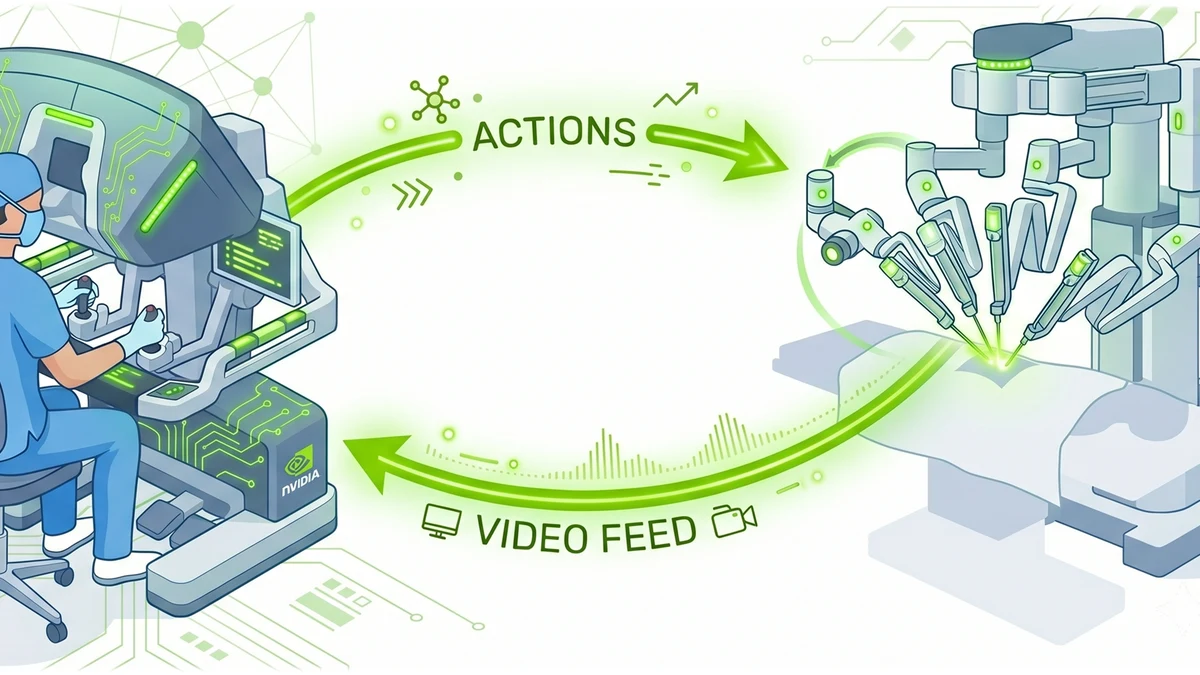
To NVIDIA’s knowledge, this is “the first real-time generative surgical simulator trained on clinical cholecystectomy recordings to support live kinematic control.” Unlike replay-based surgical footage, the system generates scene continuations conditioned on instrument commands: it takes one initial frame from the endoscopic camera, plus a live stream of robot arm commands, and generates the video of what that camera would see next.
The intended uses are surgical robotics policy evaluation in simulation, interactive teleoperated world-model exploration, and synthetic data generation for robotic cholecystectomy. The release is aimed at surgical robotics researchers, healthcare AI developers, academic institutions, and surgical robotics companies, and ships under the NVIDIA Open Model License for commercial or non-commercial use.

Key Features and Details
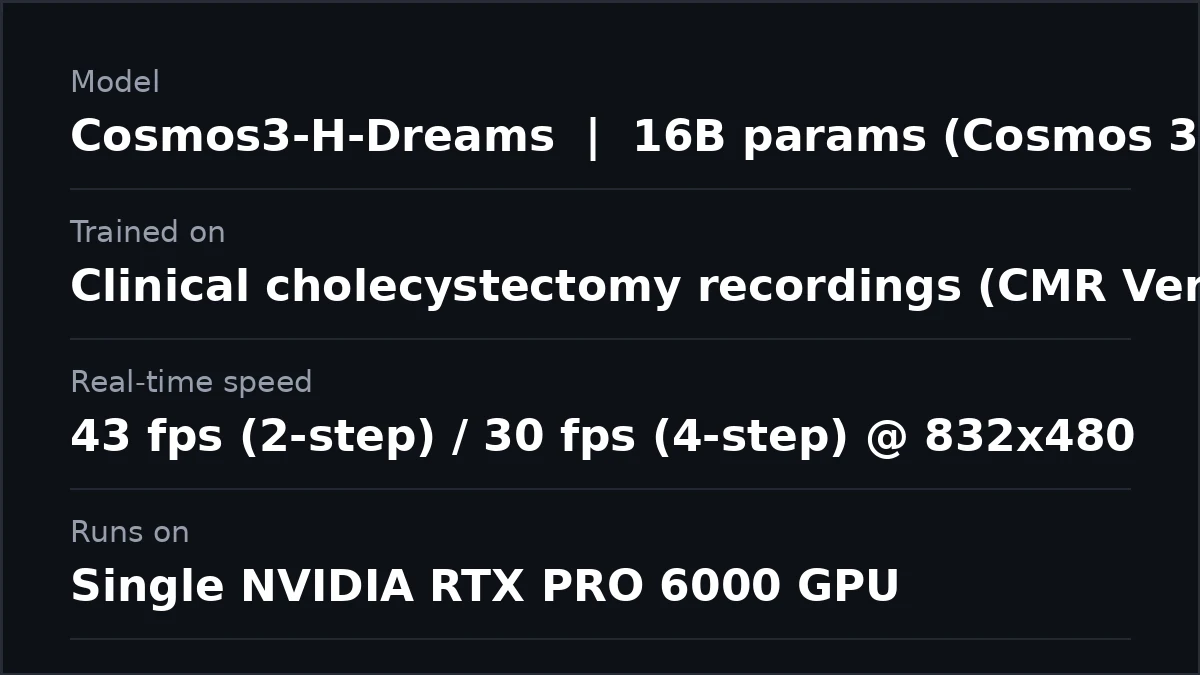
Cosmos3-H-Dreams is built on Cosmos3-H-Embodied-Nano, a 16-billion-parameter model from NVIDIA’s Cosmos 3 world-model family. It was trained on 832 x 480 video with 28 action dimensions aligned at 10 Hz, using synchronized video and robot kinematics recorded during clinical gallbladder-removal procedures (cholecystectomies) on CMR Surgical’s Versius robotic platform. It works with two visible instruments: a Cadiere grasper and a monopolar hook.
Powered by Cosmos 3 and accelerated with FlashDreams, NVIDIA’s streaming-inference library, the model runs interactively on a single NVIDIA RTX PRO 6000 GPU. NVIDIA released two separately trained checkpoints trading speed against quality: a two-step version generating about 43 frames per second and a four-step version at about 30 fps, both at 832 x 480 on the RTX PRO 6000 Blackwell Workstation Edition, IA en un minuto reports.
Control is live through three surfaces: a browser keyboard over WebRTC, a Meta Quest headset over WebXR, and a surgical robot console such as CMR Surgical’s Versius. A learned surgical policy can be dropped into the same loop in place of a human, which is what makes it a closed-loop evaluation environment for robotics research rather than a playback tool.
The release succeeds Cosmos-H-Dreams, built on Cosmos-Predict2.5, which targeted tabletop suturing with the dVRK system. The earlier system proved the concept: learn visual dynamics directly from video and kinematics rather than explicitly modeling geometry, tissue deformation, and physics. The new release moves that approach into clinical scenes, where tissue stretches under traction, reflections shift, structures become occluded, and smoke changes visibility. Distillation, self-forcing, and an adapted FadeMem module address faster generation and error accumulation during longer streaming runs, Superpower Daily reports.
Limits and Caveats
NVIDIA is careful about what this is not. The company states the research system is not validated for patient care, and cautions that visual plausibility does not establish biomechanical accuracy or suitability for clinical use. Its significance is as a controllable simulation testbed for research: clinical use would depend on broader procedure coverage, physical validation, and surgeon-reviewed benchmarks.
Why It Matters
Robotic surgery is one of the domains where simulation has lagged behind ambition. Numerical simulators must hand-author tissue, sutures, and contact physics, which breaks down for the messy reality inside the body. Cosmos3-H-Dreams demonstrates the alternative the industry has been watching: a world foundation model that learns how surgical scenes evolve straight from paired clinical video and robot motion data, then runs fast enough on a single GPU for a human or a policy to steer it live.
That matters for training and testing surgical robots. Today, evaluating a robotic surgery policy mostly means either the lab or the operating room, with little in between. A real-time, steerable simulator trained on clinical recordings gives researchers a third option: run thousands of policy trials against scenes that behave like real anatomy on screen, even if the underlying physics is learned rather than computed. If this line of work holds up to surgeon review, it could become the simulator layer for the coming generation of surgical robotics.
Sources
- NVIDIA on Hugging Face: Cosmos3-H-Dreams, Bringing Clinical Surgery to Life Through Generative Simulation (official announcement)
- Unite.AI: NVIDIA Releases Cosmos3-H-Dreams Real-Time Surgical World Model
- IA en un minuto: NVIDIA releases Cosmos3-H-Dreams, an AI surgery simulator
- Superpower Daily: NVIDIA releases AI surgery simulator trained on clinical recordings
- Undercode News: NVIDIA Cosmos3-H-Dreams Brings Generative AI Surgery Simulation Closer to Real Clinical Environments