Updated October 24, 2026
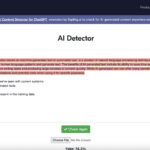
The retained image shows an earlier Sapling detector demonstration with a colored sample and a 74.3% score labelled “Fake.” This historical sample score is not proof of authorship and is not a result from a test performed for this article. The capture date was not recorded. Source: official website.
| Field |
Content |
| Name |
Sapling AI Detector |
| Overview |
Sapling AI Detector estimates whether text resembles AI-generated writing, including output from systems such as ChatGPT, Gemini, Claude and Llama. The provider says it was developed by former researchers from Stanford, Meta and Google. Its Transformer-based detector supports pasted text, PDF/DOCX uploads, a browser extension and an API. Scores can be wrong and are not proof of authorship or plagiarism. Educators, SEO professionals and reviewers should use them as one input to a wider review, not as a standalone basis for consequential decisions. |
| Key features & benefits |
- Detection estimates: Accuracy and false-positive rates depend on the data, text length and threshold; a fixed 97% detection/under-3% false-positive promise is not a universal guarantee.
- Wide model coverage: The provider describes detection across multiple model families, not reliable identification of a specific author or model.
- Sentence-level analysis: Highlights use token probabilities from the detector; a flagged sentence is not proof it was AI-written.
- Large text handling: Up to 100,000 characters for paid users.
- File uploads: PDF and DOCX support requires readable text; scanned documents may require OCR.
- Chrome extension: Browser-based checking; availability and access depend on the page and extension setup.
- API access: Integrate detection into workflows with separately billed API usage.
- Free and paid options: Free queries allow up to 2,000 characters.
|
| Use cases and applications |
- Reviewing academic papers for possible AI-generated passages alongside draft history and discussion.
- Reviewing SEO content with separate factual, originality and plagiarism checks.
- Screening blog posts, articles, or marketing material.
- Reviewing user-generated content on platforms.
- Supporting academic integrity review without using a detector score alone for disciplinary decisions.
- Content moderation for publishers with human review.
|
| Who uses? |
- Educators and professors
- SEO and content marketers
- Publishers and media companies
- Corporate communication teams
- Developers building AI detection into platforms
|
| Pricing |
- Free: Up to 2,000 characters per query.
- Pro: USD 25/month or USD 12/month billed annually; the provider advertises a one-month Pro trial. Paid detector access supports up to 100,000 characters. Confirm billing and trial conditions.
- Enterprise: Contact for a quote; published team pricing starts at USD 15 per seat/month for at least ten seats.
- API: Separate usage billing, not bundled into a Pro subscription; the API pricing page lists a USD 5 minimum payment.
|
| Tags |
ai detector, chatgpt detector, ai content detector, content review, seo tools, academic integrity |
| App available? |
Web detector and Chrome extension; API integration is available with separate billing. |
Check the original document, drafts and sources before acting on a score. Sapling warns that human writing can be flagged and edited AI writing can be missed. Sources: official detector, evaluation and limitations, plans and API billing.