Updated October 15, 2026. This overview is based on current official documentation and public pricing pages. We did not run a research query, purchase a plan or test the quality of generated answers for this revision.
Consensus is a research search service for finding academic papers and exploring their findings with AI assistance. It can help students, researchers and writers build a reading list, compare reported results and follow citations. A useful summary is a starting point for checking a paper, rather than a substitute for reading its methods and limitations.
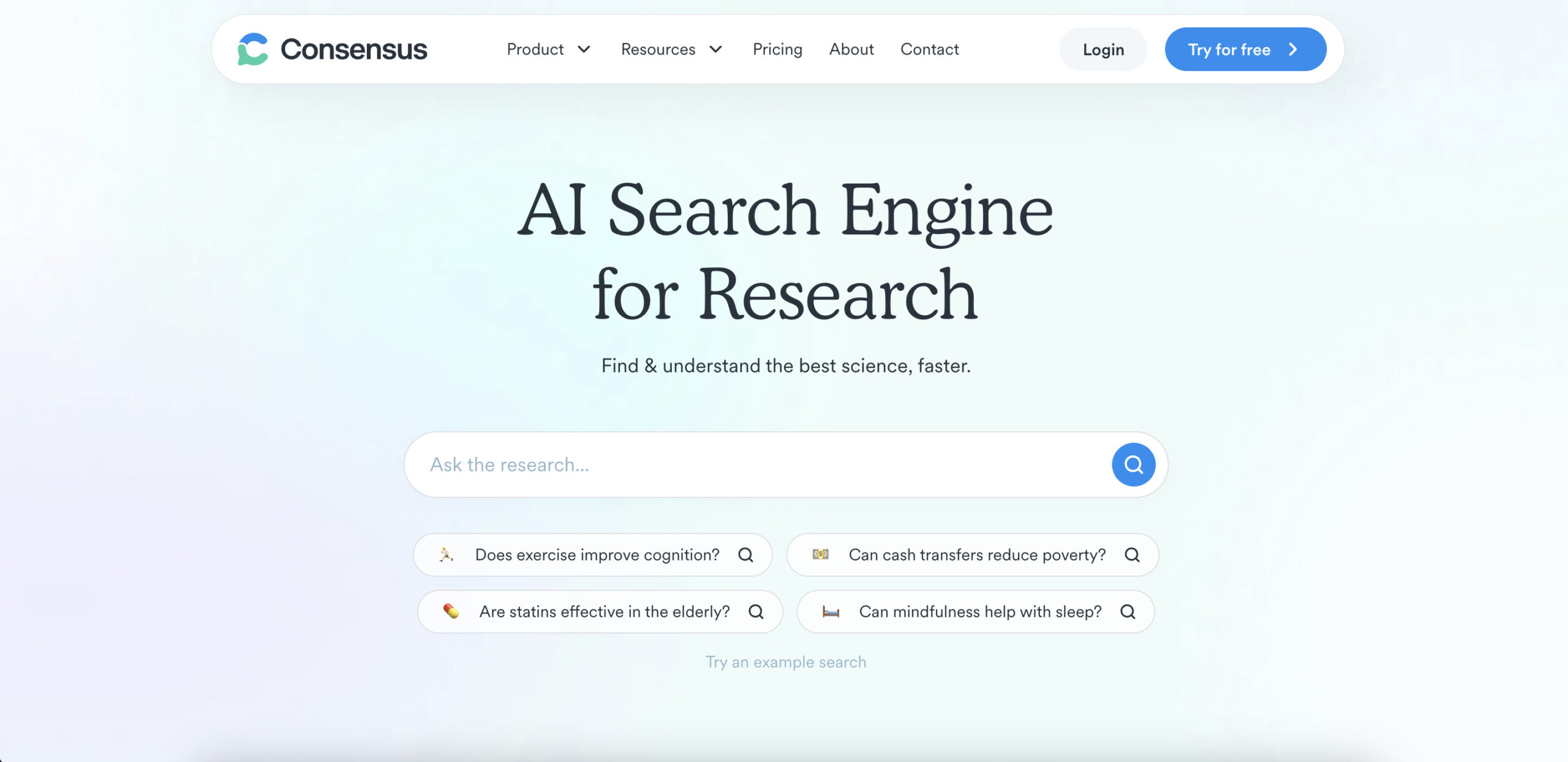
Image: historical Consensus landing-page screenshot retained from this article’s original illustration. It shows the brand and research search field; the current interface may differ. It is not a screenshot of a GPTOnline test.
What Consensus does
- Paper search: find research relevant to a question and narrow the results. Documented filters include publication year, study design and sample size. The option to exclude preprints matters when you need work that has completed peer review.
- Pro messages: produce cited explanations and structured responses. Current Pro documentation names OpenAI language models without specifying a fixed model version. A citation checkmark indicates full-text analysis; without that indicator, the analysis uses the abstract.
- Deep reviews: use a broader, multi-search process. The official guide describes synthesis of approximately 50 relevant papers. That is a documented workflow description, not a measured result from our testing.
- Developer access: a Consensus API is available. Check current documentation for access, quotas and integration requirements rather than treating it as a future feature.
How to interpret the Consensus Meter
The Consensus Meter classifies findings from a small set of retrieved papers for a yes-or-no question. Its documented scope is 5–20 relevant results. The service acknowledges possible classification errors and missing context. A displayed percentage is not the probability that a claim is true, nor a complete vote of the scientific community.
Open the contributing papers and ask whether their populations, comparisons and outcomes actually match your question. Several papers can also draw on overlapping data, so simply counting papers is not the same as weighing independent evidence.
Plans and discount eligibility
The current pricing page lists Free, Pro, Deep, Teams and Enterprise options. Free includes unlimited paper searches, 10 Pro messages and up to three Deep reviews monthly. Pro includes unlimited Pro messages and 15 Deep reviews monthly; Deep increases the latter allowance to 200. Teams advertises 50 Deep reviews per month and organizational account management. Enterprise offers a quoted arrangement.
Individual paid plans have monthly and annual billing options. An advertised monthly equivalent for an annual plan is not a month-to-month charge. Review the selected billing period, currency, taxes, usage allowance and any metered API charges before paying.
The live page advertises discounts of up to 40% for eligible students and faculty with a valid school email, and U.S. healthcare professionals with a valid NPI number. The discount guide describes eligibility verification and manual review when automatic academic verification fails. An email suffix alone does not guarantee approval.
A practical reading-list workflow
Hypothetical example, not a tested result: a university instructor wants research on whether handwritten and typed notes lead to different delayed recall outcomes in adult students.
- Define the comparison and outcome before searching: note-taking method, adult learners and delayed recall. Keep immediate quiz performance separate.
- Search for relevant papers, then inspect publication dates, participant groups and study designs. Record whether each source is a preprint.
- Make a small evidence table with one row per study: participants, task, delay before testing, outcome measure, reported result and limitations.
- Read the cited source behind each important summary. If only an abstract was analyzed, obtain the full paper where legitimately available before describing details not present in that abstract.
- Write a qualified conclusion and list unanswered questions. If findings disagree, explain the differences instead of forcing a single yes-or-no answer.
This workflow is an original editorial example. It does not claim either note-taking method is superior.
Limitations and when to use it
Consensus is useful for exploring literature and locating sources. Its responsible-AI guidance acknowledges incomplete retrieval and possible misinterpretation. Citations make checking possible; they do not guarantee that a generated statement faithfully represents a study. For a formal systematic review, document your search strategy and use the additional databases and screening procedures required by your field.
Do not use an AI literature summary to diagnose a condition or choose treatment. Compare other options in our Research tools directory, keeping source coverage, citation access and your verification workload in mind.