Updated October 15, 2026.
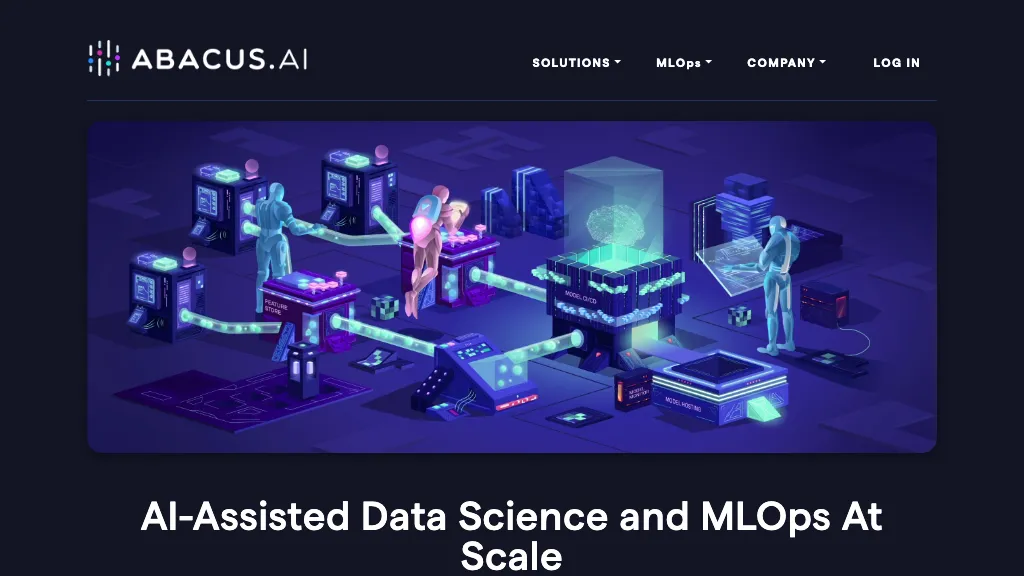
Image note: The retained featured image shows an earlier Abacus.AI homepage focused on data science and MLOps. It is historical marketing artwork, not the current ChatLLM interface or evidence of a product test.
Abacus, the platform branded Abacus.AI, brings together an AI chat workspace, task-running agents, creative tools, and enterprise AI services. Its current consumer-facing offering is much broader than the machine-learning platform shown in the older image. Professionals considering it should first distinguish everyday assistant features from enterprise deployment requirements.
This guide reviews public product documentation and pricing. We did not create an account, benchmark the models, or test an app deployment.
What does Abacus.AI do?
ChatLLM: chat, documents, and everyday analysis
ChatLLM is aimed at individuals and small teams that want several AI models in one workspace. The official feature guide describes web search, document discussion, spreadsheet analysis, charts, Python execution, and custom chatbots. Connections to services such as Google Drive, Slack, and Confluence can bring organizational information into supported workflows. The useful starting point is a specific deliverable, such as a source-linked summary or a checked spreadsheet, rather than an expectation that every model will answer identically.
Abacus AI Agent, formerly DeepAgent
The agent documentation now calls DeepAgent Abacus AI Agent. It describes multi-step work including building web and mobile apps, researching topics, preparing presentations, analyzing data, and using connected tools or a browser. These are advertised capabilities, not a guarantee that an arbitrary project will finish correctly. Start with a narrow task and inspect the output before expanding its access or responsibilities.
Enterprise AI and MLOps
Abacus.AI still offers enterprise services for forecasting, structured machine learning, anomaly detection, language and vision applications, recommendations, and optimization. Its platform lists data connectors, a real-time feature store, model monitoring, drift detection, and explainability tools. This is the relevant context for data scientists and ML engineers evaluating a managed development-and-operations platform. A ChatLLM subscription should not be assumed to include a tailored enterprise implementation. Ask about deployment, data pipelines, evaluation, access controls, support, and the scope of the quote.
Abacus pricing and usage limits
The main pricing page lists these monthly ChatLLM plans in US dollars, per user. Check the final checkout amount and applicable taxes before subscribing.
| Plan | Listed monthly price | Standard monthly credits | Agent access |
|---|---|---|---|
| Basic | $10; a $7 first-month offer is displayed | 20,000 | Three conversations per month |
| Pro | $20 total | 30,000 | Broader agent and coding access |
The billing FAQ adds important qualifications:
- The $7 promotional month receives 14,000 credits, rather than the standard 20,000.
- Pro’s unrestricted agent access still requires active credits. Credits are a usage unit, not a token count; consumption varies with models and tasks.
- Subscription credits reset at renewal; separately purchased unused credits roll over. The FAQ describes a pacing restriction that reserves the final 25% of the allowance for the last subscription week.
- Certain listed chat models remain usable after the credit balance is exhausted; this does not extend to their API use.
- Cancellation leaves access active for the paid month. The FAQ says refunds are not provided because of model output or performance.
- Enterprise pricing starts at $5,000, but the FAQ does not specify the billing period or included scope. Obtain a quote rather than treating that figure as a monthly plan.
The Studio FAQ specifies Basic video generation in up to three conversations per billing month, capped at 2,500 credits each; Pro removes those conversation caps but still consumes credits. It also lists Max at $100/month with 120,000 credits and a $7/month Go tier without Studio. Those extra tiers are not displayed on the main pricing table, so confirm availability and entitlements in your account. Studio provides media creation and editing, with estimates before generation. Its commercial-use guidance points to individual model licenses, so check the model’s terms before publishing assets.
App running costs need a separate check: the hosting guide describes an allowance followed by usage charges for traffic, databases, storage, and related operations.
The SuperComputer guide describes a persistent Ubuntu cloud machine for Pro users and above. Runtime costs one credit per five minutes, with agent, CLI, and model usage charged separately. Budget for continued operation as well as building an app.
Free tools and supported apps
The paid ChatLLM plans should be distinguished from Abacus AI Bot, a separate free, open-source desktop agent. Its FAQ says a free account receives 2,000 signup credits and the app supports Windows, Mac, and Linux. A free starting allocation is not an unlimited allowance for every model. The same FAQ says transcripts, crash logs, and related material are sent to Abacus.AI servers, although credentials and API keys stay on the computer.
ChatLLM has iOS and Android apps as well as browser access.
The separate Abacus AI Desktop FAQ lists macOS, Windows, and Linux, with Listener limited to macOS and Windows. Desktop combines chat, coding, CLI, and CoWork tools. Basic includes limited task access; Pro provides broader access subject to usage limits. Check the specific feature and operating system you need rather than assuming every interface has identical capabilities.
Example: a reviewed sales brief
Fictional example, not a product test: Imagine a small stationery shop wants to understand which products sold best last month. A cautious first task would use a synthetic spreadsheet, with columns for date, product, units, and unit price.
- Ask for totals by product, the calculation used, and a list of missing or inconsistent rows.
- Recalculate a few rows yourself and confirm whether refunds, tax, or discounts belong in the totals.
- Request a short management brief only after the numbers agree. Require each conclusion to point to a table or calculation.
- If a dashboard would help, define the fields and filters before asking the agent to build a prototype. Keep it private and use sample data until access controls and calculations have been reviewed.
This approach creates a useful acceptance check. A polished chart alone does not show that the underlying arithmetic, source data, or interpretation is correct.
Privacy and data handling
Abacus.AI’s data-security FAQ says customer data is not used for model training and that its agreements with model providers protect against training use. It also makes encryption and compliance claims. These are vendor statements; they do not establish that your particular workflow meets an organization’s security policy or legal obligations.
The privacy policy distinguishes model-provider processing from Abacus.AI’s own retention. It states that integrated model providers operate under zero-data-retention agreements, while allowing limited user-data review for service maintenance and sharing with service providers. After account deactivation, information and user content may remain for backup, archival, or audit purposes for an unspecified commercially reasonable period. Do not interpret the model-provider promise as immediate deletion everywhere.
Before uploading sensitive material, confirm the applicable contract, deletion process, retention period, and permissions with your organization and the provider. Remove unnecessary personal details from trial inputs, review each connector’s requested access, and avoid sharing conversation or app links more widely than intended.
Who should consider Abacus?
- Individuals and small teams: useful to evaluate when one workspace could cover recurring writing, research, document, and analysis tasks.
- Developers and operations teams: consider a narrowly scoped agent prototype, with code review, tests, backups, and approval before consequential actions.
- Data-science teams: assess enterprise requirements separately, using representative datasets and your own validation criteria.
The main trade-off is breadth versus predictability. A shared subscription can simplify access to multiple tools, but credit consumption, feature limits, and review time still affect the real cost. Judge the service by a small repeatable task, verified output, and the terms that apply to your selected plan.
For another agent-focused overview, see our Manus guide.