

Updated October 16, 2026. This is a documentation-only review of Quuu’s official public pages. We did not create an account, test generated content, connect social profiles, or test billing and cancellation.
Quuu AI is a social media service for discovering content, drafting posts in a brand’s voice, and scheduling publication. Its documentation describes a workflow that combines curation, AI writing, visuals, and connected-network publishing.
Our editorial view: Quuu is worth evaluating if finding relevant material and maintaining a posting routine are your main bottlenecks. Before committing, check its output against your own editorial standards and confirm the features your workflow depends on.
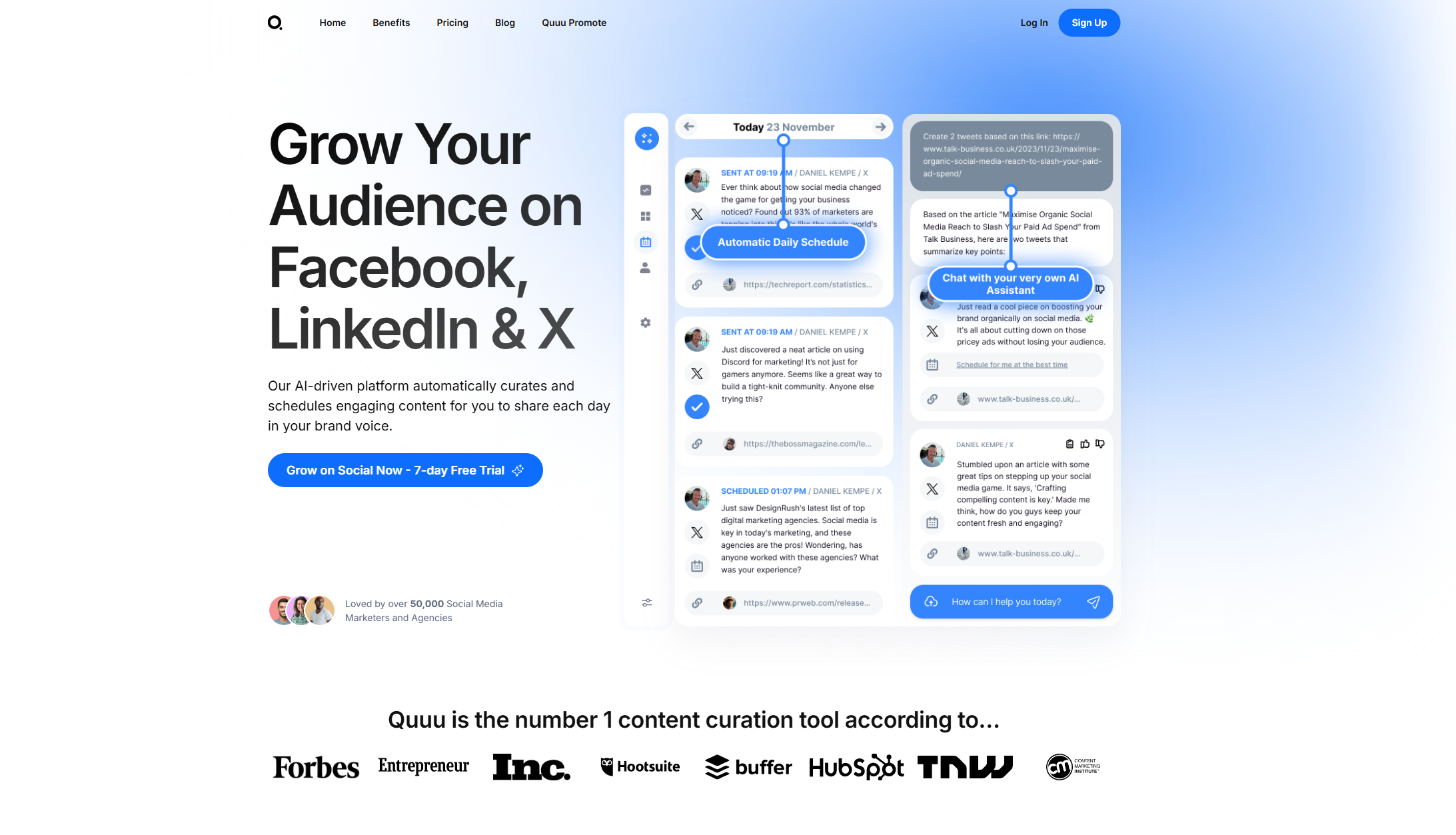
Image note: The retained featured image is a historical Quuu homepage screenshot with scheduling and chat mockups. Its audience-growth, user-count, and ranking statements are vendor marketing, not findings from this review or evidence of the current interface.
Core features
The official feature page describes:
- Content discovery: finding material related to your niche and audience.
- Post creation: text posts, threads, captions, images, and carousels.
- Scheduling: automatically queueing and publishing posts; Quuu says timing is based on audience activity.
- Personalization: settings for brand voice, topics, and posting frequency.
- AI assistance: brainstorming and revising drafts through a brand-aware assistant.
Quuu’s homepage says users can review, edit, or approve content before publication. Treat voice matching and scheduling effectiveness as vendor claims to evaluate; this review does not establish their accuracy or any engagement improvement.
Networks and access
The documented publishing networks are X, LinkedIn, Facebook, and Bluesky. Quuu also describes managing profiles, subscriptions, and invoices from its dashboard. Check that the specific account type and posting format you need are supported before connecting a client or business account.
The official website links to a browser dashboard for signup and login. We have not verified native iOS or Android applications. Do not assume Instagram, TikTok, or other networks are supported merely because AI can draft text for them.
Pricing and limits
The pricing page shows one per-profile plan:
- Monthly: $19.79 for each connected social profile.
- Annual: $16.49 per month, billed annually, for each profile. Multiplying by 12 gives $197.88 per profile per year before any applicable taxes.
- Trial: seven days, with no credit card required to start.
Three profiles on monthly billing cost $59.37 per month. These are the displayed dollar amounts; the reviewed page does not specify a currency code. Confirm currency, tax, and the final charge at checkout. It advertises unlimited AI-generated posts, but we did not verify a permanent free plan.
The support FAQ says additional AI-chat tokens can be purchased when a plan’s allowance is reached. It does not state the allowance or top-up price there. Unlimited post generation should not be read as a promise of unlimited chat usage.
Billing and refunds
According to the published terms, subscriptions renew automatically until cancelled. Cancellation is available through the dashboard and takes effect at the end of the billing period. Already-paid fees are non-refundable except where law requires otherwise. Cancelling therefore should not be assumed to produce a refund.
Quuu’s documentation says plan changes take effect in the next billing cycle and that major credit and debit cards are accepted. It says full card details are not stored on Quuu’s own servers.
The contact page invites customers to discuss refund problems with support, but it does not promise a money-back period. Ask support to resolve any checkout or policy discrepancy before paying.
Privacy and permissions
The privacy policy describes collecting account and billing information, connected-profile data and access tokens, prompts, posts, brand details, and usage information. Relevant prompts and brand context may go to AI providers; other providers and connected networks also receive data as needed.
Quuu says it does not sell personal data. Its AI-provider training restriction is qualified by what is needed to deliver the service, so it should not be summarized as an unconditional zero-training guarantee. Retention can extend beyond active use for legal obligations and disputes. The policy mentions international processing, encryption in transit, and location-dependent data rights.
Both the terms and privacy page still display notices that the documents are templates requiring legal review. This limits the assurance readers should take from the public policy text.
For confidential client work, ask for the applicable agreement, processor details, retention arrangements, and deletion process before supplying sensitive material. Review the permissions shown when connecting an account and decide who on your team may authorize publication.
Important limitations
There is an analytics ambiguity: the plan list includes reporting, while the feature page marks advanced analytics as coming soon. Confirm exactly which reports are available.
The terms warn that AI output can be inaccurate or unsuitable, and make users responsible for reviewing it and respecting connected-platform rules. Content ownership does not remove the need to check third-party rights.
- Brand accuracy: check names, dates, product claims, tone, and source links before approving a post.
- Operational fit: ask about account-type restrictions, approval roles, failed-post handling, and any platform-specific limits you need.
- Results: this review provides no measured time savings, audience-growth results, or posting-reliability benchmark.
A fictional workflow
Illustrative example only: Harbor Cycle is a fictional bicycle repair shop planning three LinkedIn posts for the next week. No Quuu output or customer result is being reported.
- Prepare a short brief: local commuters, practical maintenance advice, a friendly tone, and no unsupported safety or performance claims.
- Use two public articles as candidate source material. Read them yourself, check publication dates, and reject advice that does not apply to your customers.
- Ask for a draft explaining one useful maintenance habit. Replace generic language with the shop’s own verified advice and check any accompanying visual.
- Review the final post and link before scheduling. Choose a manageable cadence rather than maximizing volume.
- After publication, compare the approved text with the live post and record corrections and useful audience responses.
This is an editorial evaluation plan. It does not demonstrate Quuu’s interface steps or guarantee that every proposed step can be completed inside the product.
Who should consider it?
A solo marketer or small team could evaluate Quuu for a recurring mix of curated links and original social commentary. An agency should first check permissions, client separation, approval controls, reporting, and the cost of every connected profile.
If your main requirement is a network outside the documented list, detailed analytics, or tightly controlled handling of confidential material, resolve those questions before subscribing. During an evaluation, judge relevance, editing effort, and publishing accuracy against your own requirements rather than promises of automatic growth.
For a related media-monitoring topic, read our ReadPartner AI overview.
Bottom line: Quuu’s public documentation describes a broad AI-assisted social publishing workflow. Its usefulness for your business depends on content quality, supported account types, and the controls you can verify. Start with a small, reviewable workload and confirm billing and policy details before making a longer commitment.