Updated: October 17, 2026.
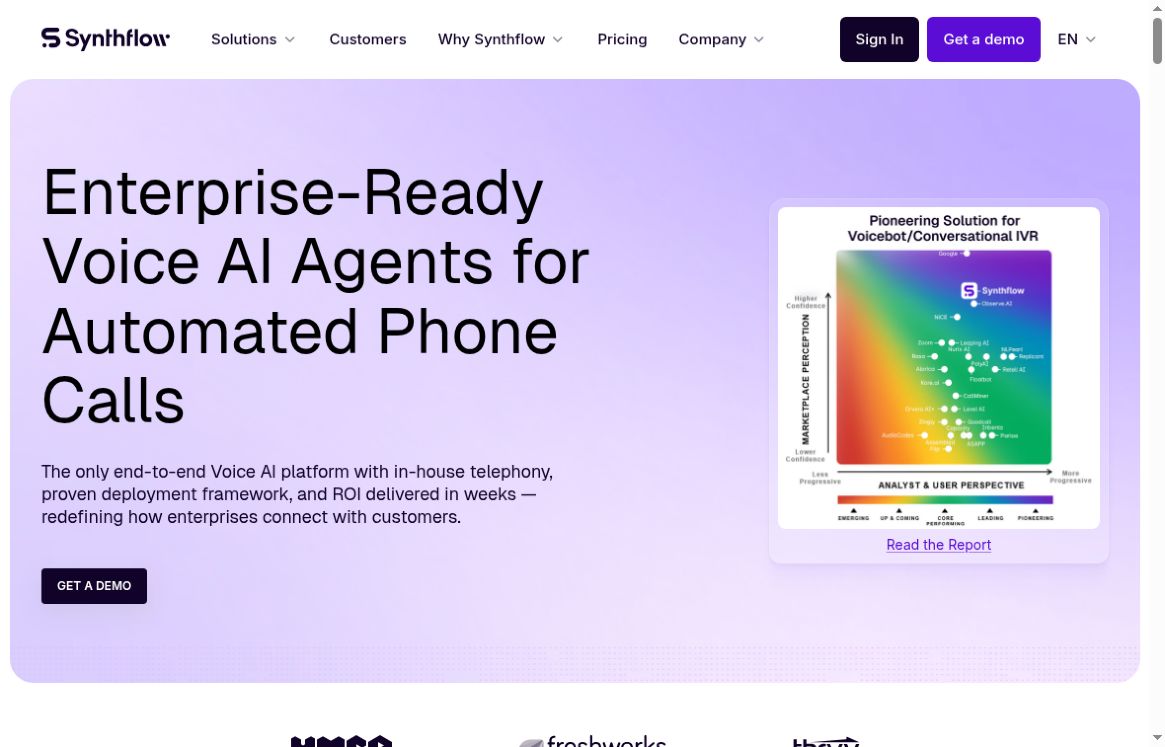
Synthflow AI is a platform for building and operating AI voice agents that answer and place business phone calls. Its current positioning emphasizes enterprise deployments, configurable call flows, integrations, and human handoffs. This overview is based on official public pages checked on October 17, 2026; it is not a hands-on performance test.
What can Synthflow AI do?
The official website describes inbound and outbound workflows for appointment booking, routine questions, lead qualification, and call routing. Teams can use a visual Flow Designer to organize conversation steps and connect business systems. Synthflow also promotes testing, monitoring, and version management as parts of its deployment process.
- Call workflows: Define questions, actions, fallback responses, and escalation paths.
- Connected tools: Integrate customer records, calendars, APIs, and downstream workflows.
- Telephony options: Discuss native telephony or connections to existing SIP infrastructure.
- Operational review: Evaluate calls and investigate problems before expanding a rollout.
The integration directory is a better starting point than assuming every advertised connection supports your exact task. Confirm the required actions, authentication, data access, and implementation work for your own systems.
Example: an appointment-request workflow
A home-services business could configure an agent to ask what service a caller needs, check the service area, and offer available appointment times through an approved calendar connection. Requests outside the supported area or questions the agent cannot answer could go to a staff member.
Before launch, test changed appointments, unclear addresses, interrupted speech, unavailable calendar slots, and failed transfers. Confirm that the booking appears correctly in the destination system. This is an illustrative workflow, not a claim that a particular integration has been tested here.
Current pricing and capacity limits
On the review date, the pricing page advertised enterprise contracts starting at $30,000 annually. Final scope depends on call volume, concurrency, telephony, integrations, security requirements, and launch support. Request a written quote covering currency, included usage, additional charges, taxes, service levels, and renewal terms.
Older Starter, Pro, and Growth price tables should not be treated as current offers. Although the homepage still mentions free agent building and pay-as-you-go usage, that wording does not establish a current self-service rate or unlimited free calling.
According to the concurrency documentation, workspaces have separate limits for simultaneous calls and outbound call attempts per second. Enterprise limits are agreed with Synthflow, and subaccounts share the main account’s capacity. Excess calls may queue or return errors depending on the setup. Large cumulative call-volume figures are not evidence of millions of simultaneous calls.
Security, privacy, and healthcare use
The Trust Center lists SOC 2 Type 2, ISO standards, and other compliance materials. Some underlying documents require an access request and NDA. Their scope was not independently audited for this article.
Synthflow documents controls for saving recordings and transcripts, limiting retention, and redacting personal information. Its security documentation warns that redaction is not perfectly accurate, does not affect live audio, and does not retroactively clean existing records. Configure connected systems appropriately too.
Healthcare organizations should review the Business Associate Agreement and required HIPAA Setting before processing protected health information. A general compliance badge does not establish that every customer deployment is suitable for sensitive data.
What to check before buying
Review the privacy policy, applicable contract, data-processing arrangements, and retention settings with your team. The self-serve subscriber terms place responsibility for checking AI output on the customer; enterprise agreements may differ. Verify calling and recording requirements for your deployment, keep a usable human escalation path, and judge a pilot by completed tasks and errors rather than voice realism alone.
Browse the GPTOnline AI tools directory to compare other tools by task before choosing a platform.