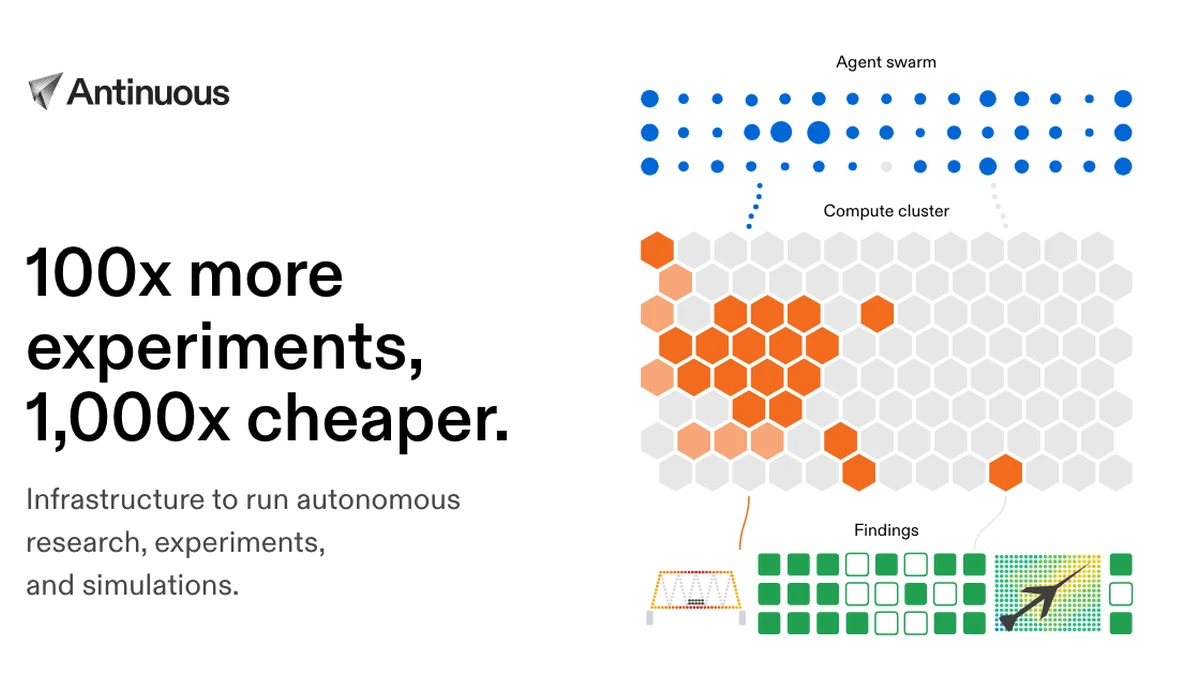
Antinuous autonomous research runs experiments and simulations thousands at a time, so hours of sequential runs take minutes: 100x more experiments, 1,000x cheaper. It entered public beta on 19 November 2026, with its Y Combinator launch listed on 23 November 2026, and it comes from Antinuous.
What is Antinuous?
Antinuous is infrastructure for autonomous research. You ask a question in plain words, or send it from a coding agent, and its agent breaks it into smaller questions, starts a swarm, and runs experiments, reads sources, and returns artifacts 3.5x faster than one agent, and up to 19x. Each round plans, gathers evidence, runs simulations, and reviews the results, dropping weak candidates as it goes, until the results hold up.
It is built in four layers. Elastic compute gives every experiment its own computer, and large jobs split across thousands of workers. Orchestration runs agents as swarms that split a large question and check sources. Simulation tests ideas instead of guessing, across engineering, science, medicine, finance, and earth science, with its own kernels and solvers alongside established ones. Artifacts arrive in the formats your field already uses: notebooks, documents, decks, charts, maps, tables, CAD models, and protein structures, with each value linked to its source or code.
Your agent can use the same layers. Claude, ChatGPT, Claude Code, Codex, Cursor, and other MCP clients call the same tools the app uses, and agents that speak A2A can start and continue research the same way. A local or cloud agent can start the Antinuous agent, steer it while it runs, and read what it finds, or start a swarm or a compute cluster directly.
Key features
- Agent swarms: a lead agent splits a question across teams of researchers that hand work to each other, finishing 3.5x sooner than one agent.
- Elastic compute: each run gets its own computer, so 3 hours of sequential runs take 8 minutes, with GPU jobs on Max and Ultra.
- Simulation across structures and crash, fluids and aerodynamics, systems and circuits, CAD and meshing, and science databases.
- Sources from the web, science databases, and your files, with full papers checked for retraction and up to 250 sources per run.
- Artifacts with a source or code link on each value, exported as sheets, documents, decks, and notebooks, with decks to PowerPoint, PDF, or Google Slides.
- MCP and A2A research primitives for any agent, plus jobs on your own Modal account.
Who is it for?
Antinuous is made for researchers, analysts, and engineers who run experiments at scale: a team testing every design change in simulation, a lab rerunning analyses across every paper and dataset, a finance analyst testing a thesis against every comparable company, or an engineer benchmarking every kernel and hardware variant. It is also for agent builders who want their own agent to run thousands of experiments at once instead of one after another.
Pricing
Every plan includes AI usage, and paid plans add compute. The Free plan costs $0 a month, with $20 a month of AI usage released weekly, open-weights models, and no compute or GPUs. Pro costs $20 a month, with $100 a month of AI usage, all models, a free sandbox, and CPU jobs. Max costs $100 a month, with 5 times Pro’s usage and GPU jobs with up to 8 GPUs. Ultra costs $200 a month, with 20 times Pro’s usage and GPU jobs with up to 8 GPUs. Your first month is free at Pro limits, with a verified mobile number and no card. Usage resets weekly. Prices were checked on the official site on 24 November 2026 and may change, so confirm them on antinuous.com/pricing first.
What to know before you try it
Antinuous is in public beta, and it grew out of a pivot: the company was formerly Salesgraph, and the Antinuous research platform itself is new. The free month and the Free plan both need a verified mobile number, limited to one account per number while the team secures more compute. GPU jobs open on Max and Ultra only after 14 days of paid history, and multi-node GPU clusters are returning after a redesign, so check the current limits before you plan a large run.