The New York Times and other newspapers sued Brave Software in Manhattan federal court on Monday, accusing the browser company of scraping their articles for AI training, selling the content to AI companies, and helping users bypass their paywalls. The complaints, filed on November 2, 2026 in the U.S. District Court for the Southern District of New York, open a new front in the publishing industry’s fight with the AI data economy, one that targets the infrastructure feeding AI models rather than the model makers themselves.

The Daniel Patrick Moynihan U.S. Courthouse in Manhattan. Photo: Americasroof / Wikimedia Commons (CC BY-SA 3.0).
What the Lawsuits Allege
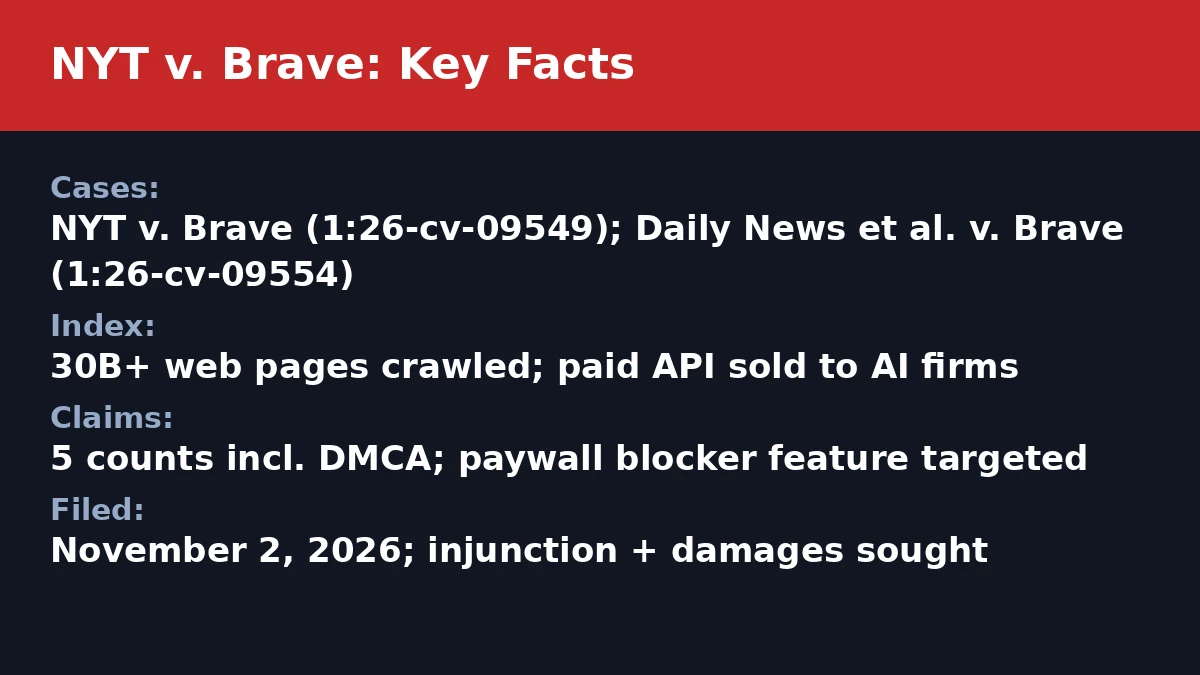
The Times’ complaint (No. 1:26-cv-09549) says Brave built an index of more than 30 billion web pages using a web crawler it has never identified, leaving publishers with no way to detect or block it. From that index, Brave sells paid access to real-time web content through its Brave Search API, which the complaint says supplies Times journalism to AI companies for training models and grounding their answers. Reuters reports that the complaints name Anthropic, Perplexity and xAI among the buyers, while TechCrunch’s account of the Times filing also names Mistral and Cohere as customers.
The complaints accuse Brave of acting “both like a burglar that misappropriates the content of publishers, and an AI ‘fence’ that sells stolen content to third parties,” according to Reuters. Times spokesperson Graham James said in a statement: “While we believe in the ethical and responsible use and development of AI, Brave has flouted established copyright law and ignored repeated requests by The Times to stop its infringing conduct.”
Hours after the Times filed, the publishers of the New York Daily News, the Chicago Tribune and the Orlando Sentinel brought a near-identical suit (No. 1:26-cv-09554) in the same court. Both complaints bring five claims: direct, contributory and vicarious copyright infringement, circumvention of access controls under the DMCA, and unjust enrichment. Both seek damages, permanent injunctions and jury trials, and both are signed by the same attorney, Steven Lieberman of Rothwell, Figg, Ernst & Manbeck. Brave had not responded in court or publicly as of the morning of November 3.
The Paywall Allegation
The suits go beyond scraping. The publishers also target a Brave browser feature described in the filings as a “Paywall blocker,” which the complaints say makes hundreds of publishers’ subscription sites accessible without a login. TechCrunch reports that the filings additionally accuse Brave of blocking publishers’ own ads while selling its own, a practice the papers say compounds the harm.
Why It Matters
The complaints are part of a wave of high-stakes copyright lawsuits against generative AI companies over training data, Reuters notes. The Times previously sued OpenAI and Microsoft in 2023 and Perplexity in December 2025 over similar claims. But the Brave suits are different in a significant way: the AI companies are not defendants. Instead, the publishers are going after what they describe as the supply chain, arguing that a privacy-focused browser company has quietly become a wholesale dealer of copyrighted content to the AI industry.
Brave, founded in 2015 and reported to have raised roughly $250 million to date, built its reputation on blocking trackers and ads. The case could force the company to expose how its index was assembled, including the identity of the unidentified crawler. For AI companies, the outcome could tighten scrutiny of every data-sourcing channel, not just the models themselves.
One early sign of the fight to come: Perplexity chief communications officer Jesse Dwyer dismissed the suit in a statement, saying the Times was “overpaying its attorneys and underpaying its journalists,” according to coverage by The Verge.
Key facts at a glac