Updated on October 20, 2026.
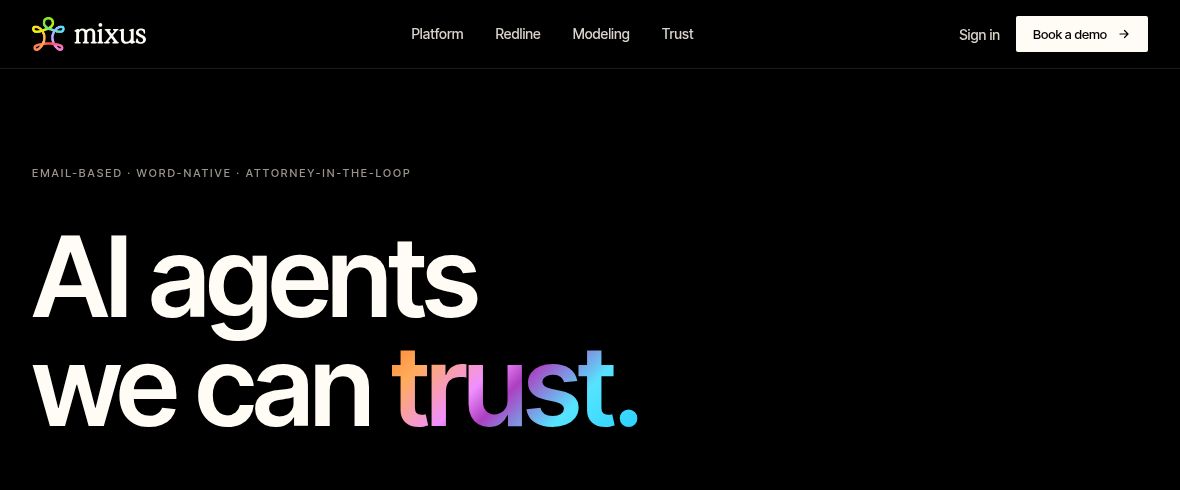
Featured image: screenshot of Mixus’s official homepage, captured October 20, 2026. Its trust headline and email, Word and attorney-review wording are the provider’s presentation, not independent assurance of legal accuracy, privacy or security.
Mixus AI now presents itself as a platform for legal teams working through email and Microsoft Word. Its homepage now emphasizes contract redlines and deal models for attorney review. Broader agent and collaboration features remain described in its official documentation.
How the current platform works
The official platform overview describes sending work through email, including reviewers in the thread, and receiving files for human approval. Firm playbooks can capture preferred clauses, fallback positions and issues that need escalation. Past agreements and review decisions help develop those playbooks; the attorney remains responsible for the result.
Main workflows
- Contract review: AI Redline returns a Word document with tracked changes, reasons tied to playbook rules and issues requiring attorney judgment. The page describes accepting, changing or dismissing suggestions inside Word. These citations identify the firm’s review rules; do not assume each is a verified citation to case law.
- Deal modeling: the modeling page describes turning term sheets and capitalization tables into Excel models with live formulas, dilution breakdowns and SAFE-conversion checks. Its turnaround claim of under 15 minutes is a vendor statement, not a speed we tested.
- Firm-specific review standards: the platform can organize playbooks by client, agreement type or practice area. Review decisions inform proposed rules, which lawyers should inspect before treating them as a firm standard.
Broader agents and integrations
Mixus still publishes agent-creation documentation covering custom instructions, triggers and team collaboration, alongside guides to chaining agents and passing context between them. Its integration page lists Gmail, Google Drive, Microsoft 365, Salesforce, Jira and Google Calendar. These resources preserve the broader automation use cases described in the earlier article, but a firm should confirm which features and connectors are supported in its proposed deployment.
Earlier coverage also discussed sales follow-ups, customer support and educational collaboration. The current legal-focused pages do not establish those as packaged offers. We could not reconfirm the specific Stanford-use example or the claim that agents can be created in seconds; readers should confirm their own setup requirements and intended use with Mixus.
Pricing and access
The legal-focused public pages reviewed on October 20, 2026 direct prospective customers to a demonstration. Separately, the official Billing & Pricing documentation still lists a free plan, a US$20-per-month Pro plan, a US$50-per-month Team plan and custom Enterprise pricing, alongside usage-based token charges. The pages reviewed do not establish whether those documented subscriptions apply to the current legal offering or provide a confirmed per-user quote for a firm.
Ask for written pricing covering users, matters, included usage, overages, integrations, onboarding and support. The earlier article’s unlimited-trial claim and specific public-chat plan benefits were not reconfirmed for the legal offering, so they should not be assumed to be included.
Security and human review
The vendor’s trust page advertises SOC 2 Type II, encryption, customer-managed keys, matter-level compartments, exportable review trails and US/EU data-residency options. It also describes zero retention by model providers and optional controls for regulated work. These are vendor disclosures; we have not inspected the underlying audit report or verified a customer deployment.
Model-provider retention is not the same as deletion from every Mixus system. A firm should check its contractual retention, subprocessors, permissions and selected deployment settings before uploading confidential client material. Using the tool does not itself establish compliance with professional duties or any regulation.
Who should evaluate it?
Mixus may suit legal teams with repeatable document workflows and established review standards. A general writing assistant may be simpler for nonconfidential brainstorming, while specialized legal research software serves a different purpose from applying a firm’s contract playbook. Compare the actual output, approval controls and integration requirements against your workflow rather than assuming all AI-agent products are interchangeable.
For an evaluation, use an approved sample agreement, confirm that every markup is justified, check spreadsheet formulas independently and test how reviewers resolve conflicting instructions. Keep a qualified person responsible for legal and financial judgments. This is a product overview based on public documentation, not legal advice, a security audit or a hands-on performance test.