Updated on October 20, 2026.
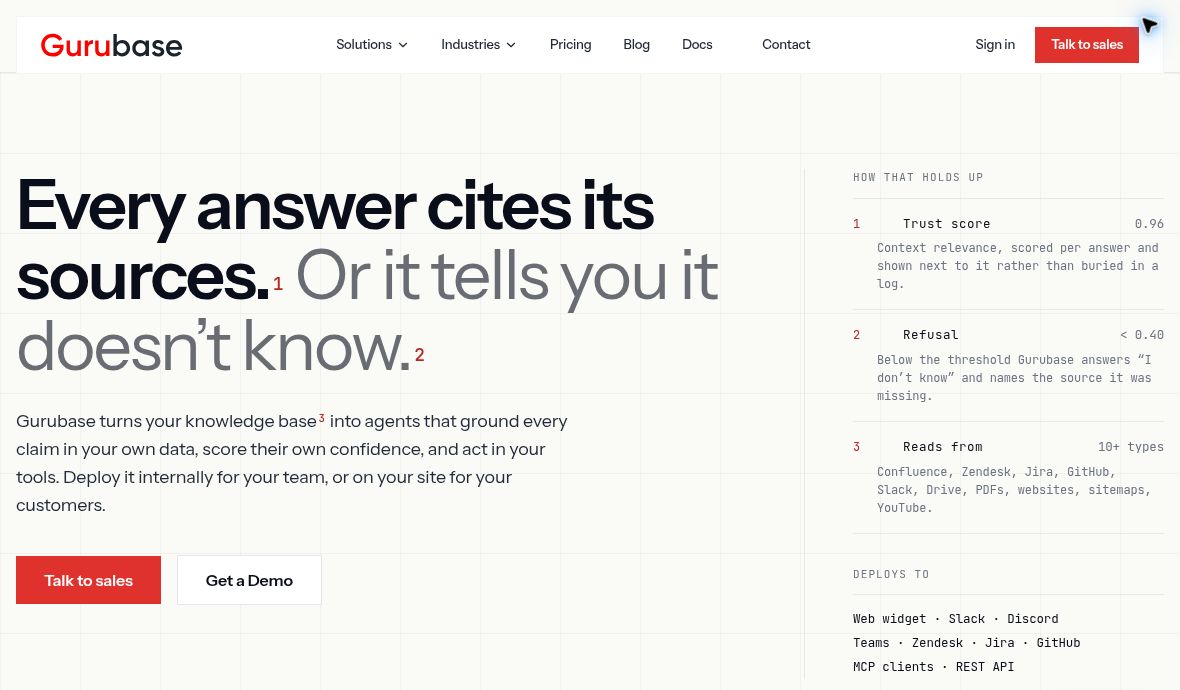
Featured image: screenshot of Gurubase’s official website, captured October 20, 2026. Vendor presentation, not a hands-on test. Displayed trust scores and claims about source citations, refusals and capabilities are vendor presentation; reliability was not independently tested.
Gurubase builds knowledge-grounded AI assistants called Gurus. Teams can connect documentation, repositories and business knowledge, then publish an assistant for colleagues or customers. The current platform goes beyond the documentation Q&A focus of this article’s original 2025 listing: it also describes actions that retrieve live information or change connected systems.
Knowledge sources and channels
The official documentation lists websites, PDFs, Word and Excel files, GitHub repositories, YouTube transcripts, and connectors including Jira, Zendesk, Confluence, Salesforce, Google Drive and Slack. Available allowances and connectors depend on the plan.
A Guru can be surfaced through a website widget, Slack, Discord, Microsoft Teams, Jira, Zendesk, GitHub, an API or MCP clients. Scheduled reindexing, analytics, remembered user context and question triage are documented capabilities. The current pricing page also lists multilingual assistance and analytics for identifying gaps in the knowledge content. These are vendor-described features; this review did not connect an account or test answer quality.
Citations are useful, but still need checking
Gurubase’s Trust Layer describes retrieval from permitted sources, a confidence assessment, citations and refusals when evidence is insufficient or a question falls outside policy. A displayed trust score is a product signal, not independent proof that an answer is correct. Check citations against the underlying material and test questions with missing, stale and conflicting information before deployment.
Actions and practical uses
The Actions page describes sandboxed Python and REST calls for workflows such as looking up a record or creating a ticket. Current documentation also describes MCP tools. Read-only knowledge search and write-enabled automation have different consequences: start with a limited test environment, narrow permissions and human review for consequential actions.
- Developer documentation: help people locate answers across product guides and code repositories.
- Customer support: provide cited help-center responses and route unresolved questions to a person.
- Internal knowledge: assist staff with approved runbooks and policies, while testing access boundaries.
Current plans and pricing
As checked on October 20, 2026, the pricing page presents Pro and Enterprise with sales-contact buttons. A fixed current price was not published in the reviewed page text. The previous Essential $99 and Growth $299 figures are no longer a reliable current offer.
- Pro: 4,000 questions per Guru per month, unlimited users, 5,000 web pages, 2,000 YouTube videos, 250 MB PDF storage and 10 GitHub repositories. The page also lists business-source ingestion, bots, MCP, analytics and up to 10 workflows.
- Enterprise: contracted volumes and custom source limits, with options such as self-hosting, single sign-on, role-based access, audit logs and custom models.
Ask for the actual subscription charge, overage rates, renewal commitment and deployment costs before choosing. The page describes volume-banded cloud overages but does not provide a complete numeric quote. A free open-source-project plan was not confirmed as a current offer.
Cloud, self-hosting and historical context
The original listing described Gurubase as an open-source, Docker-based RAG system. That historical description should not be read as a promise that today’s full commercial platform is freely self-hostable. The current self-hosting documentation places supported on-premise and air-gapped deployment under Enterprise, with licensing based on Gurus and requirements.
Deployment design matters: the documentation distinguishes local-model operation from external model services that require internet access. Do not assume every configuration keeps all processing local. Obtain the precise architecture and contractual controls for the proposed deployment. The homepage says SOC 2 is in progress, so this review does not present completed SOC 2 certification as verified.
Sources checked: October 20, 2026. Public documentation review only; no integration, deployment, security audit or paid trial was performed.