Updated: October 16, 2026. This is a documentation-based review of the GPT-2 Output Detector. We reviewed the original research, source code and model documentation; we did not submit text, run the detector or benchmark its accuracy.
The GPT-2 Output Detector is a historical text classifier developed by OpenAI to help identify text generated by GPT-2. It is useful for understanding early AI-detection research, but its scores cannot establish whether a statement is true, a document is original or a particular person used AI. OpenAI released the detector alongside its largest GPT-2 model in November 2019. Read the original release announcement. Start with OpenAI’s project documentation for access information.
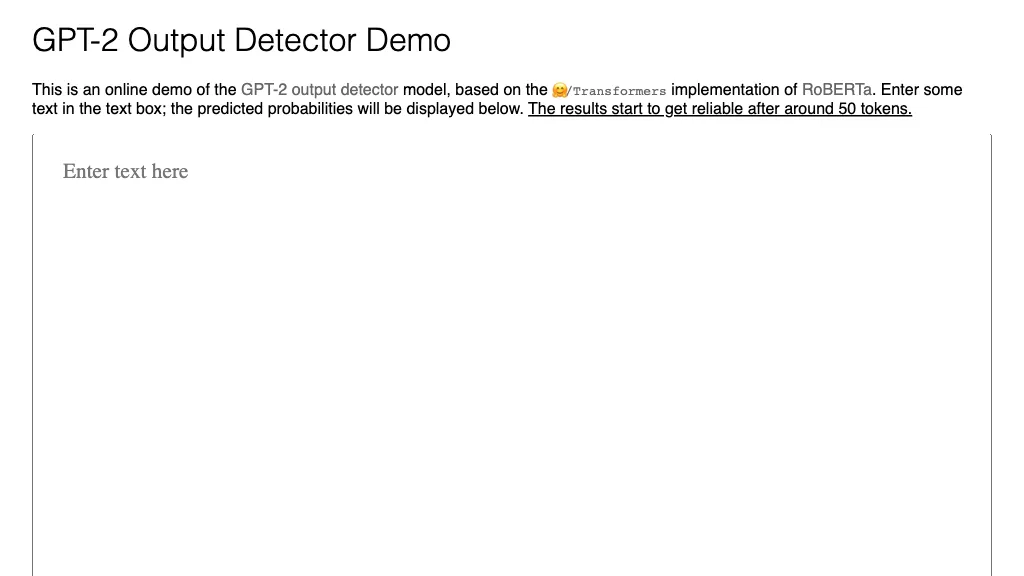
Archival image note: The retained screenshot shows the older GPT-2 Output Detector Demo with an empty input box. Its 50-token reliability statement is historical interface wording, not a verified accuracy guarantee or evidence of a current test.
Training scope
OpenAI fine-tuned RoBERTa-based sequence classifiers to distinguish outputs of the 1.5-billion-parameter GPT-2 model from WebText, the dataset used to train GPT-2. The project provides both base and large detector variants. Its documentation describes training with a mixture of temperature-1 and nucleus-sampled outputs to improve performance across generation settings. See OpenAI’s detector documentation.
The Hugging Face model card, written by the Hugging Face team, identifies the base model as an English-language classifier. This training scope matters: performance on GPT-2 samples does not establish reliable detection of current ChatGPT responses, other modern language models or writing in another language.
Interpreting Real and Fake
The original demo interface displays two classification probabilities labeled “Real” and “Fake.” Read these as the detector’s estimates for its human-text and GPT-2-output categories. They are not fact-checking verdicts. A human can write an incorrect claim, and generated text can contain correct information.
Likewise, a high score does not identify an author, prove plagiarism or establish academic misconduct. A percentage beside a label is a model output; it should not be reported as a verified probability that someone cheated. This distinction follows from the detector’s training task, which concerns text origin rather than truth or conduct.
Accuracy and the 50-token claim
The original interface suggested that results become more reliable at around 50 tokens. That statement should not be treated as a universal minimum length that makes a result dependable. Tokens are the model’s text units, so a token count is not necessarily a word count.
OpenAI’s 2019 research report describes approximately 95% accuracy in its GPT-2 detection research. One reported evaluation used 510-token examples: 5,000 held-out WebText samples and 5,000 GPT-2-generated samples. The report also shows that shorter inputs are harder to classify and that results depend on how the text was generated. These controlled, historical findings cannot be converted into an accuracy promise for any text pasted into a demo today.
Even at release, OpenAI said its results were insufficient for standalone detection and recommended combining detection with human judgment and other evidence. The Hugging Face card also specifically warns against using this model to make serious academic-misconduct allegations about ChatGPT-generated text.
Current access and project status
The research code remains readable on GitHub, where the repository is marked archived and read-only as of May 29, 2026. The documentation describes a locally hosted web interface, and Hugging Face provides model documentation and loading examples. We have not verified installation, downloaded the model weights or tested those examples.
During this review, the openai/openai-detector Space on Hugging Face displayed “Paused.” That describes this particular hosted demo. It does not establish that all deployments of the model are unavailable. Readers should start with the documentation rather than assume an old demo link offers a working text-analysis service.
License and costs
The repository carries an MIT license, and the Hugging Face model card also lists MIT. The license permits broad software reuse subject to its notice requirements and supplies the software without warranty. This review found no documented premium subscription tier for the original detector. Running a local or hosted copy can still involve computing and hosting costs; a third-party service may set its own terms.
Privacy before submitting text
The original demo’s source sends input to a server for prediction. A browser text box therefore does not establish that analysis happens entirely on your device. Review the original server implementation.
Before using any hosted copy, check who operates it, its privacy terms and its retention practices. We have not verified those practices for third-party deployments. Avoid submitting confidential work, personal records or unpublished material unless you have permission and understand how that specific service handles it.
The separate 2023 classifier
OpenAI introduced a separate AI text classifier in January 2023 and withdrew it on July 20, 2023 because of low accuracy. Its announcement explicitly compares that newer system with the previously released detector. The withdrawal notice belongs to the 2023 classifier; it should not be used to claim that the 2019 GPT-2 model or every copy of its demo was discontinued. Read OpenAI’s classifier notice.
For related historical context, see our coverage of OpenAI’s 2023 AI-detection guidance for educators.
Who should use this information
Researchers and students studying the history of generated-text detection can use the project as a documented reference. For editorial or classroom decisions, our recommendation is to examine sources, drafts, revision history and the writer’s explanation. Verify factual claims against evidence separately. Treat a detector result as a limited signal that needs context, never as sufficient grounds for an accusation or a guarantee of authenticity.