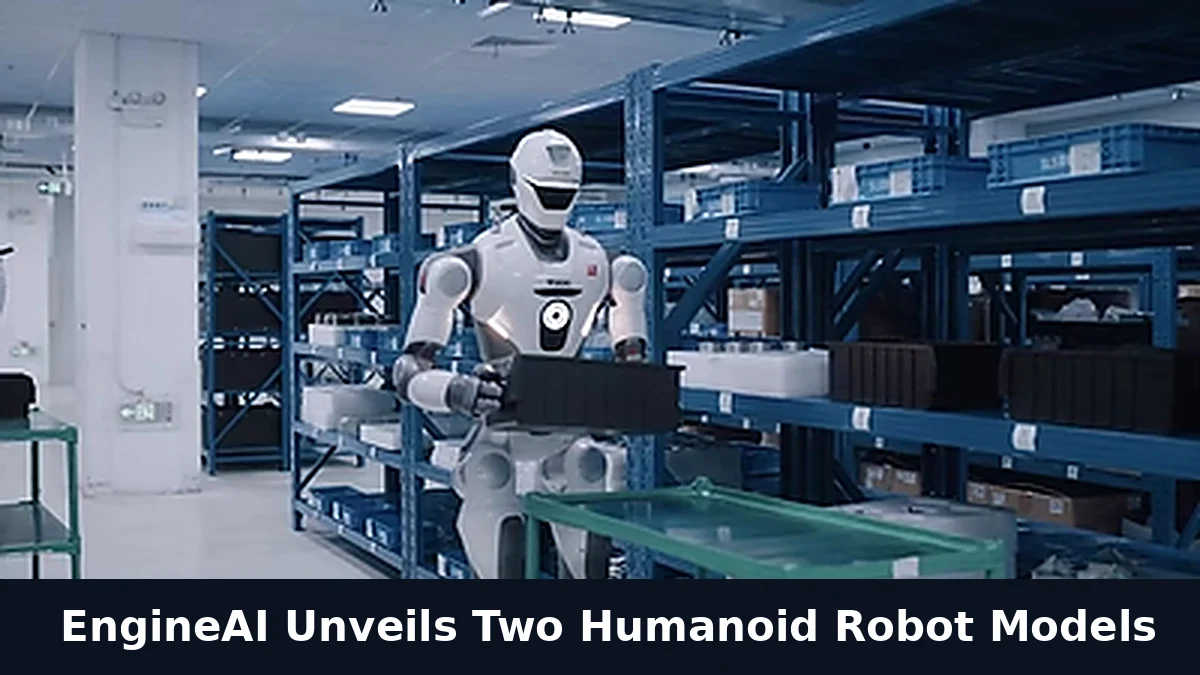
EngineAI, a Shenzhen based humanoid robotics company, has unveiled two foundation models for humanoid robots at its first Worldwide Developer Conference, alongside a $150 million support package for ecosystem partners. EngineAI Awaken-HI is a vision language action model for humanoid movement and manipulation, while EngineAI-BFM is a general purpose behavior foundation model. The company also plans to open source model weights and give developers access to control APIs.
The announcement, issued through a company release on November 29, marks EngineAI’s shift from building robots to supplying the software layer other companies can build on. The Shenzhen startup, founded in October 2023, already sells the T800 and PM01 humanoid robots, and its SE01 was the first humanoid to demonstrate a human like, straight knee gait.
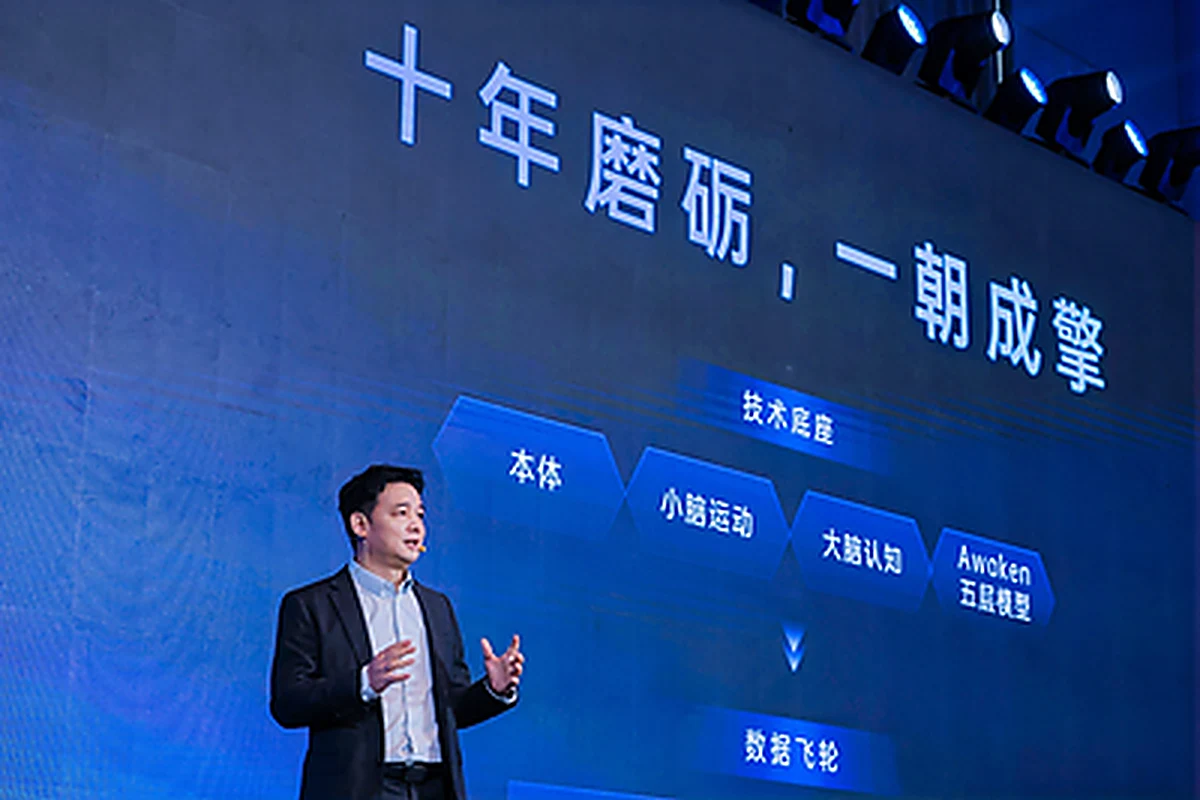
EngineAI founder and CEO Tongyang Zhao presents the Awaken architecture at the company’s first Worldwide Developer Conference. Image: EngineAI
What Was Announced?
Awaken-HI is built to turn human movement into robot action. According to EngineAI, the model predicts human motion and retargeted robot actions with a single action expert, and it reached a 90% success rate on previously unseen combinations of instructions after pre-training on a 50,000 hour human whole body motion dataset. The company says scaling that dataset from 5,000 to 50,000 hours lifted real robot task success from 56.7% to 90%, a figure presented at the conference and reported by AIReport.
EngineAI-BFM takes a broader role as a general purpose behavior foundation model. It combines high dynamic whole body movement with fine grained dexterous manipulation, and EngineAI says it supports cross robot adaptation, force aware physical interaction, and autonomous traversal of complex terrain while maintaining stable locomotion with payloads exceeding 35 kilograms.
Beyond the two models, EngineAI plans to open source its human motion agent-RSI and the EngineAI-BFM model weights, and to give developers APIs for motion control and obstacle avoidance. The company gave no date for either release. It also showed a smart inspection solution that combines task comprehension, navigation, manipulation, and detection, letting robots plan routes, avoid obstacles, take elevators, and inspect factory campuses on their own, then send anomalies and inspection reports to a cloud platform. A separate “Parallel Space” whole body teleoperation platform was also on display.
EngineAI also announced it will work with industrial chain funds, including Henan Investment Group and Chenkun Jingu, to provide $150 million of industry scale support to ecosystem partners. A developer program called “Engine Plan” will offer access to robotic platforms, computing power, and engineering experience, plus joint research, training courses, and commercial partnerships.
“Behind every industry are thousands upon thousands of clients, each with different needs. Such a vast and diverse range of demands is difficult for any single company, or even several companies, to meet on their own,” said Tongyang Zhao, founder and CEO of EngineAI.
Why It Matters
Humanoid robots are moving from demonstration videos into factory floors, and the contest is shifting from hardware to the models that control it. EngineAI’s pitch is that one behavior model can transfer across different robot bodies, which would matter if it holds up outside the company’s own machines. The company points to early deployments as evidence: a research team at ETH Zurich is using the PM01 for ladder crossing locomotion research, and the T800 is performing material picking and delivery tasks at Luxshare Precision’s Suzhou manufacturing facility.
The announcement also fits a wider week for humanoid robotics. Samsung is preparing its first humanoid robot for a debut at CES 2027, as GPTOnline reported, and the field now includes established robot makers, car companies, and AI labs all chasing the same factory and warehouse work.
Some caution is warranted. Every performance figure in the announcement comes from EngineAI itself, and none has been independently verified. The 90% success rate covers the company’s own test setup, not a public benchmark, and there is no direct comparison with rival systems. The open source promise is also open ended, with no timeline and no license named. Until weights and APIs actually ship, Awaken-HI and EngineAI-BFM are conference announcements, not tools developers can use.
Even so, the direction is clear. EngineAI is betting that the value in humanoid robotics will sit in shared models and developer ecosystems rather than in any single robot. Its URKL robot fighting competition, billed as the world’s first industrial level event of its kind, makes the same point in public: winners’ code will be open sourced so other teams can build on it.

EngineAI humanoid robots compete in the company’s URKL robot fighting competition. Image: EngineAI
Pricing and Availability
EngineAI did not announce pricing for the models, the APIs, or the inspection solution, and it gave no date for the planned open source release of the EngineAI-BFM weights. The $150 million ecosystem support figure covers funding and backing arranged with partner funds, not a product price.