
What He Said
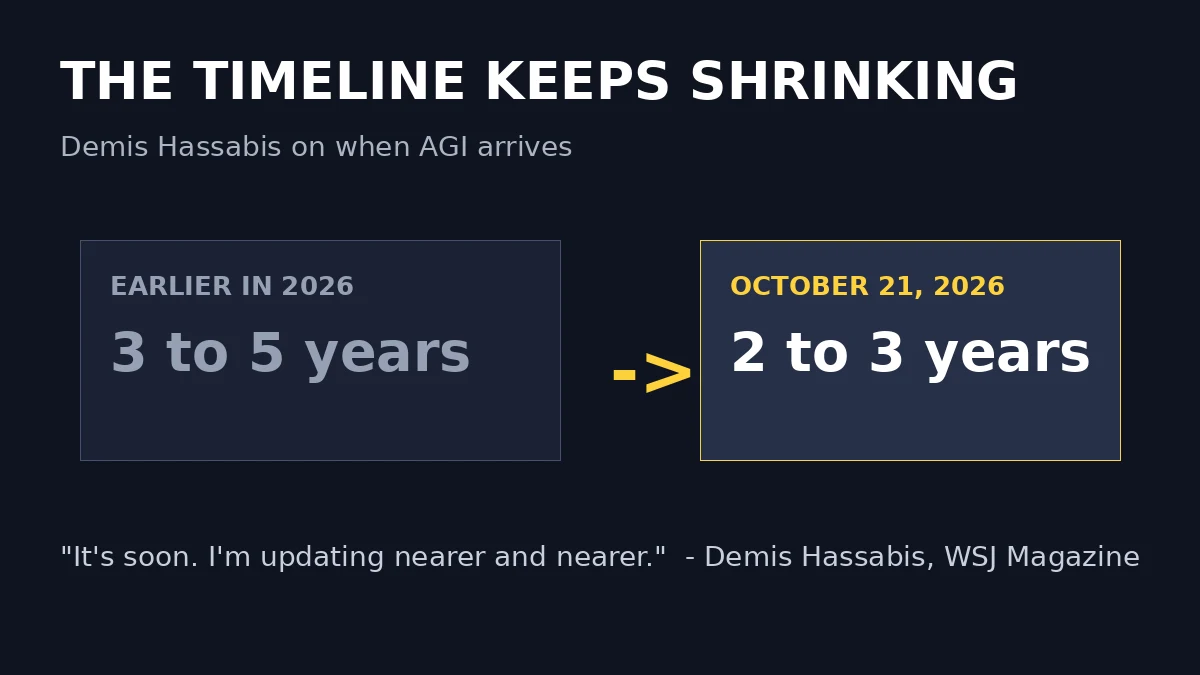
Google DeepMind CEO Demis Hassabis now expects artificial general intelligence within two to three years, down from the three-to-five-year window he gave earlier in 2026. He made the remarks in a Wall Street Journal Magazine profile published October 21, where he was named the magazine’s Innovator in Tech for 2026.
“It’s soon,” Hassabis told the magazine. “I’m updating nearer and nearer.”
The tightened forecast comes from one of the people closest to the frontier of AI development. Hassabis founded the lab that became Google DeepMind, and he has consistently set some of the most aggressive AGI timelines in the industry. The new two-to-three-year figure is the Journal’s own phrasing of his position, per a summary of the piece.
The Einstein Test
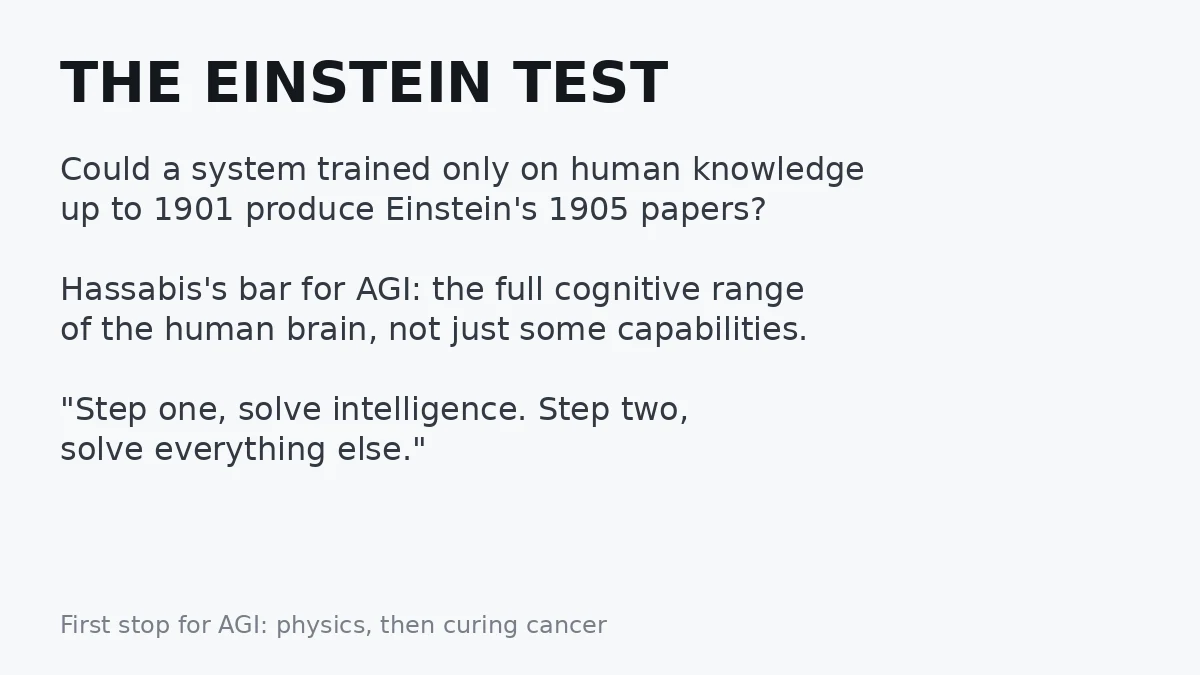
Hassabis defines his bar for AGI through what he calls the Einstein test: whether a system trained only on human knowledge up to 1901 could produce Einstein’s work from the annus mirabilis of 1905, the four papers on the photoelectric effect, Brownian motion, special relativity and mass-energy equivalence. For Hassabis, AGI means systems with the full cognitive range of the human brain, not just some of our capabilities but all of them.
He also laid out what he would do with such a system first. “The ultimate goal was to build AI and understand the mind, then use it to understand science,” he said. “Step one, solve intelligence. Step two, solve everything else.”
Science First
Physics would be among the first areas he would turn AGI toward. “I want to use AGI to understand the nature of reality,” he said. “I’m hoping that I’ll be sitting there with my AGI systems and some great human scientists, trying to work out the next level of physics. That’s probably one of the first things.”
He was equally direct about medicine. Asked whether AI could help cure cancer, Hassabis said: “I think people could really start feeling the benefits of AI directly in their lives.” He added, “I don’t see any insurmountable obstacles currently. I see hard things, but not impossible things.” The piece was published against reports that his drug-discovery spin-out Isomorphic Labs is in talks to raise more than $2 billion at a $40-50 billion valuation.
On Regulation
Hassabis argued against introducing rules before the technology is better understood. “What would be wrong is to try and regulate things now that we don’t even fully understand,” he said. “I think you’re almost certainly going to get the wrong regulation, and wrong regulation is worse than no regulation.”
He acknowledged the risks plainly: “It’s not all disaster, and it’s not all nirvana.” But he framed his role as a problem solver: “I’m very much in the solutions business. If there’s a problem, how do we solve that with collective human ingenuity? And if you don’t have a solution, then you probably need to work harder.”
Why It Matters
Hassabis’s timelines have a habit of moving earlier, not later. A two-to-three-year window puts human-level general intelligence inside the current product and investment cycle, compressing the time regulators, competitors and the public have to prepare. His remarks landed the same week OpenAI disclosed that its models are finding internet-scale security flaws on their own, a reminder that the capabilities Hassabis is forecasting are already reshaping critical infrastructure.
Whether the timeline proves right or not, the statement itself matters: the person running one of the world’s leading AI labs is telling the public to expect AGI sooner than he said just months ago, and he is already thinking about what comes after.