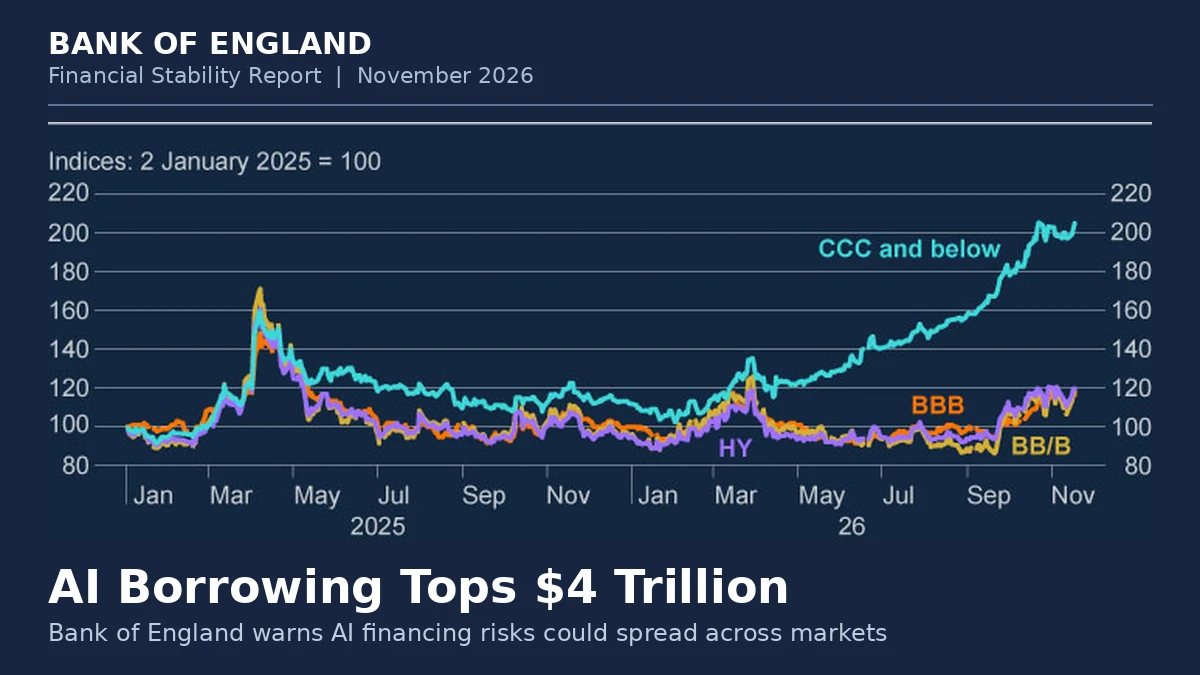
The Bank of England has warned that the borrowing boom behind the artificial intelligence buildout is creating new risks for the global financial system, with the largest cloud and AI companies now carrying just over $4 trillion in debt and off-balance-sheet commitments. The warning comes in the Bank’s half-yearly Financial Stability Report, published on November 26, 2026.
The Bank’s Financial Policy Committee said AI investment has supported global growth, but the financing behind it is expanding fast and in increasingly complex forms. It is a striking shift in tone from a central bank that, until recently, treated the AI boom mainly as a story about productivity and stock prices.
What the Bank Found
Bond issuance by the big cloud companies known as hyperscalers is set to exceed $305 billion in 2026, accounting for around 8% of global investment-grade issuance. Borrowing by hyperscalers, data-centre operators and other AI infrastructure firms is almost double its 2025 level, and total issuance from the broader AI ecosystem this year exceeds the annual borrowing of many individual governments, including the UK.
“The growth and broadening of markets used to finance AI-related investment is deepening interconnections across the system, making it more likely for stress in one area to propagate to another,” the Bank wrote in the report.
The Bank expects the financing needs of AI businesses to increase further in 2027, reaching into investment-grade bonds, leveraged finance, private credit and public and private equity.
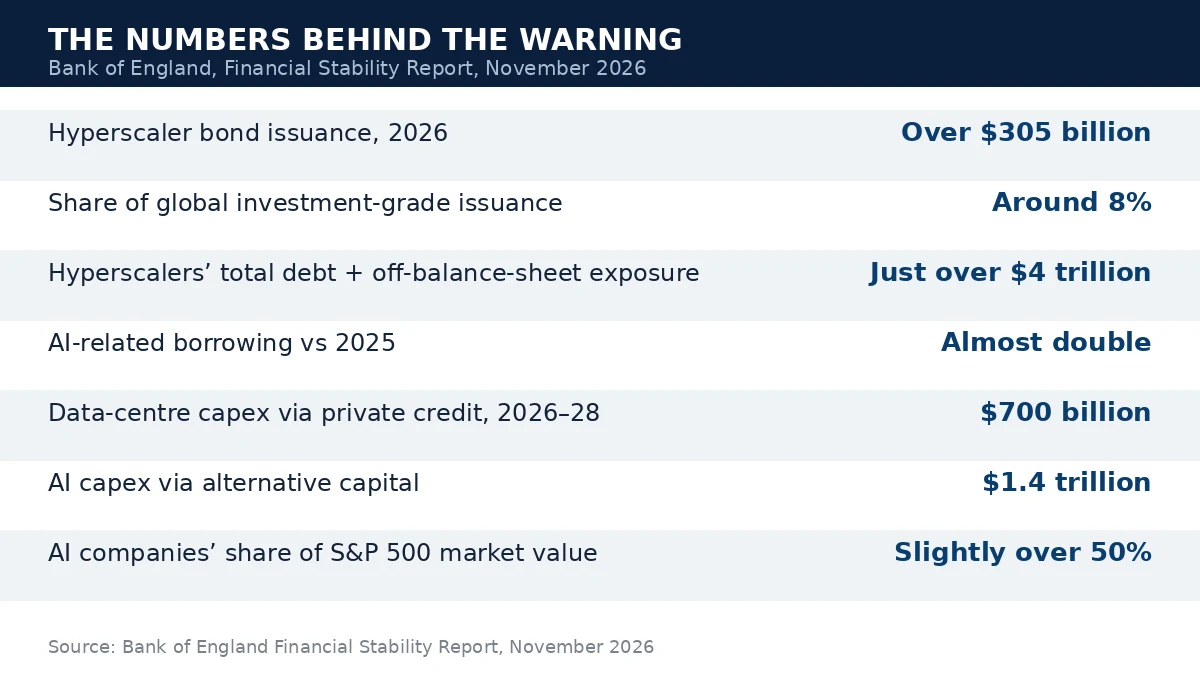
Key figures from the Bank of England’s November 2026 Financial Stability Report. Graphic: GPTOnline, using Bank of England data.
The $4 Trillion Exposure
The headline number comes from the Bank’s own estimates. Internal Bank estimates put hyperscalers’ total potential exposure, including debt and off-balance-sheet contractual commitments, at just over $4 trillion.
Much of that money flows through structures that are hard to see into. Hyperscaler financing increasingly combines bond sales with joint ventures and special purpose vehicles funded by public and private capital. Businesses across the AI supply chain rely on leases, purchase agreements, backstops and guarantees from a small number of large hyperscalers and chip designers. In some cases the same large firms act as investor, customer and supplier at the same time, in relationships sometimes described as “circular financing”.
“Off-balance-sheet arrangements make assessing the serviceability of potential future liabilities (and the associated risks) more challenging,” the report said.
Private credit is playing a growing role in the buildout. Morgan Stanley analysts estimate that $700 billion of data-centre capital spending between 2026 and 2028 will be financed by private credit, while J.P. Morgan analysts estimate that $1.4 trillion of anticipated AI capital spending could be financed by alternative capital.
Signs of Strain Are Already Visible
The Bank said credit conditions for weaker AI borrowers are already tightening. Credit spreads have widened sharply for some lower-quality AI-related borrowers since July, and spreads on US CCC-rated debt have risen to their highest level since early 2023. Some private credit funds are becoming more selective about AI and data-centre financing, and some are looking to distribute or offload exposures amid concerns about concentration in their portfolios.
Equity markets tell a similar story. AI-related companies still account for slightly over half of the S&P 500’s market capitalisation, and the 10 largest companies make up 41% of the index. AI equities fell sharply following the US midterm elections as investors reassessed the scale, pace and cost of AI-related investment, and those moves were amplified by hedge funds cutting back leveraged positions.
Frontier AI and Cyber Risk
The report also flagged the technology itself as a stability risk. Frontier AI capabilities have continued to grow since July, notably in the sophistication of AI agents and open-weight models. Recent incidents have illustrated the challenges of controlling increasingly autonomous agents, and open-weight models can be run more cheaply, with safeguards more easily disabled or removed, making advanced models more readily available to malicious actors.
Recent Google Cloud and Microsoft outages also showed how disruption at a single provider can affect many firms at once, as financial firms increasingly rely on common technologies and third-party providers. The Bank called an orderly transition to quantum-resistant cryptography an immediate financial stability priority.
Governor Andrew Bailey has called for greater international cooperation, including with China, to test new AI models before and after release, Reuters reported.

Sarah Breeden, Deputy Governor for Financial Stability at the Bank of England, presents the November 2026 Financial Stability Report. Image: Bank of England.
Why It Matters
The Bank stopped short of predicting a crisis. It described rising vulnerabilities rather than an imminent collapse, noted that spillovers across markets have so far been limited, and said the UK banking system remains well capitalised with high levels of liquidity. But the message is clear: the AI boom is no longer just a technology story or a stock market story. The way it is financed now links banks, bond markets, private credit funds and insurers, so trouble in one corner could travel further than before.
“The scale and nature of these financing commitments could come under strain in a stress or if expectations around future AI revenues were revised down,” the Bank warned.
The warning follows the US Federal Reserve’s own stability report earlier in November, which also flagged stretched AI valuations. For investors who have treated the AI buildout as a one-way bet on future earnings, the Bank of England has now put a number on the other side of the trade: $4 trillion.