Anthropic has tightened the rules for Claude Code, adding an explicit instruction that blocks the coding assistant from recreating existing video games, even when users rename the project or claim it is original. The change, confirmed by an Anthropic technical staff member on X, is a response to a surge of AI-built game clones and arrives weeks before the company’s planned Nasdaq debut.
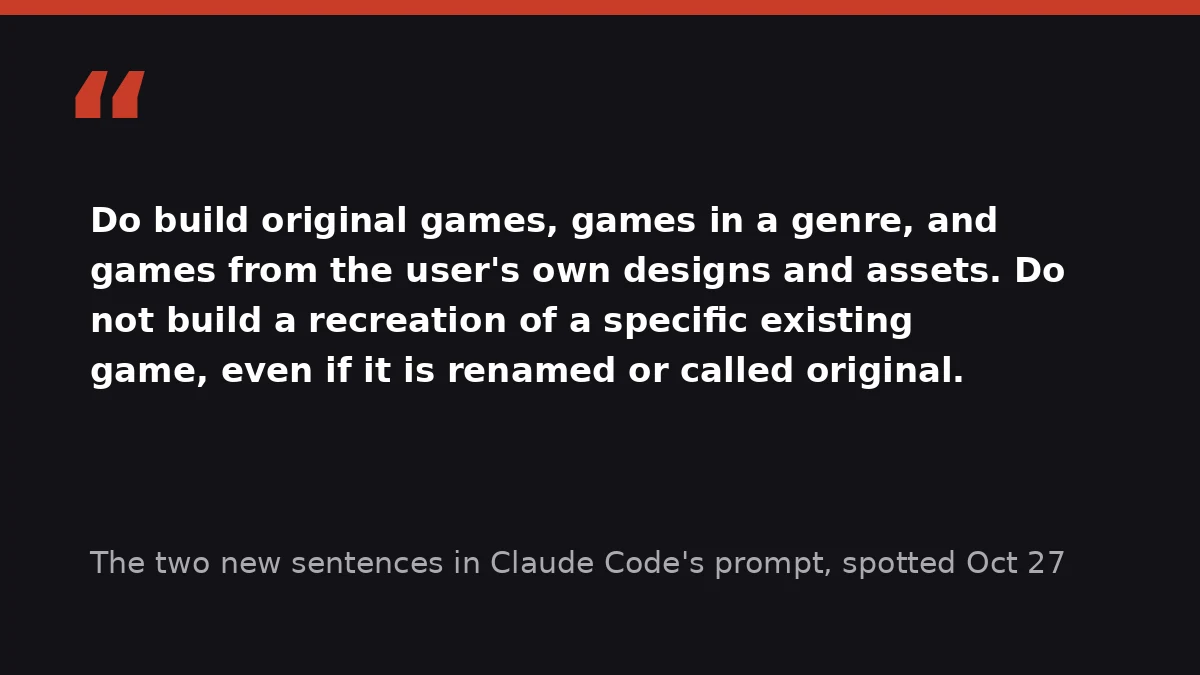
The new instruction was first spotted by an X user on October 27 inside the prompt that governs Claude Code’s behavior on the Opus 5.5 model. It reads: “Do build original games, games in a genre, and games from the user’s own designs and assets. Do not build a recreation of a specific existing game, even if it is renamed or called original.”
What changed
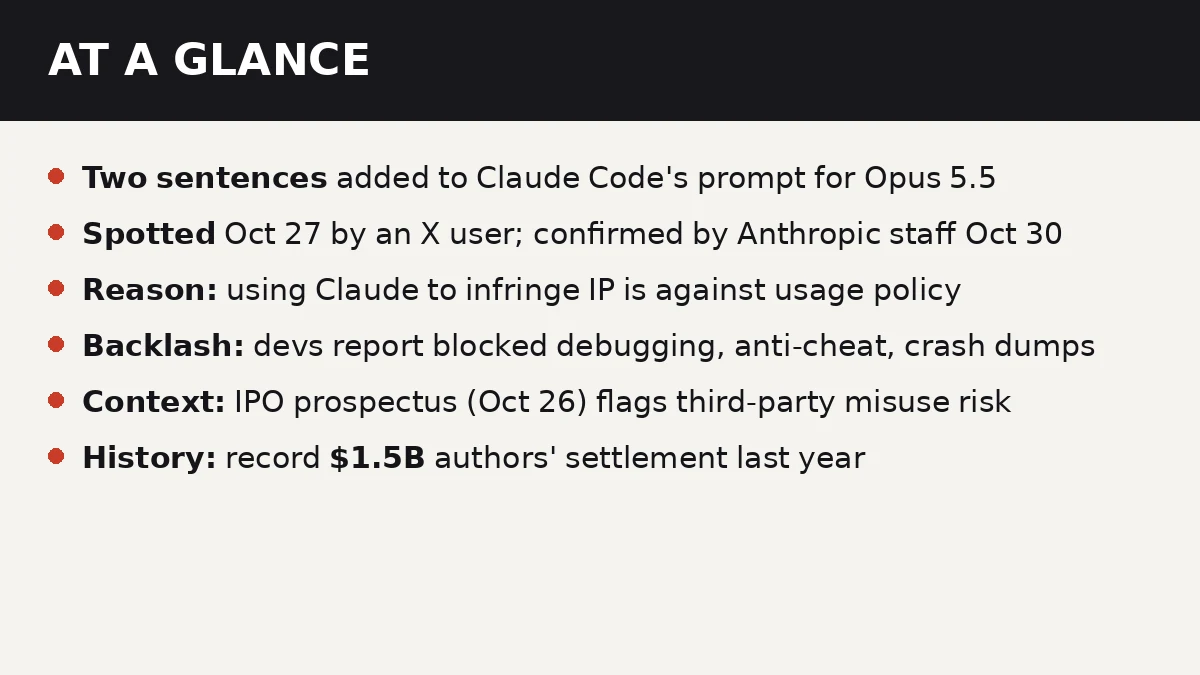
Addy Osmani, a member of Anthropic’s technical staff, confirmed the change on X on October 30, explaining that Anthropic “added two sentences to Claude Code’s prompt on Opus 5.5 to steer it away from recreating someone else’s specific game.” The company says using Claude to infringe intellectual property conflicts with its usage policies, and Osmani added that Anthropic will “continue to iterate to ensure we’re striking the right balance.”
The restriction is narrowly worded: Claude can still help build original games, games within an established genre, and projects made from a user’s own designs and assets. What it should no longer do is take a recognized commercial or indie title and reproduce its distinctive design under another name, according to Engadget’s report.
Why now
The policy lands amid a wave of AI-assisted game cloning. Engadget reported a surge of AAA titles being decompiled with AI help and released as playable browser projects, citing fan-built recreations of Halo: Combat Evolved, Call of Duty: Modern Warfare 2, and Grand Theft Auto V.
Smaller studios are feeling the pressure too. BeInCrypto reported that Digital Sun Games cancelled a public playtest over copycat fears, and some developers say they have received extortion-style threats to clone their demos into full games before the originals launch.
Anthropic has IP litigation history of its own. Last year the company agreed to a record-breaking $1.5 billion settlement in a class action in which 500,000 authors accused it of using copyrighted material to train its models, and the estate of Elvis Presley has since filed a similar suit. Its IPO prospectus, filed October 26, flags liability from third-party misuse of its models as a risk factor.
Developers report over-blocking
The rollout has not been smooth. Developers report that the new filter reaches beyond obvious clones. Claude Code’s GitHub issue tracker shows refusals in the middle of ordinary game projects, and reports cite blocked anti-cheat development, security reviews, and even analysis of a basic Windows crash dump. Anthropic has not explained how the model decides who owns a project; Osmani asked developers to flag refusals on their own work so the company can tune the balance.
The frustration has a market edge. Developers on Reddit and X say they will switch to open-weight or local models if the restrictions get in the way of legitimate work. BeInCrypto’s coverage summed up the trade-off facing every lab: the least ethical AI might be poised to become the most popular.
Why it matters
The change shows how quickly AI labs are tightening IP guardrails as legal pressure builds. With Anthropic’s shares expected to begin trading on Nasdaq in the coming weeks, every misuse incident involving Claude becomes investor-facing risk. For game developers, the question is whether the new rule stays a targeted anti-clone measure or becomes another broad filter that catches legitimate engineering work.