Historical context: This article concerns reporting published in January 2024 about 2023 search and mobile-app trends, not the current competitive position of Bing, Copilot or Google.
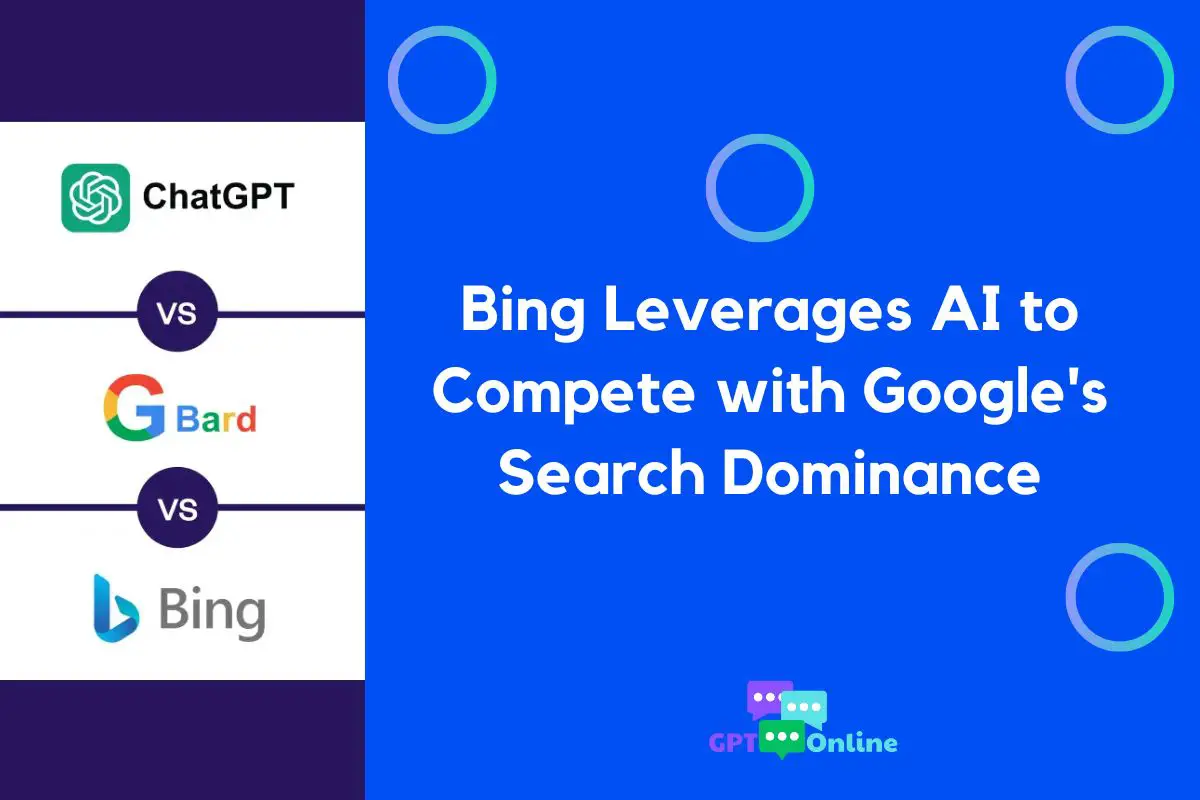
The retained cover and inline logo comparison are editorial graphics for this January 2024 article. They reflect historical branding, not a current product interface or equivalence between the services shown.
In early 2023, Microsoft introduced an AI-powered Bing using OpenAI models customized for search, rather than simply inserting the consumer ChatGPT service into the search engine. This January 2024 article discusses Bloomberg’s reporting on Bing’s position at the end of 2023. Microsoft’s broader OpenAI partnership was officially described as a multiyear, multibillion-dollar investment; the reported $10 billion figure should not be treated as the cost of the Bing feature alone.
As per data from StatCounter, a leading analytics firm, Bing’s global search market share was a mere 3.4% at the end of 2023, dwarfed by Google’s staggering 91.6%. This represents a marginal increase of less than one percentage point from early 2023. Statcounter’s measure is based on search-engine referrals to sites in its network, not a count of all searches or Bing Chat conversations. These rounded figures are retained as historical figures from the original report, not current market shares.

The Bloomberg report suggests that the AI tool’s addition may have merely halted Bing’s decline rather than fueling a resurgence. The original article also cited a 33% year-over-year engagement decline from SensorTower reporting. That historical app-engagement comparison should not be treated as a measure of all Bing web-search activity.
However, Bing did witness some positive trends in 2023. The original report described U.S. mobile-app monthly active users doubling to 3.1 million in the second quarter of 2023, alongside an 84% rise in engagement time, and reaching 4.4 million by year-end. These are attributed historical mobile-app figures, not the total audience of Bing search across devices; the exact underlying later-period series was not independently reproduced for this review.
Despite these developments, the original article noted no Microsoft comment on the report. Meanwhile, other contenders like Perplexity are leveraging AI, aiming to dethrone Google from its top spot in the search market. In January 2024, Perplexity announced a successful Series B funding round, which valued the company at an impressive $520 million.
The original Bloomberg reporting attributed to economist and Harvard Business School professor Shane Greenstein the view that Google’s established search-feedback cycle could make its position difficult to dislodge. This is a reported historical assessment, not a prediction established as fact.
The original article also raised questions about the expense of AI-generated answers. Its 1,000-times query-cost comparison lacked a specified model, workload, date and accounting basis, so it is not presented here as an established like-for-like ratio. The market-share and app-engagement observations alone do not establish the return on Microsoft’s wider investment.
Primary context sources: Statcounter’s referral methodology; Microsoft’s January 2023 partnership announcement; Microsoft’s GPT-4 explanation; Perplexity’s financing counsel confirming the historical $520 million valuation.