NVIDIA has published the weights for Nemotron-Labs-Image-30B-A3B, a 30-billion-parameter image generator, on Hugging Face. The model is the raster image component of Nemotron-Labs-VisualCreation, NVIDIA’s new “Pixel as Code” framework for agentic visual creation, and its reported benchmark scores put it ahead of OpenAI’s GPT Image 2 on several measures, including text-heavy image generation.
The release, which surfaced on Hugging Face on November 24, follows the publication of the framework’s technical report on arXiv on November 23. Unlike a conventional text-to-image model, Nemotron-Labs-Image-30B-A3B is built to work inside an agentic workflow that can also produce editable artifacts such as webpages, presentations, charts and scientific figures.
What the model is
Nemotron-Labs-Image-30B-A3B is an autoregressive image generator: it predicts discrete visual tokens that a bundled tokenizer then decodes into pixels. It uses a mixture-of-experts architecture with 30 billion total parameters and only 3 billion active per token, built on NVIDIA’s Nemotron-H architecture and initialized from Nemotron 3 Nano. The bundled visual tokenizer has roughly 642 million parameters. Training combined progressive mid-training with GRPO, a reinforcement learning method, for semantic alignment and image quality.
The download is substantial: 32 safetensors shards totaling about 133 GB, and NVIDIA’s reference inference setup calls for four H100 80GB GPUs running Python 3.12 with CUDA 13. The weights are released under NVIDIA’s own license, which limits use to noncommercial research and evaluation, so this is a research release rather than an open source one.
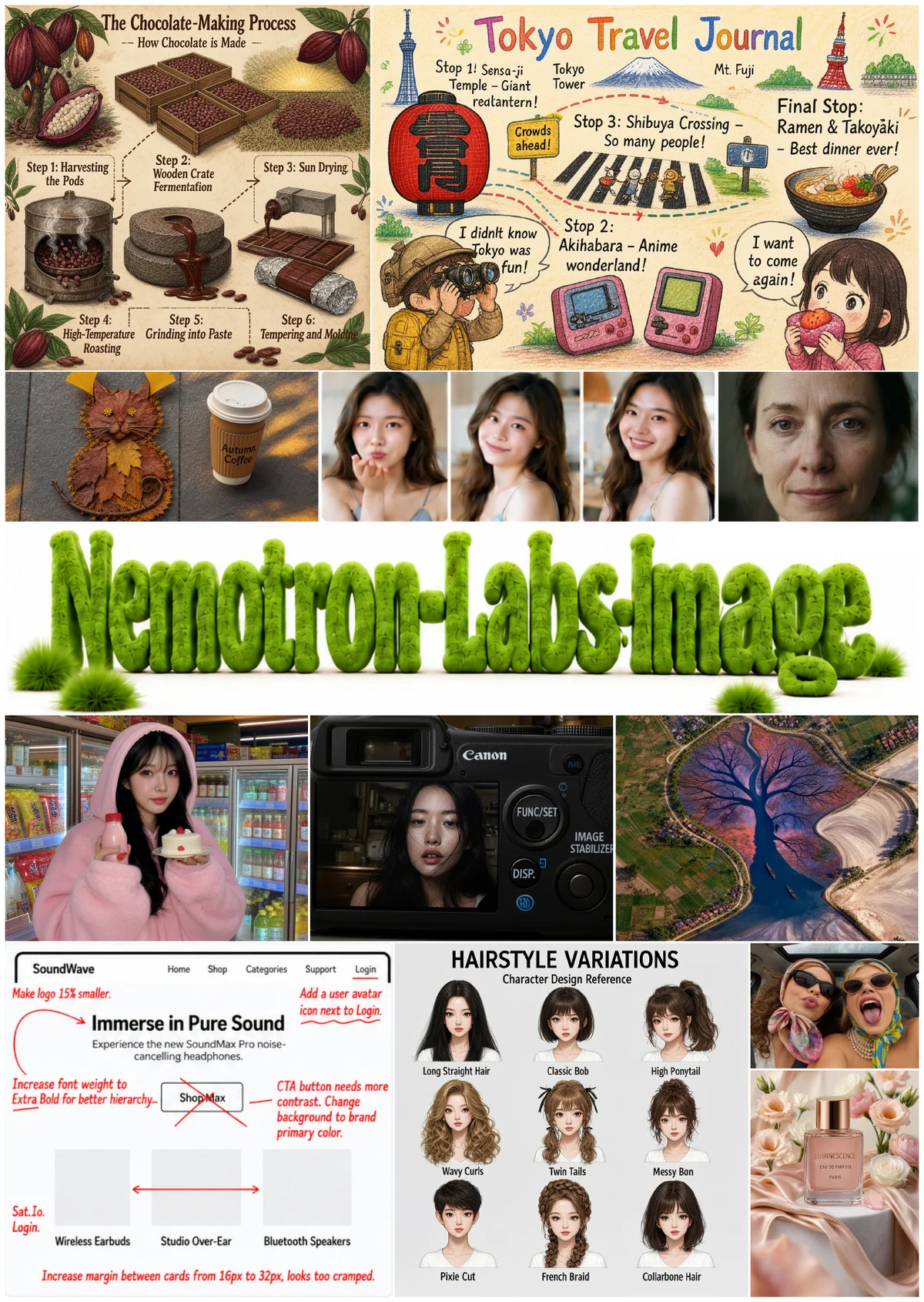
Image examples from the Nemotron-Labs-VisualCreation paper, including text-rich compositions and portraits. Image: NVIDIA
Benchmarks, with an important caveat
The headline numbers come from NVIDIA’s model card and technical report, and they describe the full VisualCreation framework in its best configuration, not the standalone image model on its own. On that basis, the framework scores 92.86 on GenEval against 89.00 for GPT Image 2, 97.98 on LongTextBench against 96.00, 91.50 on WISE Verified, and 86.0 on BizGenEval against 83.2 for GPT Image 2 and 76.7 for Nano Banana Pro.
The comparison is not one-sided. GPT Image 2 leads on GenEval2, scoring 81.00 against 65.43 for the NVIDIA framework, and on Qwen-Image-Bench, with 65.23 against 52.46. SenseNova-U1.5 leads LongTextBench at 98.80. And there is a practical gap behind the framework scores: only the image model and its tokenizer have been released so far. The VisualCreation harness and the VisionCode models that produce structured code, the parts behind much of the benchmark advantage, are listed as “will be released upon legal clearance,” with no date given. That means the full system-level results cannot yet be reproduced from what is public.
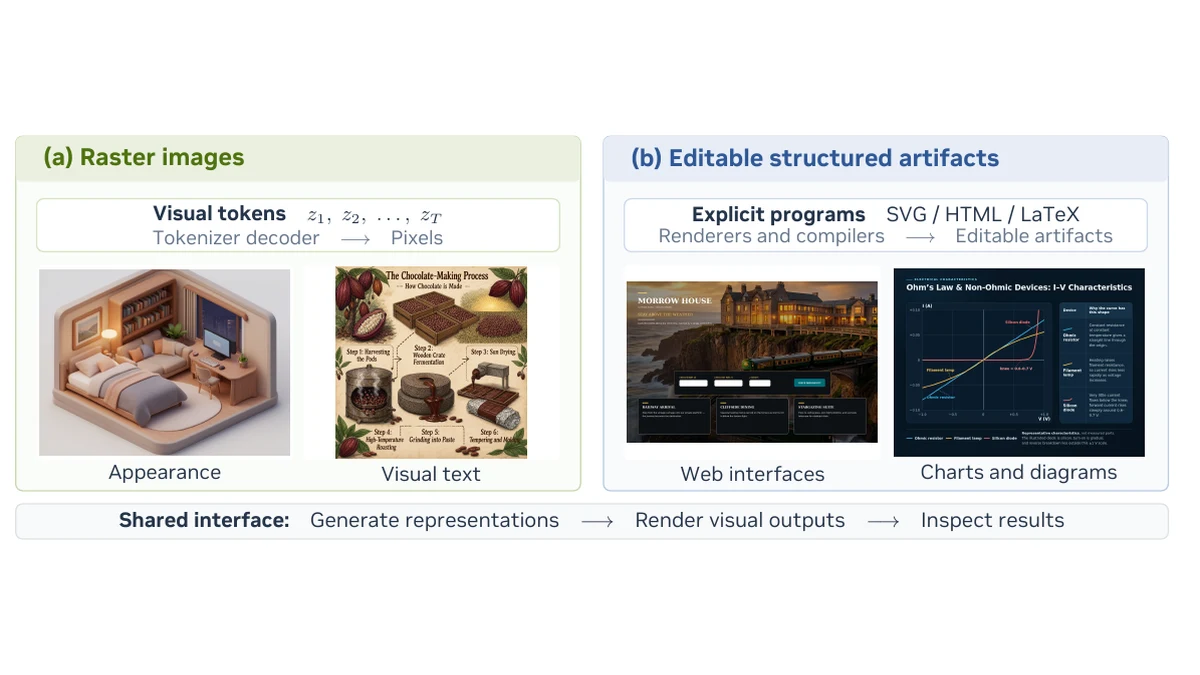
The Nemotron-Labs-VisualCreation “Pixel as Code” framework overview. Image: NVIDIA
Why it matters
Even with those limits, the release is notable. Open weights for an image generator that trades blows with the best closed models are rare, and the “Pixel as Code” idea behind it points in a different direction from most image models: instead of producing a flat picture, the framework treats pixels as code, so generated images can sit alongside editable structure such as HTML, SVG and document markup. If NVIDIA follows through with the harness and VisionCode releases, researchers will be able to test whether that approach really delivers editable, verifiable visual artifacts rather than just prettier pictures.
For now, the release gives local AI enthusiasts and researchers a heavyweight model to experiment with, provided they have the hardware to run it and accept the noncommercial terms. The technical report is available on arXiv for the full evaluation protocols and metric definitions.