OpenAI’s GPT-6 protein design research shows its GPT-6 family of models can design new protein shapes and amino acid sequences using only reasoning and general-purpose code, without calling specialized biology models to generate the designs. The finding comes from a preprint published November 24, GPT-6 as a Universal Foundation Model for Protein Biology: Beyond Specialized Models, and the company says wet-lab tests with research partner Onava showed evidence of binding across five targets.
Protein design is usually split across several specialized systems. One model proposes a three-dimensional backbone, another assigns the amino acid sequence, a third predicts whether the sequence will fold as intended, and docking tools check how the result fits its target. OpenAI’s argument is that a general-purpose model can now handle several of those stages from a plain-language prompt, switching tasks without retraining.
Lab Results: 35 of 322 Designs Bound Their Targets
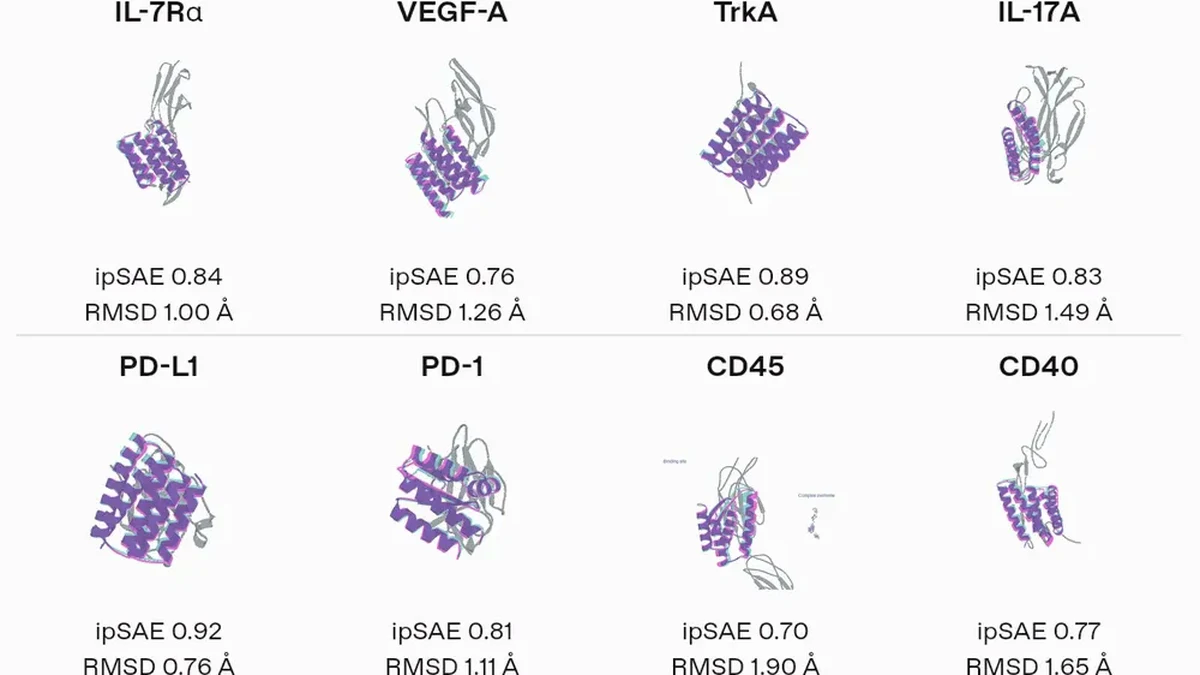
In the headline experiment, researchers gave a pre-release version of GPT-6.2 the three-dimensional structures of five target proteins and marked where a small binder protein should attach. The model wrote code to create candidate minibinder shapes, and specialized tools then supplied amino acid sequences and filtered the candidates before Onava made and tested them in the lab.
Of 322 minibinders tested, 35 (10.9%) showed evidence of binding to their intended target. The hits broke down as 18 for IL-17A, 8 for VEGF-A, 5 for PD-L1, 3 for IL-7Rα and 1 for TrkA, with at least one binder for every target. OpenAI notes the original RFdiffusion study reported higher hit rates, and that rates depend heavily on how strictly designs are filtered before testing and how binding is defined.
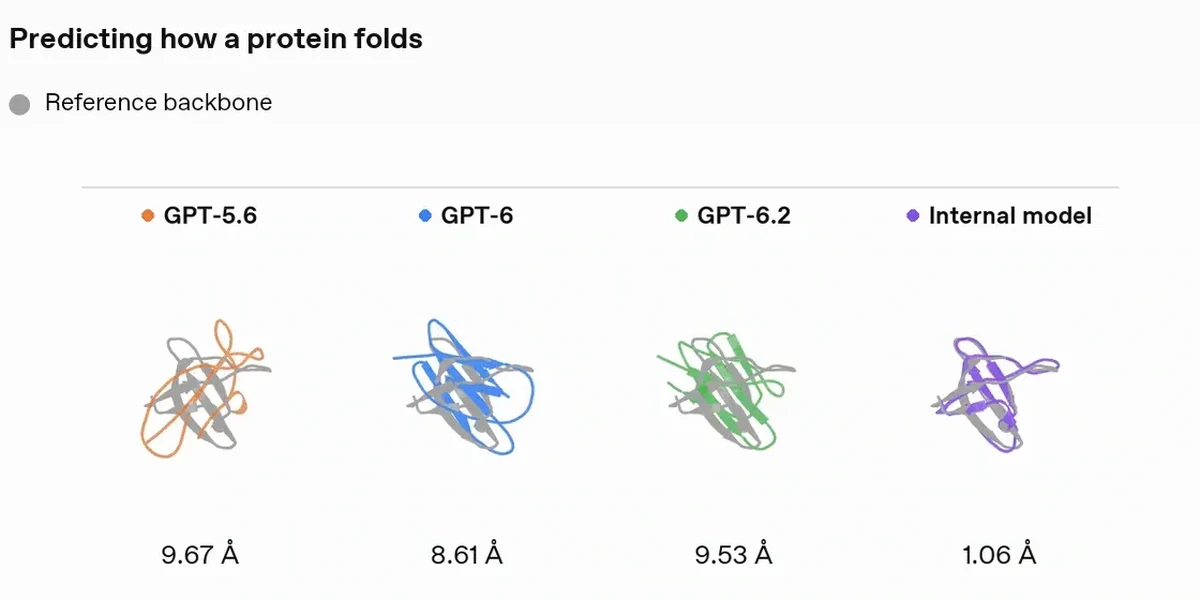
OpenAI’s models improved at predicting protein folds across generations, though a large gap to specialized predictors remains. Image: OpenAI
The team also asked GPT-6.2 to design new amino acid sequences for existing minibinder structures, with the original sequences withheld. In initial screens, binding appeared in 85% of designs for MDM2, 62% for VEGF-A and 14% for PD-1. For three unpublished minibinder shapes the model had generated itself, 14 of 107 proteins (13.1%) made from its new sequences showed binding. OpenAI presents the unpublished starting structures and the large sequence differences as strong evidence the capability goes beyond memorization.
Antibody work showed similar promise. Of 182 redesigned antibody binding loops, 128 (70%) still bound their target, IL-4Rα. In a tougher test on fragments of five therapeutic antibodies, with about half the amino acids in each binding loop changed, 179 of 272 fragments (66%) still bound their original targets, PD-1 or PD-L1.
Strong on Docking, Weak on Full Structure Prediction
On computational benchmarks, the internal research model beat specialized systems on several tasks. It scored 43.7% on MotifBench motif scaffolding, against 27.8% for RFdiffusion, and 18.9% on fold-specified design, against 17.1% for Proteina. GPT-6.2 matched the observed position of small molecules in 93% of PoseBusters docking predictions, against 50% for the specialized DiffDock-L model.
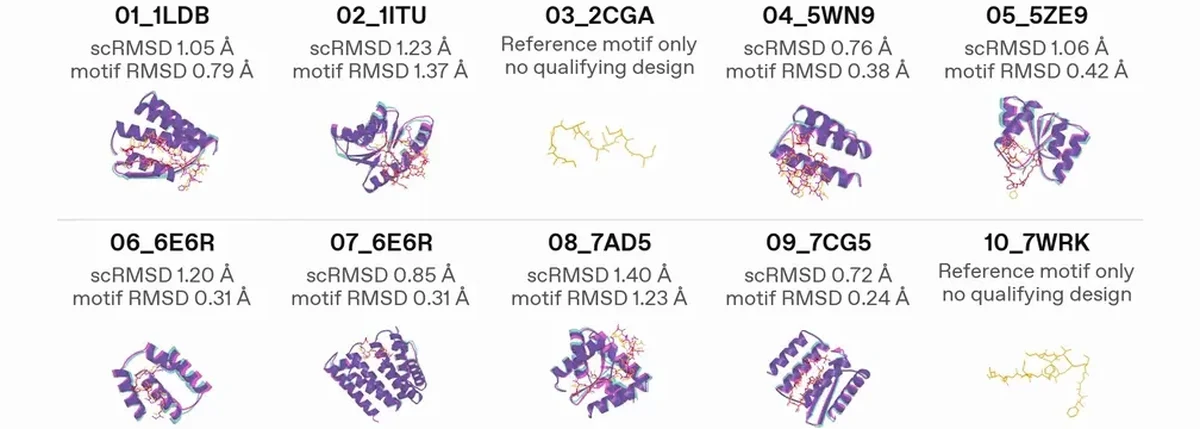
An internal OpenAI model built protein scaffolds around fixed structural motifs in 43.7% of MotifBench cases, ahead of RFdiffusion at 27.8%. Image: OpenAI
The clear weakness is predicting a complete protein structure from its sequence alone. OpenAI’s best internal model averaged a TM-score of 0.38 on that task, against 0.93 for ESMFold2, the specialized structure predictor. Scores above 0.5 generally indicate the overall fold was captured, so the gap remains large.
Why It Matters
The results matter because they point toward programmable molecular design: a scientist describing what a molecule should do in plain language and getting testable candidates back, instead of orchestrating a pipeline of narrow tools. OpenAI frames it as an early step, writing: “Ultimately, we envision enabling scientists to design proteins and molecules simply by prompting our models in natural language, massively accelerating the development of new biotechnologies and new medicines.”
That vision comes with firm limits the company states itself. Specialized models such as Boltz-2, OpenDDE and ESMFold2 still filtered candidates in these experiments, so the work does not yet show end-to-end design without them. Binding is only one early step toward a useful medicine, and specificity, stability, biological activity and safety remain untested. Some benchmark scores may also partly reflect memorization, since the structures used were public. The preprint has not been peer reviewed, and independent replication is still pending.
OpenAI also flags the dual-use risk directly. The same capabilities that could speed up new medicines could be misused, and the company says its Preparedness Framework guides how it assesses those risks. Its stated next steps are harder binding targets, designs that produce a specific biological effect such as killing a cancer cell, and a wider range of molecules including RNA and PROTACs.
Sources
- OpenAI: GPT-6 models demonstrate intrinsic protein-design capabilities
- OpenAI preprint (PDF): GPT-6 as a Universal Foundation Model for Protein Biology
- Unite.AI: OpenAI Reports GPT-6 Designs Proteins With Reasoning and Code
- Techmeme: OpenAI says GPT-6 models can design new protein shapes and sequences