Tencent has open-sourced OmniEVIE-4B, a 4.54-billion-parameter retrieval model that searches across text, images, documents and video with a single unified system, and it now sits at the top of the widely used MMEB embedding benchmark. The release, published on November 24 by the Tencent IMA Product Center and Tencent Youtu Lab, is aimed at a familiar pain point in retrieval: finding the right document is only half the job, since users still have to hunt inside it for the passage, table cell or video moment that actually answers the question.
OmniEVIE-4B, short for Evidence-Vector-Informed Embedding, is built on a Qwen3.5 backbone and covers five input types in one model: text, natural images, visual documents, native video, and agent data such as tool, GUI and memory records. The weights are available on Hugging Face under the Apache 2.0 license, with code and a technical report on GitHub.
Top of the MMEB leaderboard
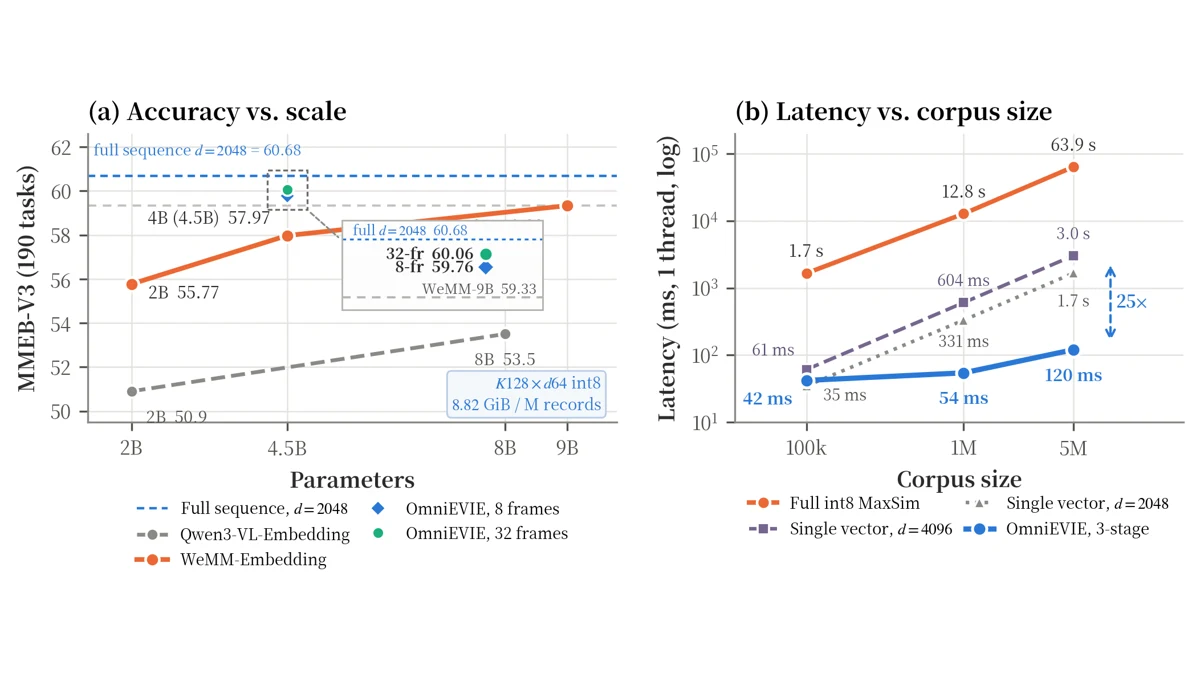
On the MMEB leaderboard, which spans 190 tasks, OmniEVIE-4B (Full) scores 60.68, while the compressed variant scores 60.06, the two best results among models evaluated without audio. The model also leads the Text track at 52.97 and the Agent track at 54.14, ahead of 9.4-billion-parameter baselines, according to Tencent. The figures are the team’s own benchmark results, not independently reproduced scores.
The accuracy comes with a deliberately small footprint. Instead of flattening a whole page or video into a single vector, OmniEVIE-4B distills each document into at most 128 int8 vectors of dimension 64, or no more than 9,472 bytes per record. A million-record index takes 8.82 GiB, and can shrink to 2.15 GiB with fewer clusters. Search over one million records takes 54.2 milliseconds on a single CPU thread, rising to 120.2 milliseconds at five million records.
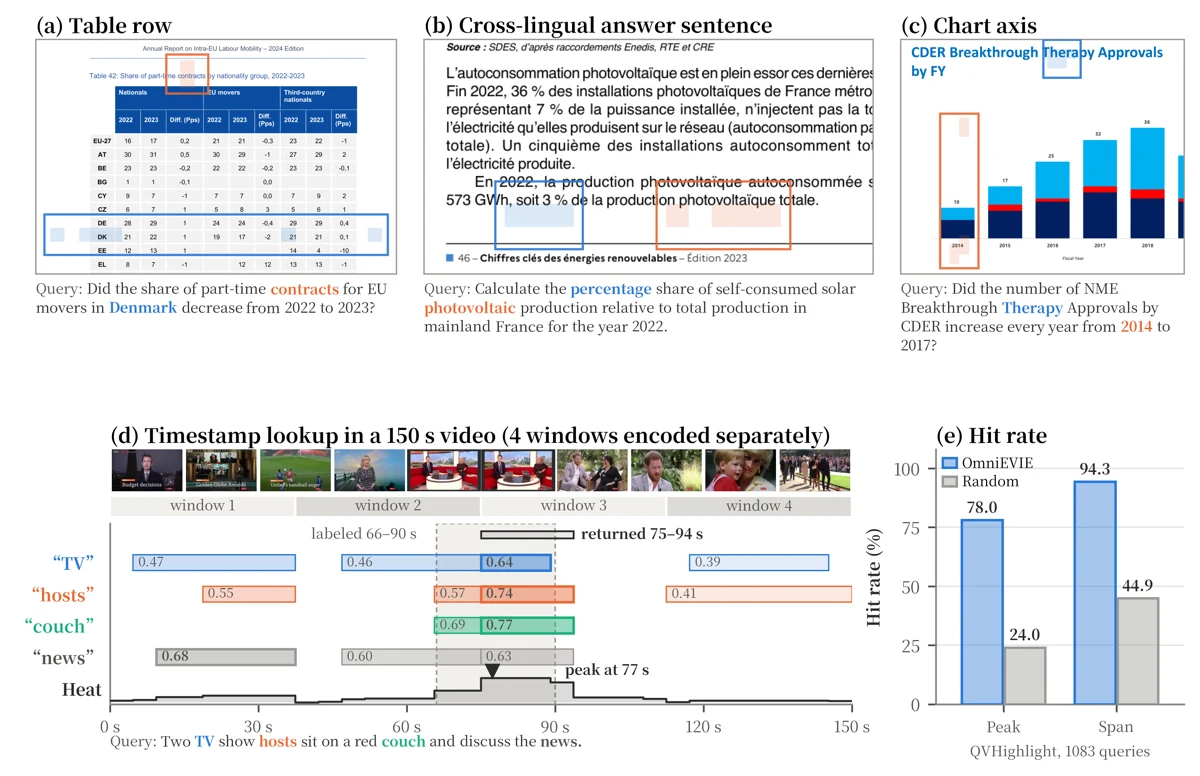
OmniEVIE-4B traces each hit to the exact table row, sentence or chart bar behind it. Image: Tencent
Evidence you can point to
The feature Tencent highlights most is evidence localization. Every retrieval hit carries its own coordinates, so the model can return the page bounding box or the video timestamp interval where the answer lives, without an external OCR or video-captioning step. As the team puts it in the project readme: “Evidence lives in the details, a single cell in a dense table, a fleeting gesture in a two-minute clip, a buried clause across pages.”
On the QVHighlights video benchmark, the model’s attention peak falls inside the labeled time interval for 78.0% of 1,083 validation queries, and the returned span intersects the labeled interval for 94.3%, compared with 44.9% for a random baseline. The returned spans cover 18% of video duration on average, so the localization is specific rather than a broad guess.
Video frames are encoded directly by the model’s spatio-temporal backbone, so a query can land on the target action inside a 150-second clip without first converting the video into text. The same compression pipeline handles text windows, document pages and video segments, and a single Prefix-MRL head supports embedding dimensions from 64 to 2,048 at runtime, letting users trade accuracy against index size.
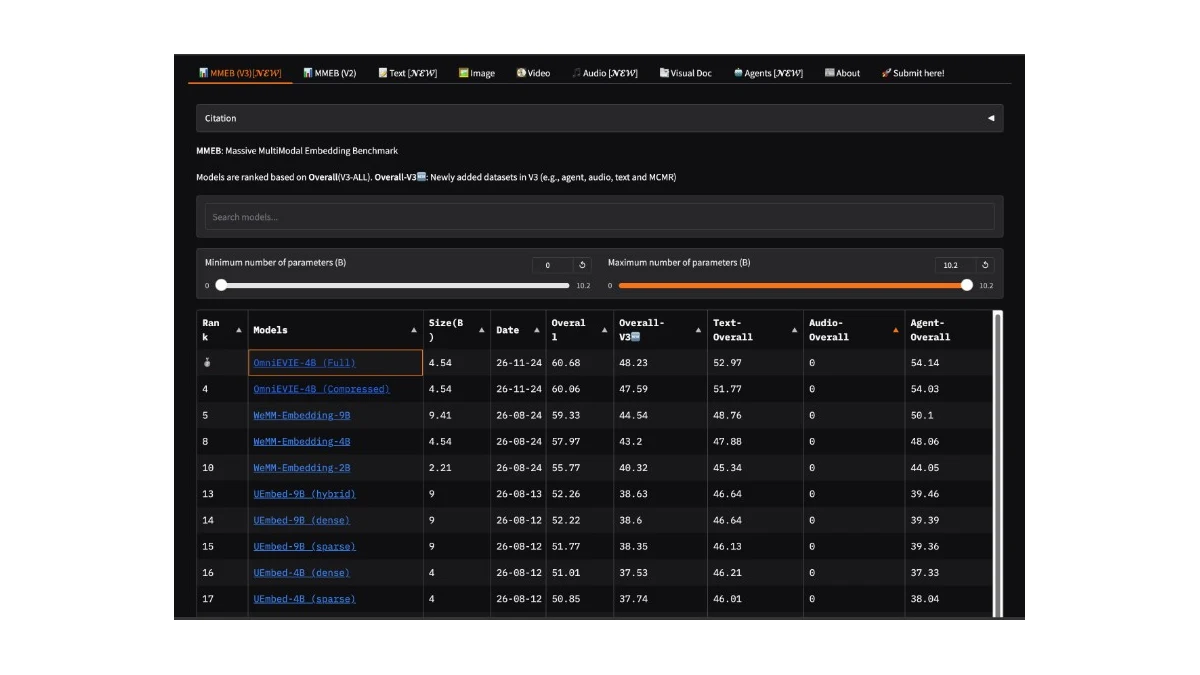
OmniEVIE-4B ranks first on the MMEB leaderboard among non-audio models. Image: Tencent
Why it matters
Retrieval is the quiet infrastructure behind AI search, enterprise knowledge bases and retrieval-augmented generation, and the field has been split between single-vector models that are fast but coarse, and cross-encoders that are precise but slow. OmniEVIE-4B tries to close that gap with multi-vector retrieval that stays cheap at scale: a compact index, millisecond search on one CPU thread, and hits that come with their own evidence attached.
For builders, the practical appeal is that one open model now handles the document types that previously needed separate systems, from scanned pages to long video. The open Apache 2.0 license and the small index footprint make it easy to test in a self-hosted setup. The open question is how the benchmark lead holds up outside MMEB’s task mix, and whether the localization accuracy transfers to messy real-world corpora, but as an open release it gives the retrieval community a strong new baseline to measure against.