
Paris-based robotics startup Genesis AI has raised $500 million in Series A funding at a $3.5 billion post-money valuation, the company announced on Tuesday, November 17, in one of the largest robotics rounds ever raised in Europe.
The round was co-led by Premji Invest, Khosla Ventures and Eclipse, with participation from Durable Capital Partners, T. Rowe Price Associates, Bpifrance, HSG, NVIDIA, AMD Ventures, Zoom, Samsung Next and Ericsson. Individual investors include former Google chief executive Eric Schmidt, Zoom chief executive Eric Yuan, former Yahoo chief executive Jerry Yang, French tech entrepreneur Xavier Niel and former Tesla chief financial officer Zach Kirkhorn.
Genesis said the money will expand its data acquisition and large-scale training, push its robots toward human-level physical manipulation, ramp up deployment of Eno, its flagship general-purpose robot, and hire more AI researchers and robotics engineers. The startup previously raised $105 million in seed funding in July 2025, bringing its total disclosed funding to $605 million, according to Crunchbase News.
What Genesis Is Building
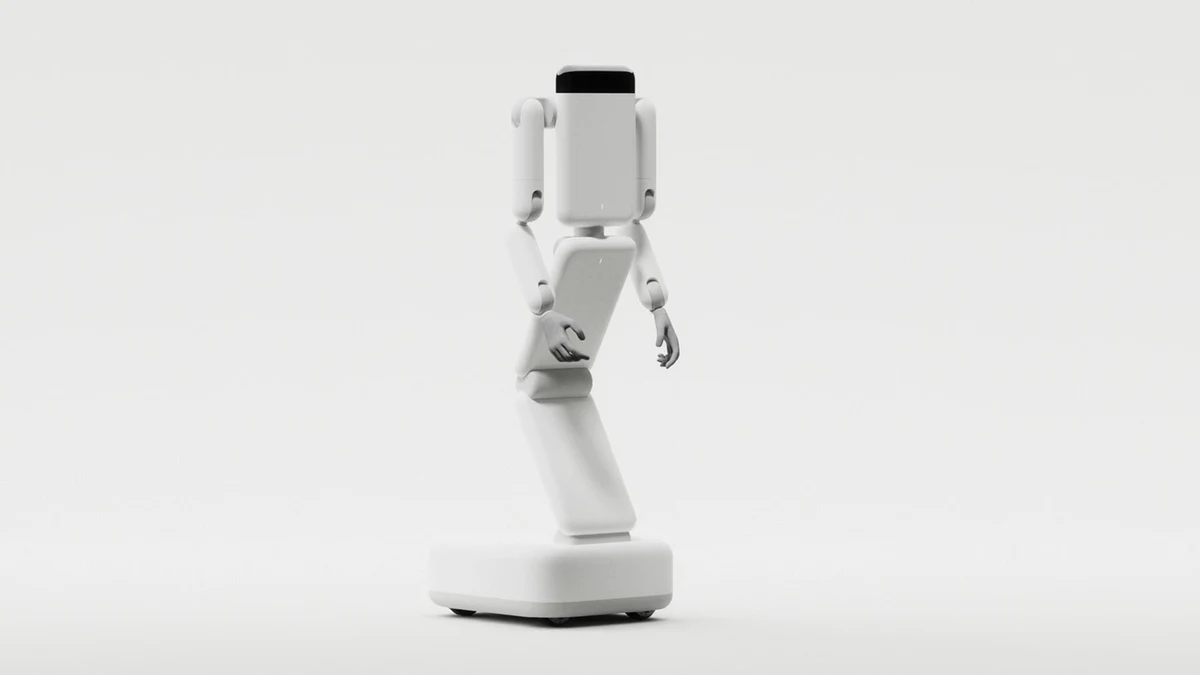
Eno, Genesis AI’s general-purpose robot. Image: Genesis AI.
Genesis, founded in 2024 by Zhou Xian and Theophile Gervet, builds its entire robotics stack in house: the robot hardware, the AI model that controls it, the data pipeline that trains it and the simulation platform that tests it. The approach is a deliberate bet that general-purpose robotics is a systems problem, not a single breakthrough in hardware or software alone.
At the center of the system is Eno, a wheeled general-purpose robot unveiled on June 16, 2026. Eno has no head or face. Instead, three body segments mounted on a rotating wheeled base fold into a compact form for storage, then rise to roughly human height to work. Its two arms end in human-scale hands with 20 actuated degrees of freedom each, built for the fine manipulation that has long been the hardest part of useful robotics.
The robot is driven by GENE, the company’s AI foundation model, which Genesis describes as its robotic brain. GENE was shown in May 2026 handling cooking, pipetting and liquid transfer, wire bundling and grasping several objects at once. A third layer, Genesis World, is a simulation platform where robots practice skills across virtual scenarios before trying them in the real world.
The Glove Behind the Dexterity
What sets Genesis apart from rivals such as Figure and Agility is how it gathers training data. More than 100 real workers around the world wear sensor-enabled gloves fitted with tactile-sensing electronic skin while doing their regular jobs, recording hand and finger movements along with force and touch information. The robot’s hand closely matches the human hand and the recording glove, creating a one-to-one-to-one mapping that lets the model learn directly from recorded human movement.
“The next generation of robotics won’t be built by improving hardware or AI models in isolation. It requires rethinking how AI, data and hardware work together,” said Vinod Khosla, founder of Khosla Ventures.
The focus on dexterity is also where the honest limits sit. Genesis has built 30 to 40 Eno robots so far, and the company told TechCrunch its dexterous hands can only operate for a few weeks of regular work before they need to be replaced. Reliability across full workflows is the real test: if each of 20 steps in a task succeeds 99 percent of the time, the chance of an error-free run falls to 82 percent. That gap between a lab demo and reliable automation is exactly what the new funding is meant to close.
From Development to Deployment
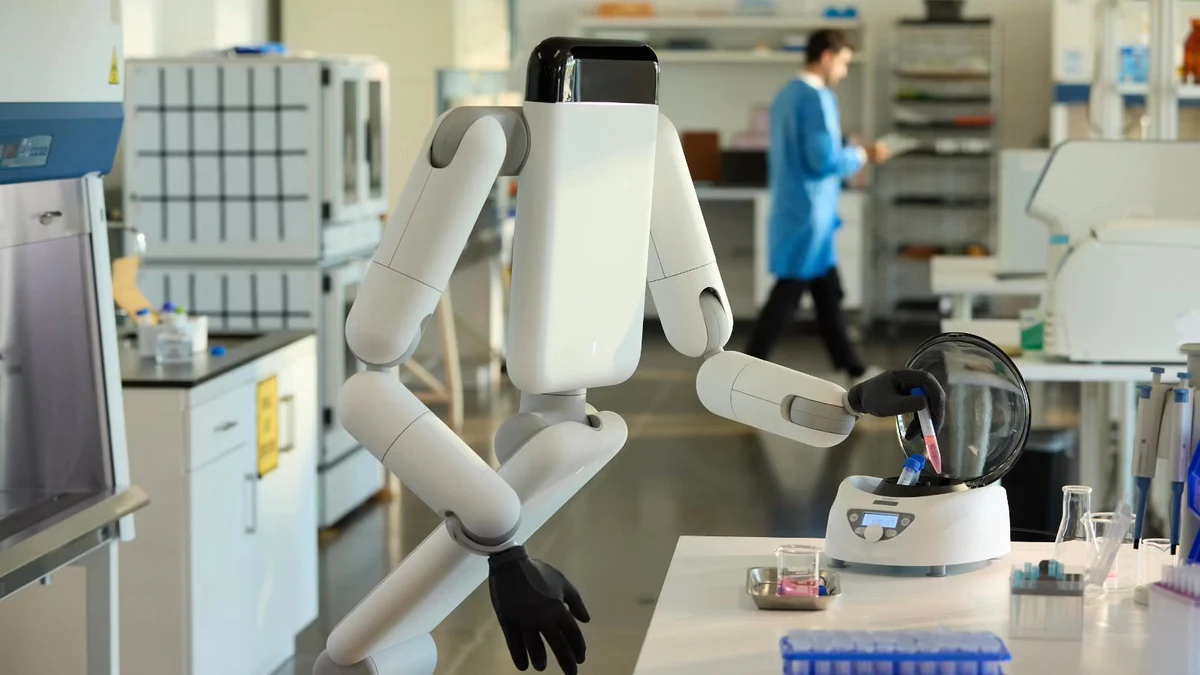
Eno handling laboratory samples. Image: Genesis AI.
Genesis is ramping up production of Eno for industrial customers first, in manufacturing, logistics and laboratories, before expanding into hospitality and healthcare, followed by consumer and outdoor uses. Chief executive Zhou Xian told Reuters the company expects a wider customer rollout in 2027. Genesis is also exploring a rental model in which customers pay for the robot and its software as a combined service.
“Our mission is to remove the physical limits on human ambition,” said Zhou Xian, co-founder and chief executive of Genesis AI. “To accomplish this, we’re working to build the world’s best general-purpose robot, one that works reliably in the real world, day after day.”
Investors pointed to the same evidence. “What stood out to us was watching Genesis robots complete long, multi-step tasks on their own at the same speed a person would, with smooth and natural movement,” said Vedant Agrawal, partner at Premji Invest. “Completing full tasks in real time, not just short clips, is what turns a robot into something a business can rely on.”
Why It Matters
Capital is pouring into physical AI, which many investors view as the next major wave after chatbots and coding agents. Robots that can reliably do real work in factories and warehouses would extend AI from screens into the physical economy, and dexterous manipulation is the capability standing between demonstration videos and deployable machines.
The scale of the bet stands out even in a frothy market. Dealroom ranks the round in the first percentile among 223 Series A rounds in French robotics of all time, and Reuters called it one of the biggest funding rounds in Europe’s robotics sector. Genesis is now valued at $3.5 billion barely two years after its founding, with a product that has yet to show scaled commercial deployment. The $500 million gives it the runway to find out whether its full-stack approach can cross that gap before rivals do.
Sources
- Genesis AI Raises $500M Series A at $3.5B Valuation (Genesis AI via PR Newswire, November 17, 2026)
- French robot maker Genesis raises $500 million at $3.5 billion valuation (Reuters, November 17, 2026)
- Genesis AI, a Robotics Startup, Raises $500 Million (The Wall Street Journal, November 17, 2026)
- Genesis AI raises $500 million to deploy glove-wearing robots (TechCrunch, November 17, 2026)
- Genesis AI Raises $500M At $3.5B Valuation To Bring Its Robots To Factories And Warehouses (Crunchbase News, November 17, 2026)
- Genesis AI lands $500M Series A at $3.5B valuation for human-level robot hands (Dealroom, November 17, 2026)
- Related on GPTOnline: Isomorphic Labs Raises $5 Billion in Series C Funding and Corma 1 Billion Valuation With $125M AI Security Round