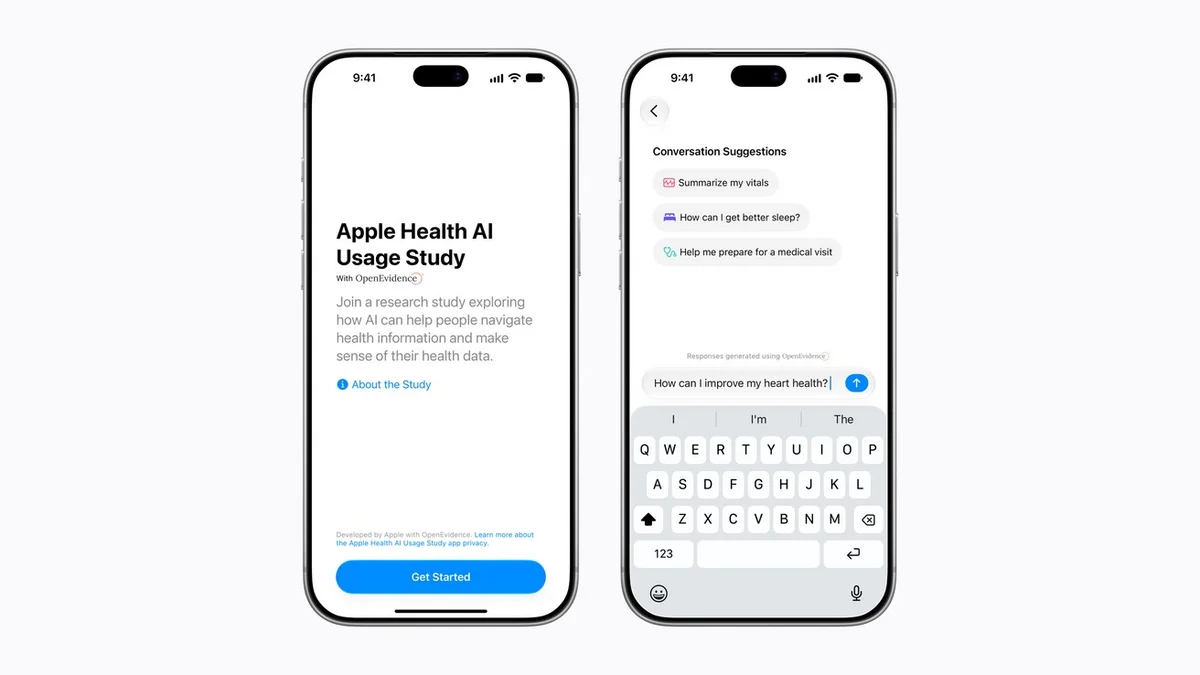
Apple has launched a large-scale research study to find out how people actually use conversational AI for health questions, opening enrollment to up to 200,000 iPhone users in the United States. The Apple Health AI Usage Study, announced on November 15 and run with clinical AI company OpenEvidence, will examine what drives trust in AI health answers, how well people understand them, and whether the tools change everyday health decisions, Apple said in its announcement.
Rather than shipping a new health feature, Apple is treating the question as a research problem first. “At Apple, we believe responsible innovation starts with scientific rigor and clinical grounding. Health is deeply personal, and conducting a dedicated research study is the most thoughtful way to understand how people engage with, comprehend, and evaluate health AI in everyday life,” said Sumbul Desai, M.D., Apple’s vice president of Health and Fitness. “Insights from this study will help advance the broader scientific conversation and ensure that as technology evolves, we continue building trusted tools that genuinely support people wherever they are on their health journey.”
What the Study Will Measure
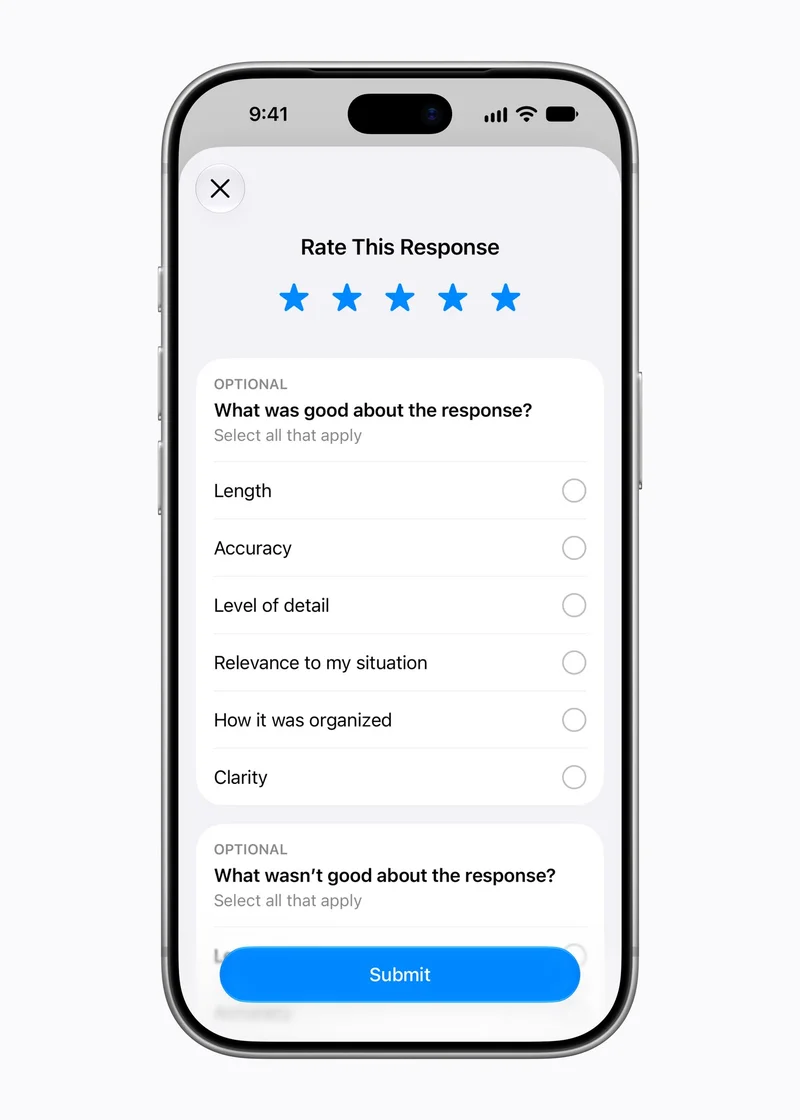
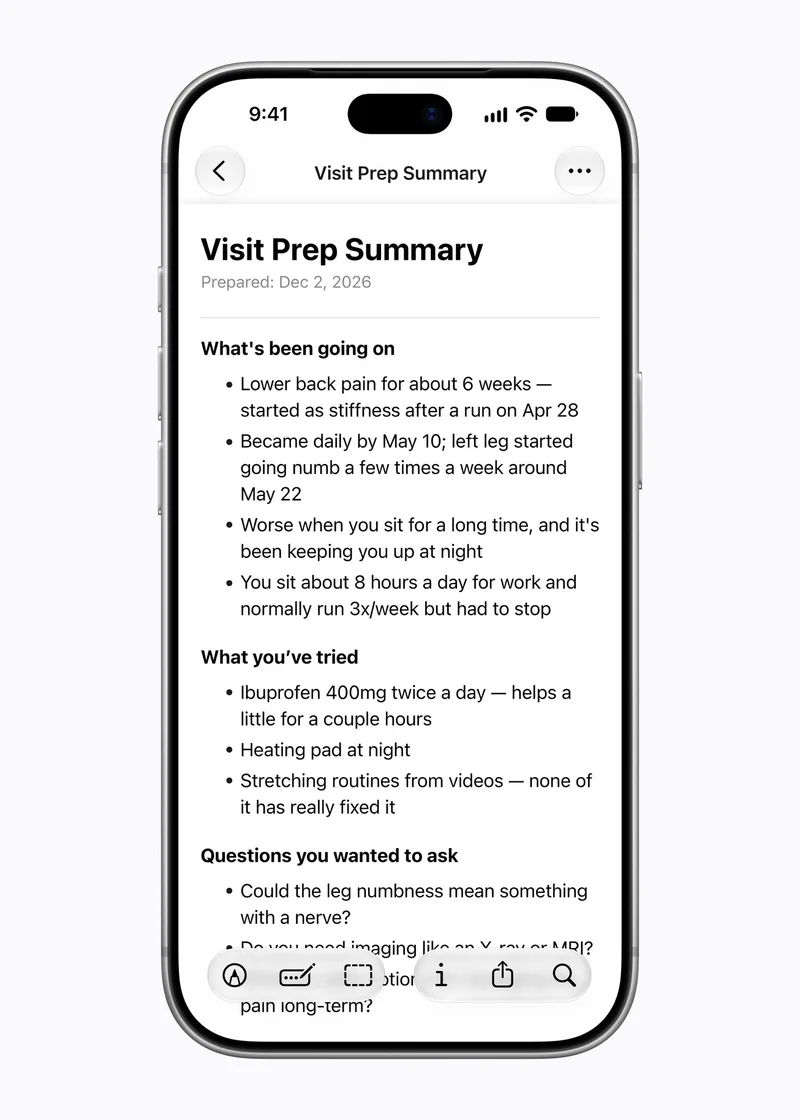
The study will look at four things: what drives user trust, the quality of responses, comprehension, and everyday health actions. Participants will ask the study app everyday health questions and rate the answers on accuracy, level of detail, and relevance, TechCrunch reports. The research will also explore whether health AI can help participants better prepare for clinical visits with their own doctors, according to Apple.
How the Study App Works
Participants use a dedicated study app built on OpenEvidence technology. OpenEvidence is a clinical AI platform widely used by healthcare professionals, and it generates answers from medical information in established sources such as The New England Journal of Medicine, the Journal of the American Medical Association, and Nature. Answers arrive in plain language with linked, peer-reviewed clinical citations that ground each response, Apple said.
Participants can also choose to share HealthKit data, such as resting heart rate, activity, sleep, or lab results, to explore how personal data affects the relevance and understanding of answers. Sharing is optional, and participants keep control over whether to share any HealthKit metrics or survey responses.
The study app is a standalone experience. The Verge reports it is not integrated with Siri and does not itself use Apple Intelligence, even though enrollment requires an Apple Intelligence-enabled iPhone. It is also separate from the main Health app and Apple’s Research app, Fierce Healthcare reports.
Privacy and Safety Guardrails
Apple says the study was designed with privacy protections, transparency, and clinical guardrails, and that study data will not be used to train AI models. Data is anonymized before it is sent to a secure third-party cloud provider, and OpenEvidence deletes query and response data after 24 hours, TechCrunch reports. The study is overseen by an independent review board, Fierce Healthcare reports.
The app also has safety guardrails intended to detect certain concerning questions and suggest that a participant follow up with a provider or other resources if needed. Apple stresses that the study app is not meant to diagnose or treat any condition and does not replace the advice of medical professionals.
Who Can Join
Enrollment is open to up to 200,000 eligible participants age 21 and older across the United States. To join, participants need an Apple Intelligence-enabled iPhone (iPhone 15 Pro or later) running iOS 26 or later. The app is available to download now, and TechCrunch reports Apple plans to run the study for more than 12 months.
Why It Matters
Millions of people already ask general-purpose chatbots about symptoms, medications, and test results, but the tools patients use and the tools clinicians use have largely been built and tested apart. “Patients and clinicians are both turning to AI, but the tools they use are being built and tested in separate worlds,” said Robert M. Wachter, M.D., professor and chair of the Department of Medicine at UCSF. “When patients and doctors draw on versions of the same trustworthy tools, patients arrive prepared, conversations improve, and next steps happen seamlessly. Connecting these tools, and rigorously studying what works, is how we’ll get there.”
Apple’s approach is also a contrast with rivals that have shipped AI health features directly into consumer products. By running a formal study first, Apple gets a controlled setting to learn where AI answers help and where they mislead, before deciding whether any of it belongs in the Health app or Siri. TechCrunch notes it is not yet clear whether Apple plans to bring AI-powered health answering to those products.
The findings are meant to inform the responsible design of health AI experiences for Apple and the wider industry, Apple said. For now, the study itself is the product: a large, real-world test of whether people can trust an AI with their health questions, and what it takes to earn that trust.
Sources
- Apple Newsroom, “Apple launches research study to explore the use of AI for health”
- TechCrunch, “Apple launches new app to study how people use AI for health”
- Fierce Healthcare, “HLTH26: Apple kicks off 200K-person health AI study”
- The Verge, “Apple’s new study looks to improve the effectiveness of AI health tools” (app separation from Siri and Apple Intelligence, as reported by multiple outlets)