Meituan has released the weights for LongCat-2.5, a 1.6-trillion-parameter model built for long-horizon AI agents, in one of the most significant open-weight releases of the year. The model was announced on November 2 and the weights went public a week later under the MIT license, which allows commercial use, modification and redistribution. What sets the release apart is the hardware story: according to Meituan, LongCat-2.5 was trained and fine-tuned on domestic Chinese accelerators, with no Nvidia GPUs involved anywhere in the pipeline.
The release drew wider attention on November 15, when The Decoder reported that the model performs at roughly the level of leading Western models on several coding-agent benchmarks. The weights are available on Hugging Face, and developers can also try the model in a chat interface at longcat.ai.
What LongCat-2.5 Is
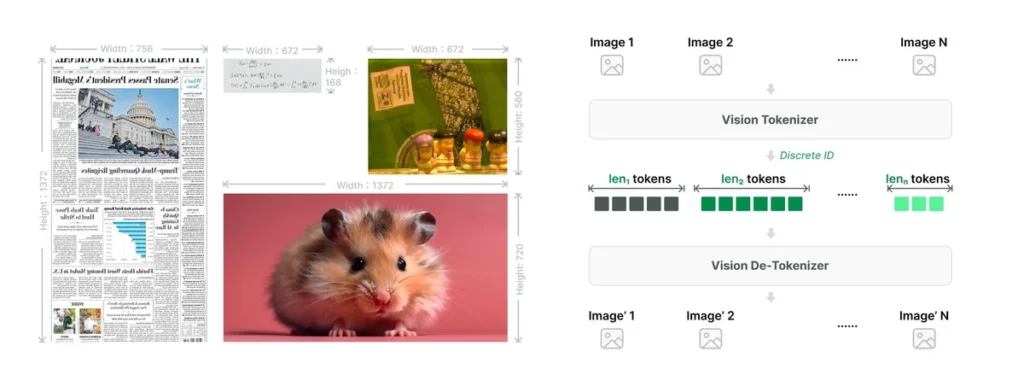
LongCat-2.5 is a native multimodal mixture-of-experts (MoE) model for long-horizon agentic tasks, in Meituan’s own description. Out of 1.6 trillion total parameters, roughly 48 billion are active per token. It builds on its predecessor, LongCat-2.0, and adds visual understanding: instead of bolting on a separate image encoder, the model converts images into discrete tokens that it processes alongside text, an approach meant to improve visual coding, design and 3D work.
Through the API, the model handles up to one million tokens of input at once and generates responses up to 128,000 tokens long. It understands text, images and video, responds in text, and lets users toggle reasoning on and off. The API supports both the OpenAI and Anthropic formats and plugs into agent harnesses such as Claude Code, Codex and Hermes.
Trained and Served Without Nvidia Hardware
The hardware angle is the headline. Meituan says training and fine-tuning ran on domestic Chinese accelerators, and its model card describes infrastructure optimizations for those chips. The model applies W4A4 quantization to expert weights and activations, a 4-bit format that Chinese chips process natively. In Meituan’s load tests, that delivers about 43 percent higher prefill throughput and about 43 percent higher decode throughput than an 8-bit version, with accuracy staying on par with the uncompressed model.
The self-hosting guide describes a deployment on a cluster of 194 Huawei Ascend Atlas A2 accelerators: two handle image processing, 64 handle prompt ingestion and 128 handle response generation. There is no guidance for Nvidia GPUs. The precedent is LongCat-2.0, which Meituan says it trained in late June entirely on a cluster of more than 50,000 Chinese AI chips.
Benchmarks: Close to Claude Opus 5 on Coding Agents
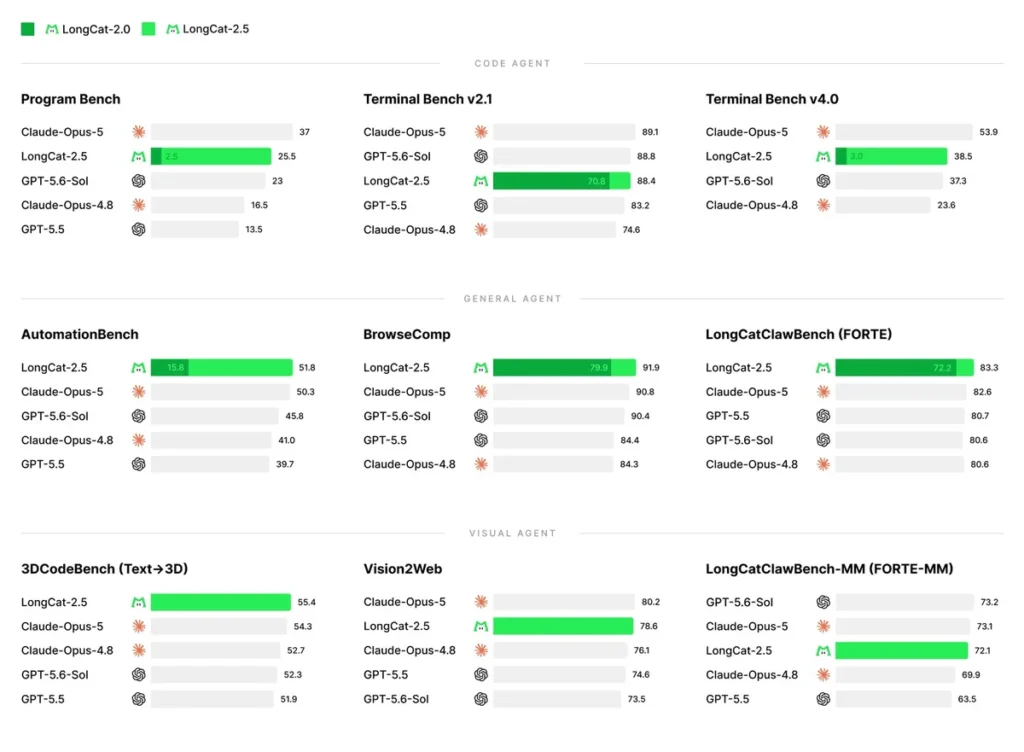
Meituan reports a score of 88.4 on Terminal Bench v2.1, which measures how well agents solve command-line tasks. That sits just behind Claude Opus 5 at 89.1 and GPT-5.6 Sol at 88.8, with DeepSeek-V4.1-Flash leading the table at 90.6. On the harder Terminal Bench v4.0, LongCat-2.5 scores 38.5, slightly above GPT-5.6 Sol’s 37.3 but well below Opus 5’s 53.9.
The gains over its predecessor are large. On DeepSWE, a benchmark for fixing bugs in real repositories, LongCat-2.5 jumps from 9.7 for LongCat-2.0 to 64.6, though DeepSeek-V4.1-Flash still leads at 74.2. The model posts 91.9 on the web search benchmark BrowseComp, the highest score in Meituan’s table, and leads its peer group on 3DCodeBench at 55.4. It scores 78.6 on Vision2Web, close to Opus 5’s 80.2.
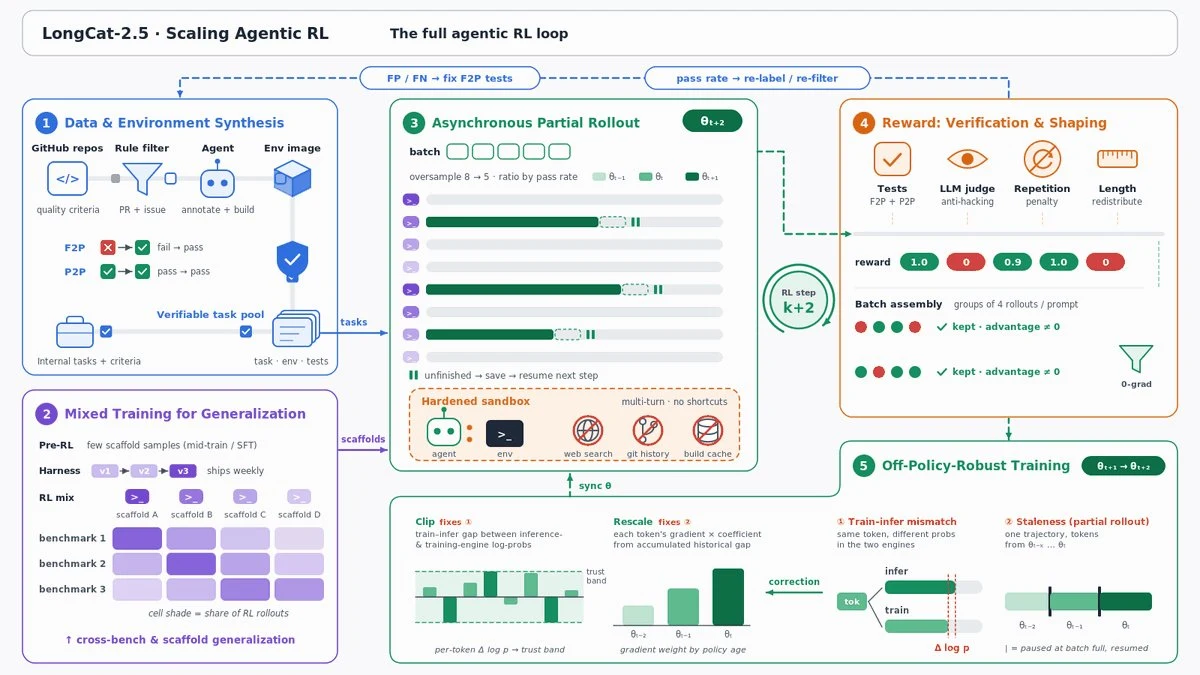
Two caveats matter. These are Meituan’s own evaluations, and the company notes that unmarked scores in its table were measured in-house and are indicative only, while starred scores are cited from public reports or leaderboards. Independent verification has not yet appeared. The training method is also notable: the team built reinforcement learning tasks from real GitHub pull requests, ran them in a sandboxed environment with no internet access, Git history or build cache, and used a language model judge to check solutions for tricks.
Pricing and Availability
The weights are published on Hugging Face in two repositories: the full BF16 checkpoint and a separate W4A4 quantized build. At launch, Meituan is charging a limited-time promotional price of roughly 0.27 euros per million input tokens and 1.07 euros per million output tokens. Prices may change after the launch period, so developers should check the current rate card at longcat.ai before building on it.
Self-hosting is a datacenter-scale undertaking: the full checkpoint spans 194 shards, and the documented deployment runs on a 194-chip Huawei cluster. For most developers, the realistic path is the hosted API or the chat interface.
Why It Matters
LongCat-2.5 lands as US export controls limit China’s access to advanced Nvidia hardware, and as Chinese open-weight models have largely caught up with top US models on common benchmarks. The Decoder points to Kimi K3.1 and GLM-5.3 as recent examples of that catch-up. A frontier-class agent model that was trained, quantized and served entirely on domestic chips is a proof point for the whole stack, not just for one model.
It also changes the economics for developers outside China. Open weights optimized for Chinese chips from the start make that hardware more attractive globally, and the MIT license removes the usual licensing friction for commercial use. The open question is whether independent evaluations confirm Meituan’s numbers, and whether developers adopt a model whose serving stack is built around hardware most Western teams do not run.