Edge0 AI has open-sourced Edge0-145B and its smaller sibling Edge0-120B, a pair of on-device models that bring 145-billion-parameter scale to a personal laptop. The company describes Edge0-145B as “the world’s first open-source on-device AI model with 145 billion parameters,” and the weights landed on Hugging Face on November 11, with the official announcement following on November 12. Adoption has been fast: the two Edge0-145B builds passed 61,000 combined downloads in their first three days, and the project’s GitHub repository passed 11,500 stars.
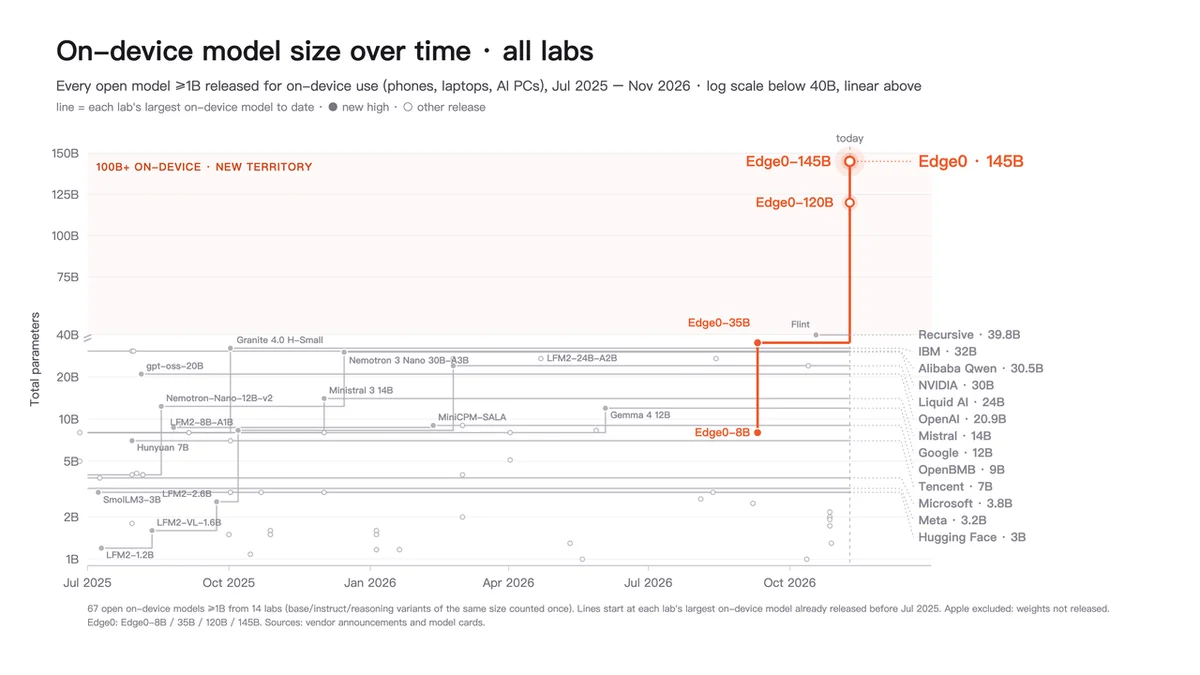
The release matters because on-device AI has, until now, been a small-model game. Before September 2026, most on-device models stayed below 10 billion parameters: Apple Intelligence ran at about 3 billion, and Google’s Gemini Nano came in 1.8B and 3.25B versions. Edge0’s own 35B phone model in September pushed that ceiling upward; Edge0-145B now takes it past 100 billion on a laptop.
What Was Announced?
Edge0-145B is a latent sparse mixture-of-experts model with 145 billion total parameters and only about 10 billion active per token, spread across 48 layers with 512 experts per layer. It supports a 256K-token context window and native 4-bit training. Two quantized builds are available on Hugging Face: Q3_K at 40.81 GiB and NVFP4 at 47.79 GiB. The sibling Edge0-120B has 120 billion total parameters with 8.64 billion active per token.
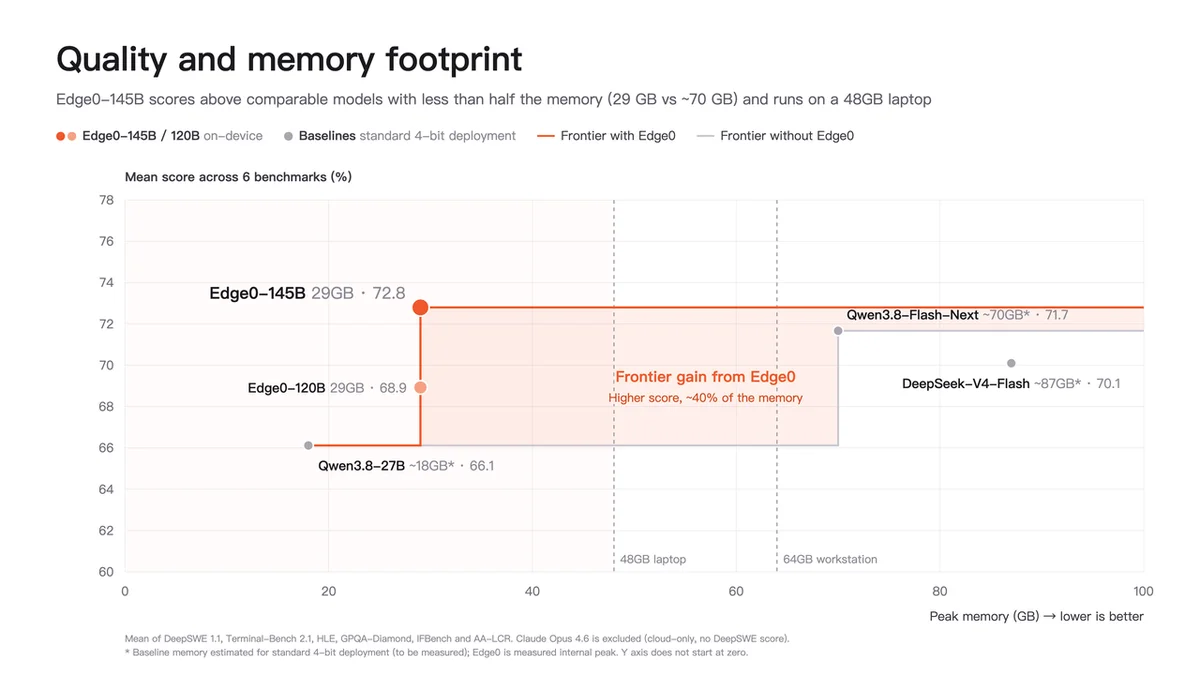
On a compatible laptop, the model runs with 29GB peak memory, 1,100+ tokens per second of prompt processing and 80+ tokens per second of generation, at about 120W of typical power, according to Edge0. Day-one support covers macOS, Windows and Linux, including Apple M-series chips and Nvidia RTX Spark, RTX 4090 and RTX 5090 GPUs. On an RTX 5090, the model card reports 121.2 tokens per second of decoding for the Q3_K build.
Edge0 also released its unified inference framework, deployment tools and a one-click Edge0 App, whose core capabilities work offline without an account or usage quota. Local inference carries no cloud-model token or API fees, and code and data stay on the user’s own hardware. The weights use the Edge0 Community Model 1.0 license, a custom community license, so commercial users should read its terms before building on it. The model card lists Qwen3.8-Flash-Next as the base model.
Benchmarks: Strong on Coding, With a Caveat
Edge0 reports that the model leads on agent and coding work in its own evaluations. It scores 86.52 on Terminal-Bench 2.1, ahead of Claude Opus 4.6 (Max) at 78.2, and 64.6 on DeepSWE 1.1, ahead of Qwen3.8-Flash-Next at 58.7 and DeepSeek-V4-Flash-0731 at 54.4. On reasoning and knowledge it scores 90.4 on GPQA-Diamond, close to Claude Opus 4.6 (Max) at 91.3, and 80.6 on IFBench, ahead of DeepSeek-V4-Flash-0731 at 79.2.
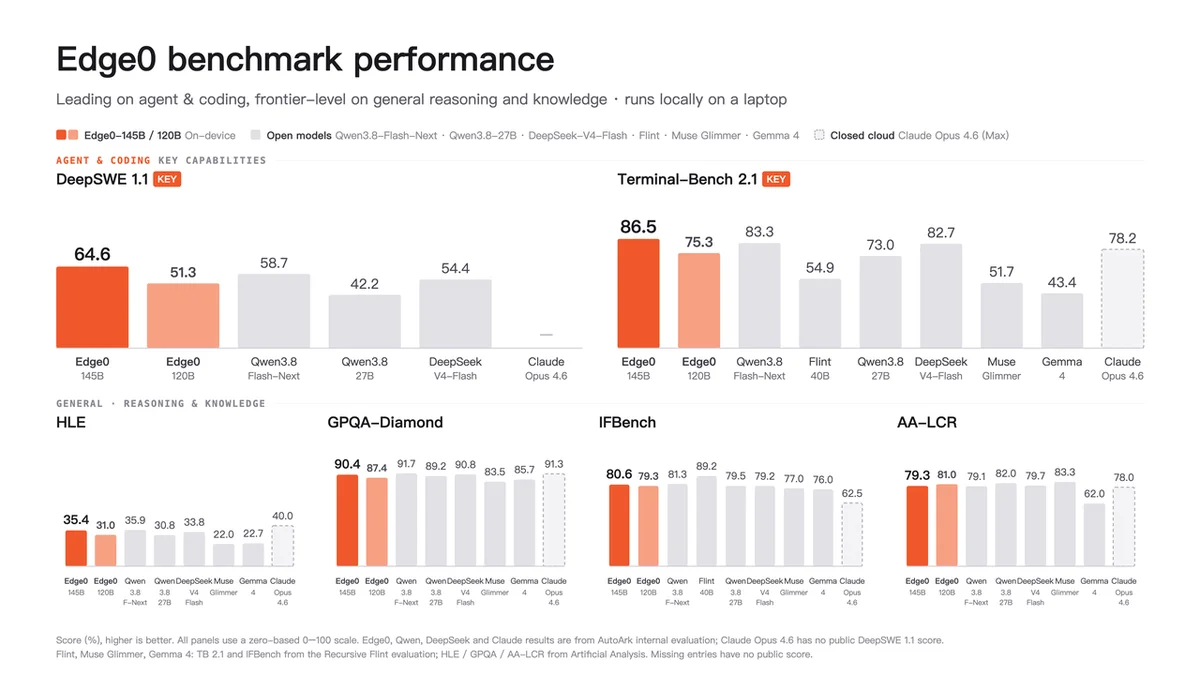
Across the six benchmarks Edge0 reports, the model averages 72.8, against 71.7 for Qwen3.8-Flash-Next and 70.1 for DeepSeek-V4-Flash-0731. The important context is that these are Edge0’s internal evaluations, and the company says its full evaluation setup and reproduction instructions are coming with a technical report. Independent results have not yet appeared, so the numbers should be read as vendor claims for now.
Why It Matters
The practical pitch is local agents that plan, write and run code, debug errors and visually check their own work, without sending anything to a cloud provider. Edge0’s demos show the model building a 3D Manhattan scene in Blender, writing a program that flies a real drone to find a red backpack, designing a PCB in KiCad, and producing an explainer video, all locally. A leading cloud model needed hundreds of tool calls and hundreds of millions of tokens for the same city-scene task, according to the company.
For teams, the draw is threefold: no per-token fees that grow with usage, sensitive code and documents that never leave the machine, and core capabilities that keep working offline. The trade-off is hardware: a 145B model needs a suitably equipped laptop, and features that depend on live information still need a connection. Edge0 says its broader portfolio has passed 15 million downloads in three months and serves more than 110,000 customer organizations, figures the company reports from its own data.
Pricing and Availability
Edge0-145B and Edge0-120B are available now, free to download, from Hugging Face. The inference framework and deployment guides are on GitHub, and the Edge0 App offers one-click local setup. There are no usage fees for local inference; the remaining costs are the hardware and the electricity to run it.