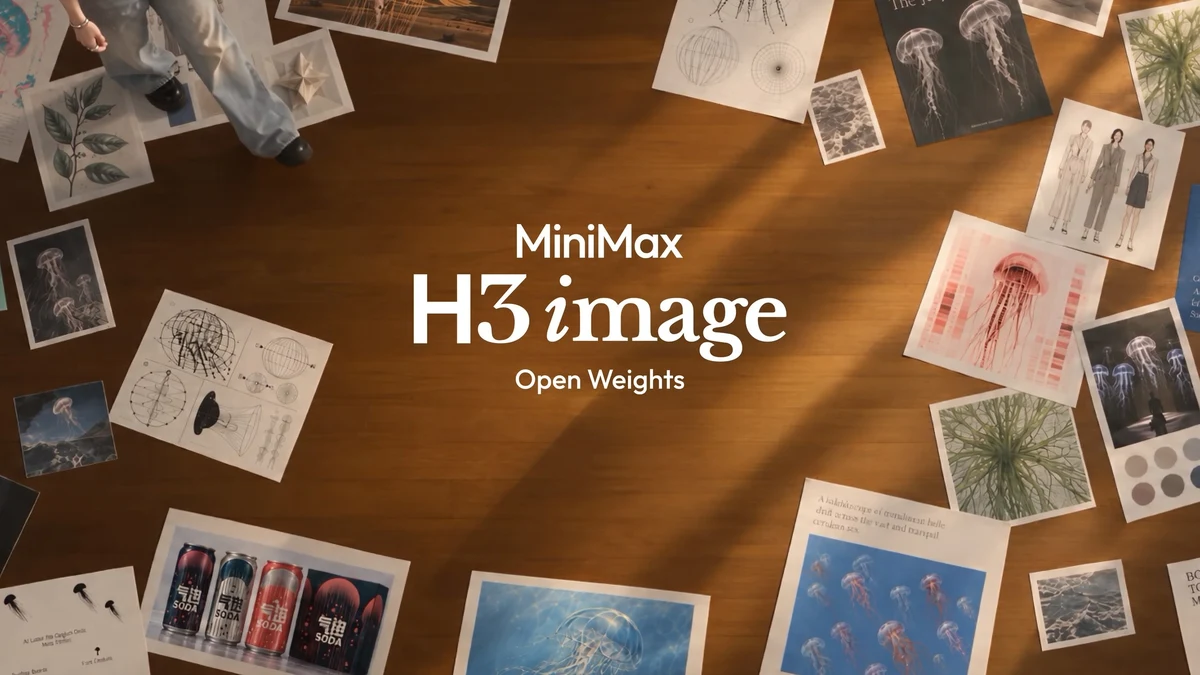
MiniMax has released H3-Image, an open-weight image model that generates native 4K images in under 10 seconds, the Chinese AI company announced on November 10, 2026. The 33.1-billion-parameter model handles text-to-image generation and image editing in a single checkpoint, supports up to 16 reference images in one edit, and ships with its weights freely downloadable from Hugging Face.
H3-Image is the image-generation member of MiniMax’s H3 family, which began with the H3 omni-modal video model open-sourced in August 2026. It is available through the MiniMax API, MiniMax Code and the Hailuo AI app, and it arrived with native ComfyUI support on launch day. “We hope H3-Image can help narrow the gap between open-weight image models and leading proprietary models,” MiniMax wrote in its announcement.
What Was Announced?
The headline number is resolution. H3-Image generates images of about 16 megapixels at every aspect ratio, from 4096 by 4096 at 1:1 to 6272 by 2688 at 21:9, directly and without an upscaler, according to the official model card. MiniMax says a full 4K image takes under 10 seconds and runs up to 5 times as fast as mainstream alternatives. Those speed and quality figures are the company’s own claims: no independent benchmark had been published as of launch week, and one independent tester measured 22 to 24 seconds per 4K image through the API, slower than the advertised time.
Under the hood, the model is a 33.1-billion-parameter diffusion transformer distilled to 6 sampling steps, with no classifier-free guidance and no negative prompt support. The checkpoint weighs 68.65 GB in BF16, plus a separate 66.7 GB text encoder borrowed unchanged from MiniMax H3.

Key Features and Details
- One checkpoint, two jobs: text-to-image generation and reference-based editing are unified in a single model.
- Up to 16 reference images can steer a single edit, useful for keeping characters, products or styles consistent.
- Native 4K output: about 16 megapixels at any aspect ratio, with a working range of roughly 4 to 20 megapixels.
- Day-one tooling: native ComfyUI support at launch, plus SGLang, vLLM-Omni and diffusers recipes for self-hosting.
- Prompt expander: an optional H3-Image-PE model expands short prompts before generation.
The License Catch
The “open weights” label comes with a major restriction. The MiniMax-H3-Image Community License grants use only within the “Applicable Territory”, defined as worldwide excluding the European Union, the United Kingdom, South Korea and the United States. Developers in those regions cannot legally run the weights without a separate written license from MiniMax, which says it will consider requests “based on robust controls and guardrails”. The license also requires prior written authorization if annualized revenue exceeds $1 million or if the model is offered as a hosted service to third parties.
The restriction echoes the license on the original H3 video model, and it means the two largest developer markets are effectively locked out of the open-weight release, even though the hosted API remains available worldwide.
Pricing and Availability
Through the API, MiniMax prices H3-Image at 50 to 70 percent of comparable mainstream offerings. Launch week brings 50 percent off the standard price for generations at 4K resolution and above, until November 17 at 16:00 UTC. Independent testing during launch week put a 4K image at about $0.034 with the discount applied.
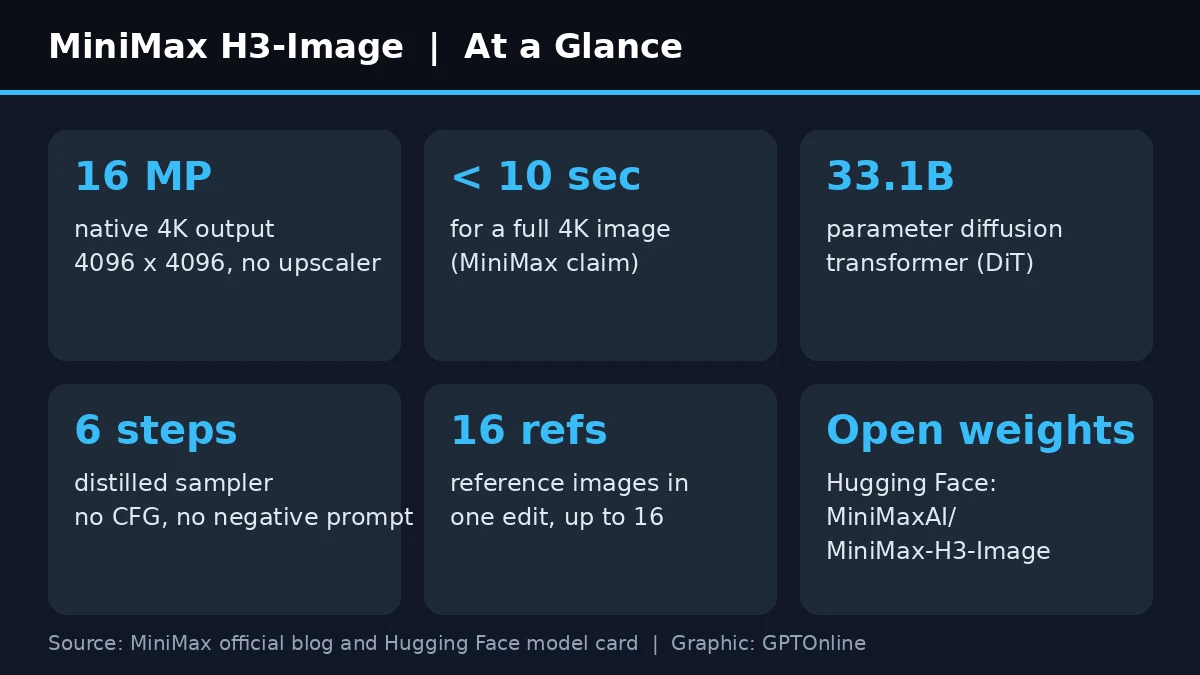
H3-Image is available now through the MiniMax API Platform, MiniMax Code and Hailuo AI, with the weights on Hugging Face under the repository MiniMaxAI/MiniMax-H3-Image.
Why It Matters
Open-weight image models have trailed proprietary systems on resolution and speed, and H3-Image attacks both gaps at once: native 4K output and a 6-step sampler make high-resolution generation practical on local hardware, while day-one ComfyUI support puts the model straight into creators’ existing workflows. If the speed claims hold up in wider testing, it could become the default open option for print-quality image work.
The territorial license is the real limit on that ambition. By excluding the US, the EU, the UK and South Korea from the weights grant, MiniMax keeps its most capable image model out of the hands of the developers most likely to build on it, a tradeoff that protects the company’s hosted API business but weakens the open release. For creators outside those regions, H3-Image is a genuinely capable new tool; for everyone else, it is API-only.