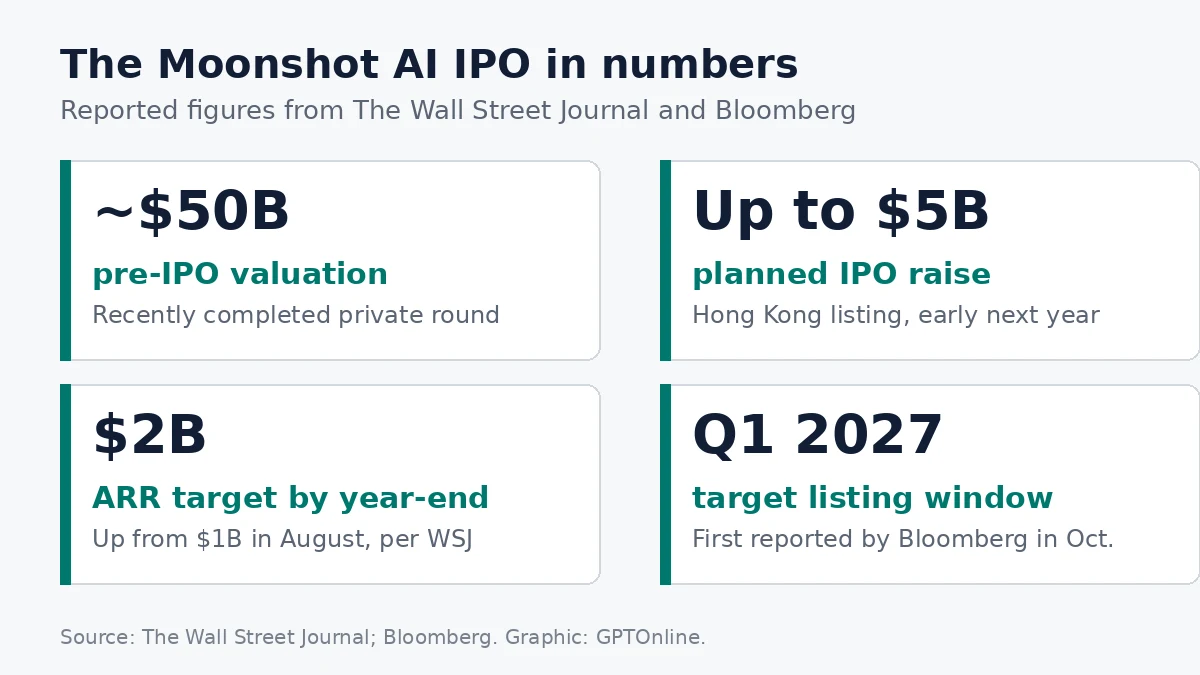
Chinese AI startup Moonshot AI is wrapping up a corporate restructuring that would clear the way for an initial public offering, The Wall Street Journal reported on Friday, citing people familiar with the matter. The Beijing-based maker of the Kimi chatbot aims to list in Hong Kong early next year and could raise up to $5 billion, the report said.
The listing would put one of China’s most prominent AI labs on public markets at a moment when the country’s frontier model makers are racing US rivals. Moonshot was valued at about $50 billion in a recently completed pre-IPO fundraising round, according to the Journal.
What the restructuring involves
Moonshot’s operations are mainly in China, but it has a holding company incorporated in the Cayman Islands, where many of its early backers invested in dollars. Under a recently reached agreement, the company is deactivating that holding company and moving investors’ stakes to its primary operating entity in China, the people familiar with the matter said.
Moonshot is buying back shares from those investors, who will then reinvest the capital into the China entity. Investors will keep the option to transact in dollars with an entity outside mainland China, according to the report.

Why Beijing wants the offshore structure gone
The move follows a push by Chinese officials for domestic companies to abandon so-called red-chip structures, the practice of setting up offshore holding companies to control onshore operations. Beijing has signaled that companies should dismantle these structures before pursuing an IPO, and it hopes the shift will increase governance and financial transparency, the Journal reported.
Moonshot is not the first Chinese AI company to take that path. Its Shanghai-based competitor StepFun unwound a similar structure earlier this year as it prepared to go public in Hong Kong.
The IPO plan in context
The Hong Kong listing plan itself is not new. Bloomberg reported in October that Moonshot was targeting a first-quarter 2027 listing, and Reuters reported in September that the company had filed confidentially with the Hong Kong exchange. What is new is that the restructuring, the main structural hurdle, is now close to done.
Moonshot’s rise has been fast. Founded in 2023 by Yang Zhilin, a graduate of Carnegie Mellon University and Tsinghua University, the company jolted the global industry in July with its Kimi K3 model, whose performance rivals that of some top-tier American offerings, the Journal noted. Its backers include HSG, Alibaba and Tencent.
The company has told some investors that its annual recurring revenue could reach $2 billion by the end of the year, up from $1 billion in August, according to people familiar with the matter. Giacomo Ficari, Moonshot’s director of international, told an audience in Lisbon on Thursday that the company works with Amazon Web Services, Microsoft and Nebius to offer its models globally, and the company is hiring in Europe, Japan and Singapore, according to job posts cited by the Journal.
What could still change
The listing is not a done deal. Recent market turbulence is rattling some investors, who worry that persistent volatility could sour sentiment, pressure valuations and delay timelines, the Journal reported. Considerations are ongoing and details of the plan, including the timeline and size, are subject to change. Moonshot declined to comment on the restructuring or the listing.
Why it matters
If it proceeds, Moonshot’s listing would be one of the largest AI IPOs to date and a major public-market test for a Chinese frontier lab, arriving in the same week that Anthropic’s US listing drew about six times more orders than shares on offer. It would also show how far Beijing’s push to bring its AI champions home has come: the offshore structures that once funneled foreign capital into Chinese startups are being dismantled, one lab at a time.
Sources
- China’s Moonshot AI Restructures to Pave Way for IPO, The Wall Street Journal, November 13, 2026
- Anthropic IPO Six Times Oversubscribed as Amodei Tells Dimon He Hopes to “Underpromise and Overdeliver”, GPTOnline, November 13, 2026
- Moonshot AI Rented Nvidia B300 Chips in China, Documents Show, GPTOnline, November 10, 2026